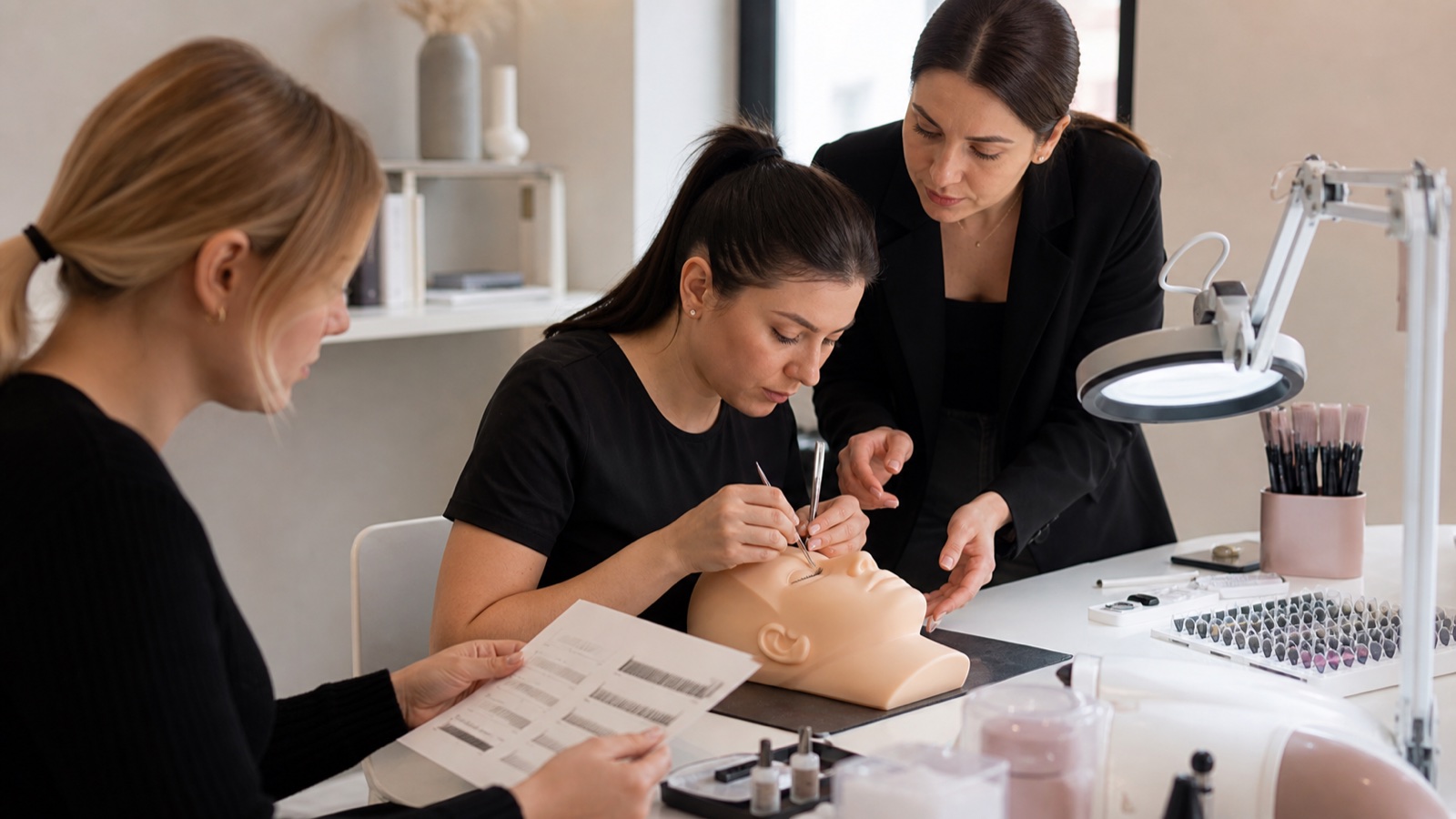
Becoming a lash artist is not one short course followed by a full diary. It is a progression from theory to controlled hand skills, supervised work on adult models, evidence-based feedback and responsibility for an entire eye-area service. A credible route also separates what a private course certificate proves from any qualification, licence, registration or premises approval required where you intend to work.
A strong starting plan has four parts: learn one service in depth; practise progressively until the result is repeatable rather than merely photogenic; build consultation, hygiene, records and stop criteria around the technique; then verify the legal, business and insurance requirements in your own country, state, province and local authority. The title lash artist, lash technician or lash stylist is a market job title, not a universal licence.
This guide owns the career intent. It does not teach the full professional lash-lift procedure, replace the shared theory in natural-eyelash anatomy and the growth cycle or decide between services for a client. Read lash extensions vs lash lift for that comparison. Nothing here is individual legal, tax, insurance or medical advice.
What a lash artist does
Lash artist is a broad commercial term for someone trained to provide cosmetic eyelash services. Depending on their training and legal scope, that may include classic or volume extensions, infills, professional removal, lash lifting and tinting. These are not interchangeable versions of one technique. Extensions add fibres with adhesive; a lift changes the visible direction of natural lashes through a controlled cosmetic system; tint uses another product category and exposure profile.
The job begins before application. A practitioner gathers relevant history without diagnosing, observes the visible lash line, agrees a realistic design, explains maintenance and obtains appropriate consent. During the service they control cleanliness, product traceability, posture, comfort and exposure. Afterwards they document the result, provide aftercare, arrange follow-up and respond appropriately to complaints or unexpected reactions.
A job title alone does not define permission to practise. Authorities usually regulate the actual activity, the body area, products, premises and business arrangement. Calling the same service lash styling does not remove a licensing requirement, and calling a private certificate accredited does not automatically turn it into a government qualification. Start with the service description, not the marketing name.
Course evidence, public qualification and permission to practise
Three layers, three different questions
Learning, recognition and legal permission are related—not interchangeable
Competence
What you can perform and evidence
Certificate
What one course records
Qualification
Recognition within a defined framework
Permission
Licence, registration, premises and scope
Three ideas are often collapsed into the word qualified. Course evidence describes what one provider says you attended or passed. A public or formally recognised qualification follows the education framework of a jurisdiction. Permission to practise can additionally depend on licensing, registration, supervision, insurance, zoning, premises or local public-health rules. One document may contribute to another process, but none should be assumed to replace the rest.
Layer | What it can show | What it does not prove by itself |
|---|---|---|
Private course certificate | Attendance, assessment or completion against that provider's stated criteria | A government licence, competence in every lash service or permission to work everywhere |
Recognised qualification | Education and assessment completed within a defined framework | Automatic approval for any premises, business model or additional technique |
Licence, registration or permit | Permission granted for a specified activity, person, business or location | Permanent technical competence or compliance after the service changes |
Insurance acceptance | That a policy was offered for declared work under stated conditions | Legal authorisation or cover for undeclared products, premises and techniques |
Read the exact wording. A certificate should identify the provider, learner, service, date, learning outcomes and assessment where applicable. An insurer may set training conditions that are stricter or simply different from local law. An employer may require evidence beyond both. Treat these as separate checks and retain the documents that support each answer.
Requirements depend on the jurisdiction and the service
There is no globally valid answer to whether a lash artist must hold a beauty-therapy qualification. In the European Union, regulated-profession requirements vary by country and the European Commission provides a database to identify national rules and contact points. In the United Kingdom, national guidance directs businesses to a licence finder while local authorities may apply their own special-treatment or premises regimes. In the United States, business and occupational requirements can vary across state, county and city.
Those examples demonstrate variation; they are not a shortcut to an answer for your address. A rule found for a neighbouring city, a salon owner in another state or an online educator in another country may not apply to you. Home studios, mobile services and rented chairs can also be treated differently from a dedicated salon. Verify the exact activity and location before investing in fit-out or accepting a paying client.
Write down the proposed service, products, work location, employment status and whether you will supervise or employ anyone. Send that description to the competent licensing, professional-registration, business and local public-health authorities. Ask for source links or written confirmation, record the date and re-check whenever the service, premises or jurisdiction changes.
A six-step jurisdiction check before taking payment
Define first, verify second
The job title does not decide the rule
Define the activity
Identify the authority
Verify competence rules
Check the workplace
Set up and maintain compliance
Step | Question | Evidence to retain |
|---|---|---|
1. Define the activity | Extensions, removal, lift, tint or a combination? Which products and eye-area contact? | Written service description and manufacturer documents |
2. Find the regulator | Is the occupation or activity regulated nationally, regionally or locally? | Official register, legislation, licence page and authority contact |
3. Check competence rules | Which qualification, assessment, age, supervision or continuing education is required? | Qualification record and written response for the precise service |
4. Check the workplace | Are salon, home, mobile and chair-rental models permitted and inspected? | Planning, zoning, hygiene, fire, accessibility and premises decisions |
5. Set up the business | What registration, tax, insurance, employment, consumer and privacy duties apply? | Registrations, policy schedules, adviser notes and operating procedures |
6. Maintain compliance | Which permissions expire and what changes trigger a new check? | Renewal calendar and dated review after each material change |
Core competencies a lash artist needs
Technique is one part of the service
Competence connects knowledge, control and judgement
Foundation
Anatomy, products and limits
Procedure
Placement, direction and control
Client
Consultation, consent and comfort
System
Records, follow-up and improvement
Manual application is only one competency domain. A learner needs a working understanding of visible eyelash anatomy, renewal, product purpose, manufacturer directions, contamination control and the boundary between cosmetic observation and diagnosis. Consultation, consent, record keeping, communication, ergonomics and emergency response turn separate gestures into a professional service.
Domain | Observable evidence | Common blind spot |
|---|---|---|
Assessment | Relevant questions, visible observations, realistic design and a documented proceed-or-stop decision | Treating every requested photograph as technically suitable |
Technical control | Isolation or shield fit, direction, compatible load, clean product control and reproducible finish | Judging quality only from an open-eye front photograph |
Safety system | Hand hygiene, prepared station, traceability, exposure control and stop criteria | Using a tidy social image as proof of contamination control |
Client care | Consent, comfort checks, aftercare, accessible complaints route and follow-up | Assuming consent is permanent or covers publication |
Professional judgement | Adapting within training, declining unsuitable work and referring symptoms appropriately | Trying to solve medical uncertainty with another cosmetic step |
How to choose initial lash training
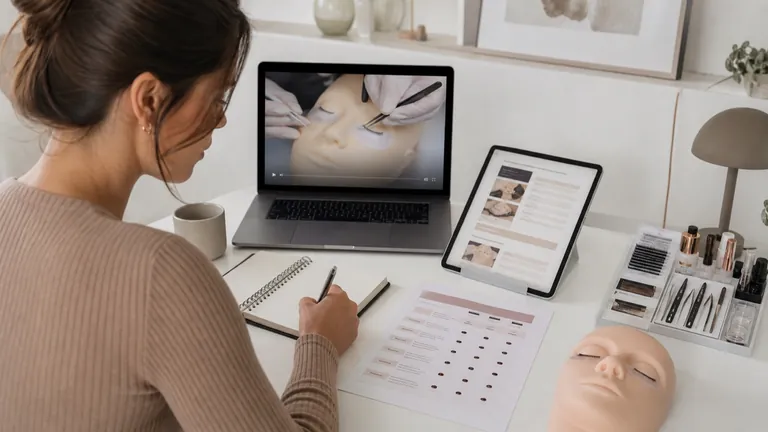
Begin with one clearly defined service rather than the largest bundle. The curriculum should name its level, prerequisites, products, safety content, demonstrations, practical submissions, feedback process and completion standard. Ask who assesses the work, what evidence is returned, how long support remains available and what happens when a submission does not meet the criteria.
For extensions, look for natural-lash assessment, isolation, attachment, distance, direction, weight, adhesive control, mapping, infill, removal and aftercare. For lifts, look for fibre assessment, shield selection and fit, precise placement, system-specific sequence and timing, tint where included, removal, documentation and correction limits. A strong course teaches when not to proceed as carefully as it teaches the desired result.
Online theory can be effective when the demonstrations are close, well lit and complete and when the learner submits real evidence for individual feedback. Live attendance is not automatically good training, and online attendance is not automatically sufficient. Compare the amount and quality of observed practice. Check separately whether the format and certificate satisfy regulators, insurers or employers in your jurisdiction.
BeautyLearn's English lash-course collection lets you compare available programmes, and the online lash-lift course shows one service-specific route. Always use the current course page for the tutor, curriculum, access period, materials and assessment terms; the catalogue does not replace your local permission check.
Progressive practice: from training aid to adult model
Increase complexity in controlled stages
Progress when the evidence is stable
Training aid
Grip, quantity and direction
Mannequin
Posture, sequence and symmetry
Supervised model
Adaptation, comfort and records
Independent
Repeatable service plus legal checks
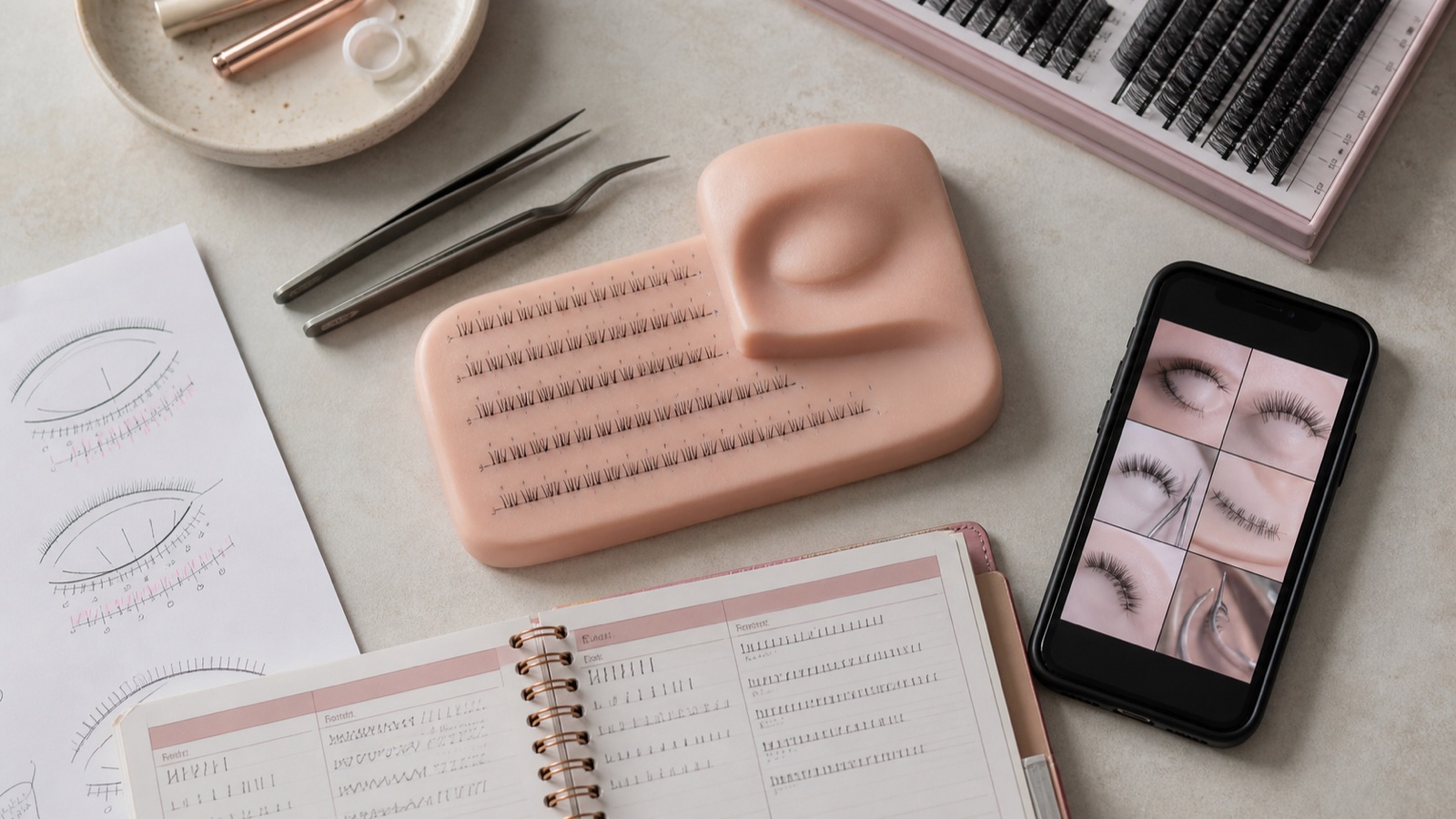
Product handling and hand coordination begin on appropriate training aids. Strips, sponges or practice lashes can isolate one movement; a mannequin can add posture, sequence, orientation and symmetry. These supports cannot reproduce blinking, tears, communication, natural-lash variation or an unexpected sensation. They are a controlled first stage, not evidence that someone is ready for unsupervised eye-area work.
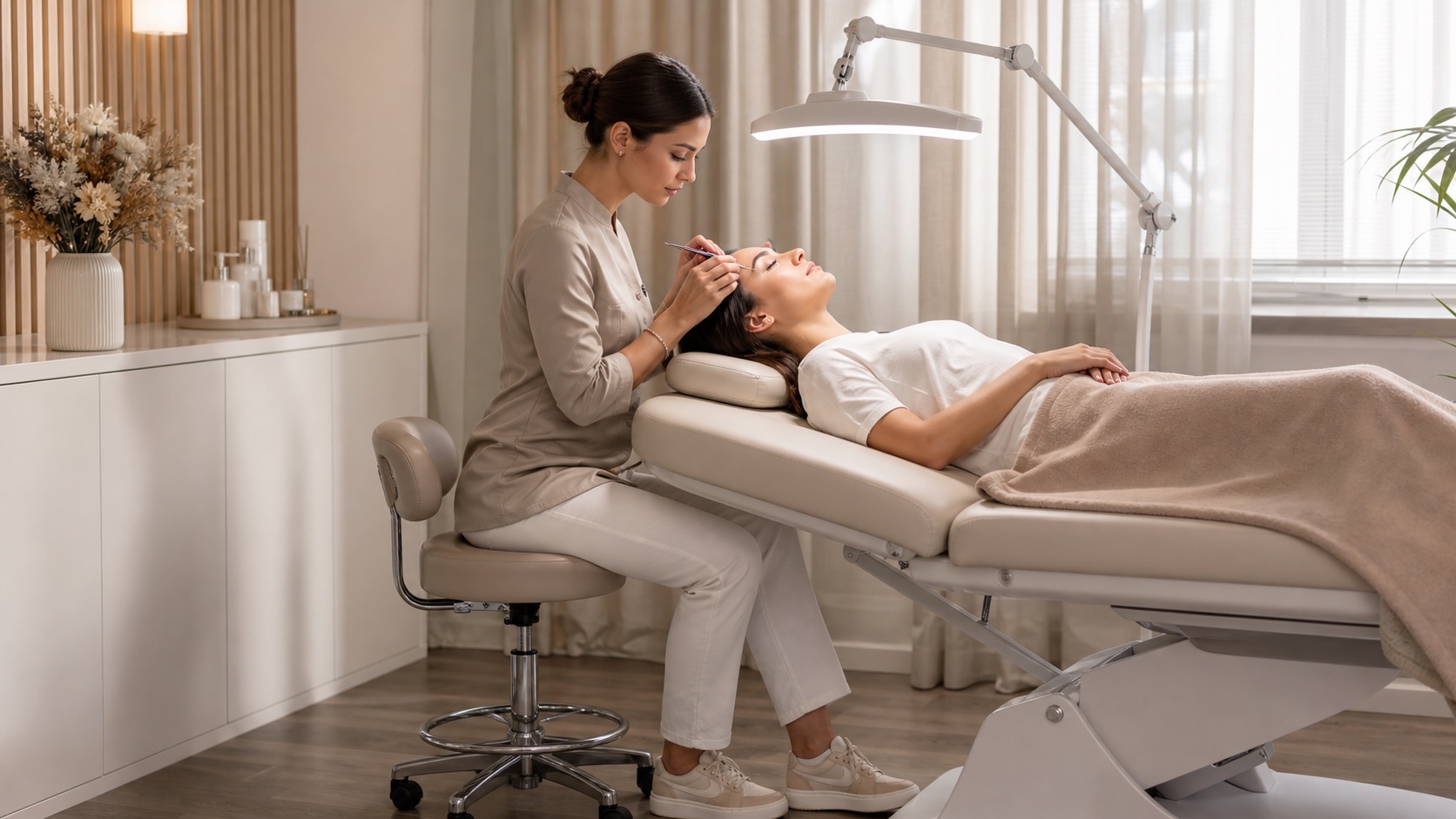
Move to an adult consenting model only when the course or supervisor has confirmed the prerequisites for that stage. Screen according to the taught process, explain that the work is training, agree supervision and stopping arrangements, and allow enough time. A discounted or free model service does not reduce the duty of care. A friend is still a client for consent, privacy, products, records and response to an unexpected event.
Practise one dominant objective at a time: isolation, direction, adhesive quantity, clean bases, fan control, shield placement, wrap, symmetry or consultation. Speed is recorded only after quality and comfort are stable. Rushing an unstable process simply makes the same uncertainty happen faster and can conceal steps that should never be removed.
Use a practice log and progression criteria
A practice log changes repetition into evidence. Record the date, support or model, objective, products and batch where relevant, environmental conditions required by the system, observable result, discomfort or interruption, educator feedback and the one correction to test next time. Keep photographs comparable and store them under the privacy rules that apply to you.
Stage | Progress when | Do not progress merely because |
|---|---|---|
Training aid | Grip, separation, product quantity and direction are controlled repeatedly | One photograph looked neat |
Mannequin | Sequence, posture, access and symmetry remain stable without skipped checks | The planned number of hours elapsed |
Supervised model | Consultation, adaptation, technique, comfort, documentation and follow-up meet the rubric | Several similar models were completed |
Independent service | Competence is repeatable across suitable cases and legal, insurance and workplace checks are complete | A certificate arrived |
There is no universal model count that guarantees readiness. Ten nearly identical cases without feedback can consolidate the same error, while a smaller supervised set may reveal precise corrections but still not cover enough variation. Use an explicit rubric and a final end-to-end assessment. If isolation, product control, consultation or stop decisions are inconsistent, add targeted practice rather than chasing a number.
How to build a credible lash portfolio
A portfolio is evidence, not decoration
Show decisions as well as outcomes
Before
Comparable light, angle and eye position
Plan
Objective and reasoned adaptation
Result
Technical views without digital alteration
Permission
Separate consent for publication
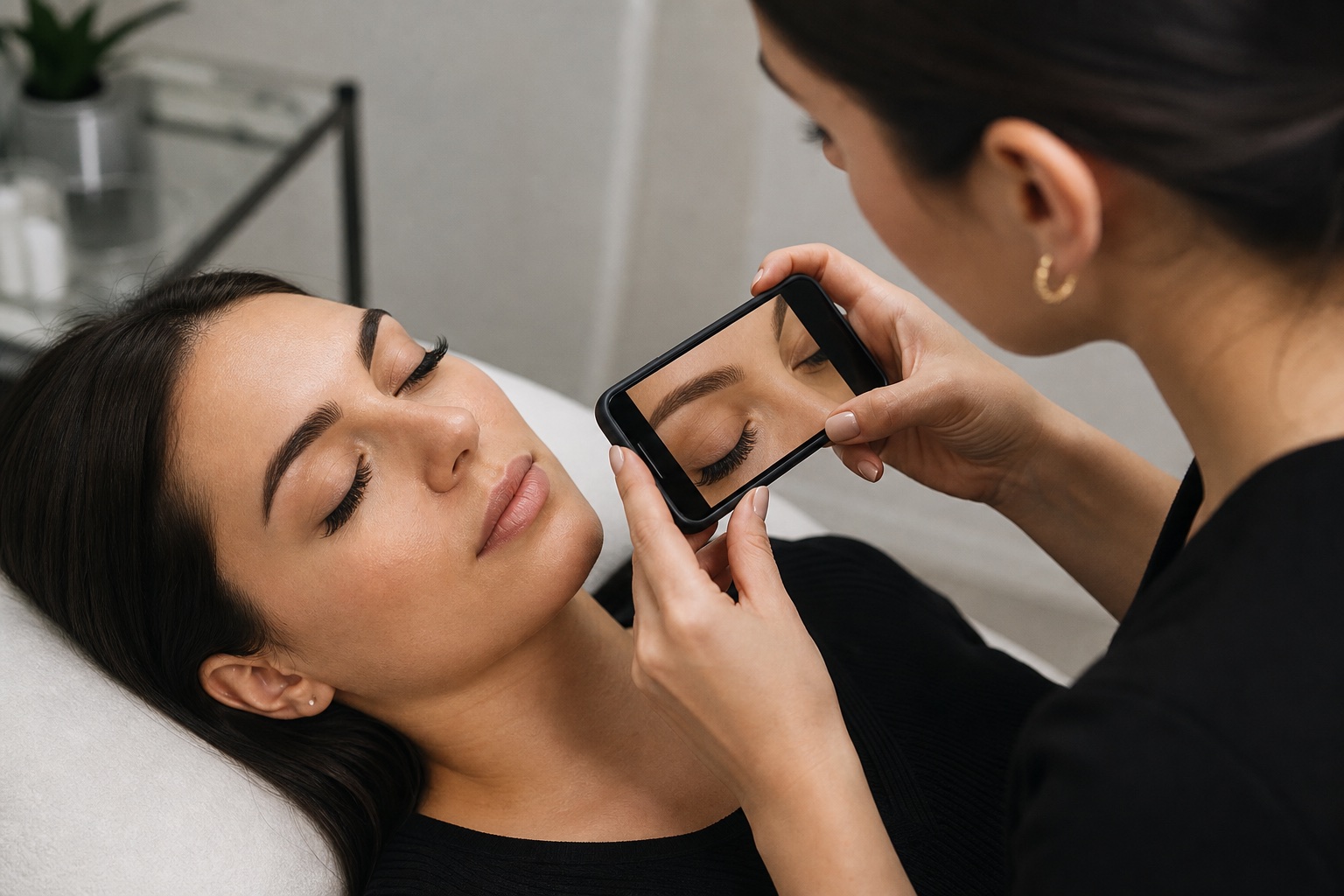
A portfolio should demonstrate reasoning and repeatability, not only dramatic density. For each case, retain a standardised before image, the agreed objective, relevant design choices, a clear result and follow-up where available. For extensions, include closed-eye views that reveal bases, direction and uniformity. For lifts, show the untreated starting direction and final separation without hiding tips or asymmetry.
Use the same light, distance, lens, eye position and colour treatment wherever possible. Do not smooth skin, draw lashes, deepen blacks selectively or use angles that create a false comparison. Label training work honestly. A strong portfolio includes restrained results, different suitable bases and explanations of why a requested style was modified or declined.
Consent to receive a service is not consent to publish a face or close-up eye image. Obtain a separate, specific and revocable permission that explains the channels, level of identification and intended use under the law that applies to you. Store the original record securely, limit access and have a process for withdrawal. If valid publication permission is absent, the image stays out of the portfolio.
From supervised model to first paying client
Payment does not create competence; it raises the consequence of every gap. Before opening appointments, simulate the entire service: enquiry, eligibility questions, booking terms, preparation, consultation, photography, application, comfort checks, payment, aftercare, record storage, follow-up, complaint handling and an unexpected interruption. Time the whole workflow, not only hands-on application.
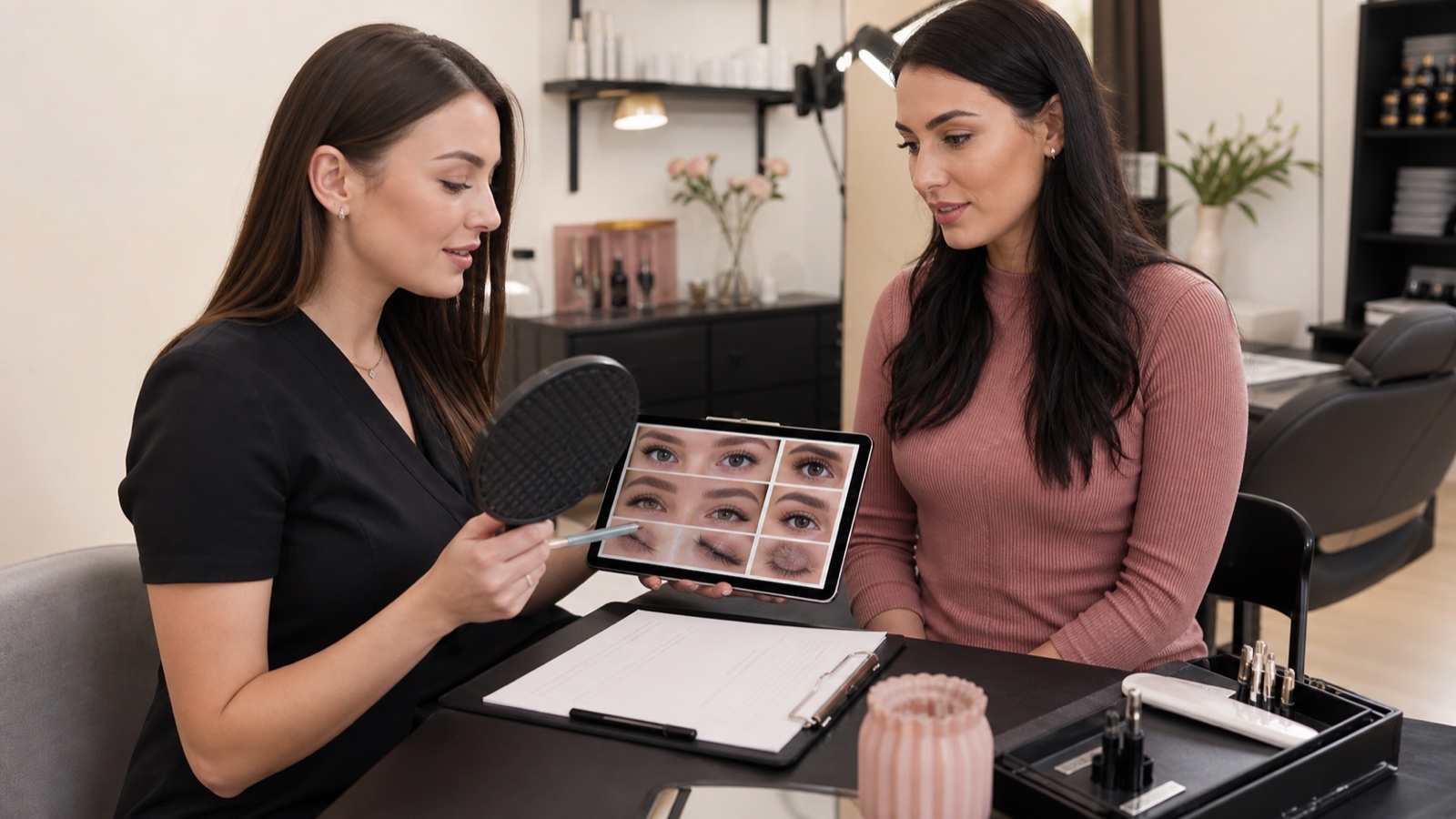
Choose a limited launch menu that matches verified competence. It is better to offer one well-controlled service with honest timings than extensions, volume, lift, tint and correction after one introductory course. Set booking buffers for preparation, cleaning, records and recovery from delays. Define cancellation, late-arrival, complaint, refund and urgent-contact routes in plain language consistent with local consumer law.
Do not convert models into paying clients by hiding that your process is still under assessment. Explain your current experience, the service limitations and who supports you. If a model outcome reveals uncertainty, return to supervised practice. The commercial calendar must follow competence, not the other way around.
Where a lash artist can work
Common settings include employment in a salon, self-employment within another business, a dedicated studio, a home-based room or mobile work. Each changes control, overhead, records, infection-control logistics, lone-working risk and legal duties. A rental agreement does not necessarily make a worker self-employed, and using another salon's booking system does not necessarily transfer professional responsibility.
Employment can provide premises, systems, mentoring and clients but still requires clarity about training and authorised services. Chair or room rental adds independence but may split responsibility between landlord and practitioner. Home and mobile arrangements need specific confirmation on zoning, landlord or mortgage terms, insurance, waste, transport, privacy and whether the environment can meet the same standard as a fixed professional station.
Business foundations: price, cost, insurance and records
Startup costs include education, supervised practice, products, consumables, lighting, ergonomic furniture, tools, premises, licences, registration, professional advice, insurance, booking systems and non-billable time. Buy according to the chosen system and turnover rather than collecting a large kit with unknown storage needs. Track opening date, batch and expiry or period-after-opening where applicable.
Price must cover the complete service time, product use, disposables, fixed overhead, payment fees, cancellations, tax obligations, continued training and a sustainable wage. Revenue is not profit and a full diary is not necessarily a viable business. Model three demand scenarios, including a quiet launch period, and avoid income claims based solely on multiplying a headline price by every available hour.
Discuss professional liability, treatment risk, products, premises, mobile work, employees and data with a regulated insurance adviser where required. Read exclusions, conditions, limits and notification duties. Keep consultation, consent, product, batch, timing, design, aftercare, image permission, follow-up and incident records for the retention period supported by local law, insurer requirements and a documented privacy policy.
Professional boundaries and referral
A lash artist can observe visible features, ask relevant questions and choose not to proceed. They do not diagnose allergies, blepharitis, infection, alopecia or another eye or skin condition, and they do not prescribe medicines or tell a client to stop prescribed treatment. A cosmetic consultation is not a medical examination, even when the practitioner has extensive product knowledge.
Pain, persistent burning or itching, significant redness, swelling, discharge, light sensitivity, altered vision, sudden or patchy lash loss and an unexplained change at the eyelid margin require postponement and appropriate assessment. During a service, stop for unexpected discomfort or product movement and follow the product and emergency instructions. Do not neutralise symptoms with another cosmetic product simply to finish the photograph.
Professional language matters. Say what you observed, what the client reported, what action you took and why the service was postponed. Do not name a condition or guarantee an outcome. A clear referral boundary protects the client and gives the practitioner a repeatable decision process.
Readiness checklist before opening your diary
Open the diary after the system is ready
Competence must survive outside the training photograph
Evidence
Assessed work and practice log
Service
Consultation through follow-up
Compliance
Scope, workplace and insurance
Boundaries
Stop, document and refer
I can show service-specific education, assessment and recent supervised evidence.
I can complete consultation, technique, comfort checks, aftercare, records and follow-up without skipping steps.
My errors and corrections are documented in a practice log and reviewed against a rubric.
My qualification, licence, registration, premises and business position are confirmed for this service and location.
My insurer knows the exact techniques, products, workplace and employment arrangement.
My products are intended for the use, stored as directed and traceable to the service record.
My images are faithful and backed by separate publication consent.
My prices include full time and costs, and my complaint and incident routes are usable.
I can state my professional limits and stop or refer without improvising a diagnosis.
Continue through the English lash guide hub for service-specific theory. Start with what a lash lift is and what results to expect if you are comparing training directions, and use the lash-lift troubleshooting guide to understand why correction has limits. Then compare current training in the lash-course collection.
Frequently asked questions about becoming a lash artist
What does a lash artist do?
A lash artist provides cosmetic eyelash services within their verified training and legal scope. The work may include extensions, infills, removal, lifts or tinting, but each requires specific competence. The practitioner assesses cosmetically, agrees a design, controls the service, keeps records and provides aftercare without diagnosing eye or skin conditions.
Do I need a beauty-therapy qualification to become a lash artist?
There is no worldwide answer. Requirements depend on the exact service and the country, state, province and local authority, and may also change with the workplace. Check the official regulated-profession, licensing and local-business sources for your address and obtain written clarification before accepting payment.
Does a lash course certificate allow me to work legally?
Not automatically. A private certificate records what its provider states you completed or passed. A public qualification, occupational licence, business registration, premises approval and insurance are different matters. Ask the relevant authorities and insurer whether that certificate is accepted for your precise service, location and work model.
How long does it take to become a lash artist?
Course length is not the same as readiness. Progress depends on prior skills, the technique, quality of supervision, variety of suitable cases and whether the complete service is repeatable. Legal and business checks take additional time. Use competency evidence rather than a promised number of days.
How many models should I complete before charging?
No universal model count guarantees competence. Use adult consenting models across suitable variations, receive specific feedback and assess consultation, adaptation, technique, comfort, records and follow-up. Repeated similar cases without review can reinforce an error. Charge only after a complete assessment and legal checks are satisfied.
Should I learn extensions or lash lifting first?
Choose the service that matches your planned work, available supervision and local permissions. Extensions develop isolation, attachment, load and mapping; lifts require fibre assessment, shield fit, placement and process control. Neither is a beginner level of the other. Consolidate one before adding separate training.
Can I become a lash artist through an online course?
Online learning can deliver strong theory and clear demonstrations when it includes structured submissions and individual feedback. It does not remove the need for hands-on practice, safe work on adult models or supervision at the right stage. Confirm separately whether an online certificate meets regulator, employer and insurer requirements where you work.
How can I recognise a good lash course?
Look for measurable outcomes, stated prerequisites, complete demonstrations, hygiene, consultation, product directions, error analysis, practical submissions and a transparent assessment rubric. Verify the educator's relevant work and feedback process. Be cautious when universal licensing, guaranteed income or mastery after one unassessed application is promised.
What should a beginner lash portfolio contain?
Include standardised before, result and follow-up images where available, plus the objective, technique and adaptation for each case. Use unfiltered photographs that show technical areas, not only an open-eye glamour view. Label supervised training honestly and obtain specific publication consent separate from service consent.
Can a lash artist work from home?
Possibly, but never assume it. Home work may require planning or zoning approval, landlord or mortgage consent, a premises or treatment licence, suitable hygiene arrangements, insurance and compliance with local rules. Verify the address and activity before fitting out a room or inviting clients.
Can I work as a mobile lash artist?
Only where the service and mobile model are permitted and can be delivered safely. Transport, lighting, ergonomic setup, clean and used-item separation, product storage, privacy and emergency response all become harder. Describe the mobile arrangement to the authority and insurer rather than relying on rules for a fixed salon.
How much does it cost to start lash work?
Budget for training, supervised practice, product systems, consumables, tools, light, furniture, licences, premises, insurance, professional advice, booking and non-billable time. Start with a controlled service menu and compatible stock. A large low-cost kit can create waste and storage risk rather than readiness.
How much can a lash artist earn?
There is no responsible universal figure. Revenue depends on prices and bookings; profit also subtracts products, overhead, tax, fees, cancellations, training and unpaid work. Capacity is limited by full service time and sustainable posture. Build local scenarios and never treat a course provider's income claim as a forecast.
Do lash artists need professional insurance?
The legal requirement varies, while employers, landlords, regulators or professional bodies may impose conditions. Regardless, discuss suitable liability and business cover with a regulated adviser. Declare every service, product, location and worker and read exclusions, excesses, limits and reporting deadlines before relying on the policy.
Can a lash artist diagnose an allergy or eyelid condition?
No. They may record reported history, observe visible signs and decide not to proceed. Diagnosis, prescription and treatment belong to appropriately qualified healthcare professionals. Pain, swelling, discharge, altered vision, persistent irritation or sudden lash loss should trigger postponement and suitable referral, not an improvised cosmetic correction.
How do I find my first lash clients responsibly?
First build assessed cases and a complete service system. Publish a faithful consented portfolio, clear scope, realistic timings, prices and maintenance information. Local pages, professional collaborations and genuine reviews can then support discovery. Retention should come from consistent care and communication, not medical claims, hidden discounts or guaranteed results.
Official sources and editorial criteria
For cross-border professional requirements, consult the European Commission's database of regulated professions. UK businesses can start with the official licence finder and then verify the relevant local authority. US businesses can use the Small Business Administration guidance on licences, permits, location and insurance before checking state, county and city rules. These are examples of official starting points, not a determination for one practitioner.
Eye-area safety language is informed by the US Food and Drug Administration's eye cosmetic safety guidance and its current consumer safety questions for eye cosmetics. For hand hygiene principles, consult the US Centers for Disease Control and Prevention's clean-hands guidance. Product instructions and the rules of the market where a cosmetic is supplied remain essential.
Editorial review: 5 September 2026. This independent guide is not sponsored and contains no competitor links. Regulatory examples were checked against official sources, but rules change and must be verified for the reader's exact service and location. The article requires review by an experienced extension and lash-lift educator and, where used for a business decision, the relevant licensing, legal, tax, insurance and healthcare professionals.
Before enrolling, use the independent guide to choosing an online lash course: it compares curriculum, tutor, demonstrations, assessed practice, feedback, kit, access, total cost and certificate without ranking providers.
Before providing a service, use the pre-treatment consultation for extensions and lash lifts: it separates questions, descriptive observation, product instructions, contraindications, postponement and stop decisions from diagnosis.
Use the lash workstation hygiene protocol to separate hand hygiene, clean stock, reusable tweezers, single-use supplies, product dosing, surface treatment and between-client turnover without shortcuts.
Record the service with the lash client record for extensions and lifts: it separates consultation outcomes, technical delivery, product batches, permissions, privacy, aftercare, incidents and follow-up into an auditable lifecycle.
For colour-specific service planning, use the professional eyelash-tinting guide: it separates legal product suitability, colour, system compatibility, ratio, timing, closed-eye control, removal and follow-up from lash-lift reshaping.
Plan tools and stock by function with the professional lash artist kit guide: it connects tested tweezers, lighting, consumables, traceable products, measured adhesive conditions, inventory and staged purchasing without brand rankings.
For the complete client-level overview, read the eyelash extensions guide: it connects classic, volume and hybrid principles with design, the appointment, realistic duration, infills, preparation, aftercare, removal and safety boundaries.
Study the classic technique in the one-to-one eyelash extensions guide: it makes natural-lash selection, isolation, off-skin distance, direction, contact, adhesive dose and sticky checks separately verifiable.
Compare every volume-family construction in the volume, hybrid and mega-volume guide: it keeps D labels, total load, fan anatomy, hybrid design, mega-volume prerequisites and troubleshooting inside one non-cannibalising technical intent.
For a complete specification and mapping framework, continue with the guide to extension curls, lengths, diameters and total load. It explains product-label limits, leverage, zone adaptations, grow-out and sustainable set design without splitting every curl or diameter into a competing page.
Connect eye references, visible balance and texture with the complete lash mapping guide. Cat eye, doll/open eye, squirrel and wispy stay together as one non-cannibalising design intent, with no universal map assigned to an eye-shape label.
For product identity, environmental control, storage, exposure and reaction boundaries, use the complete eyelash extension adhesive guide. It also owns irritation, sensitisation and patch-test limits, so no separate competing page is needed for glue allergy.
For duration, natural shedding, early-loss troubleshooting and the choice between maintenance and replacement, use the complete lash retention and infill guide. It also owns the search intent “why eyelash extensions fall out”, avoiding a second competing page.
For product choice, a no-pull sequence, residue inspection, incident response and stop criteria, use the professional eyelash extension removal guide. It also owns DIY removal and cream-versus-gel search intent, avoiding thin competing pages.
For cleanser choice, a complete wash-and-dry method, make-up, sleep, exercise, swimming and stop signs, use the complete eyelash extension aftercare guide. It also owns “when can lashes get wet” and sleeping-with-extensions intent, avoiding thin competing pages.
For natural-lash protection, load, stickies, tension, breakage and warning signs, use the complete eyelash extension safety guide. It owns “do extensions damage natural lashes?” intent without creating a competing fear-based page.
For customer-facing costs, inclusions, maintenance budgets and quote comparison, use the eyelash extension and lash lift cost guide. It avoids misleading international averages and remains separate from professional rate-card calculation.
Before taking paying clients, use the lash artist certificate and licensing guide to verify practitioner, premises, business and insurance requirements in the exact jurisdiction. It keeps legal-entry intent separate from technique and career development.
For a currency-neutral model of paid appointments, full service time, occupancy, costs and operating profit, use the lash artist earnings guide. It keeps professional earnings separate from client price comparison and future rate-card construction.
To build a traceable unit price from complete time, real product use, overhead, labour, fees and margin, use the professional lash service pricing guide. It keeps the rate card distinct from client quote comparison and monthly earnings analysis.
For a repeatable capture workflow covering permission, lighting, focus, honest before-and-after comparison, colour and editing limits, use the professional lash photography guide. It documents completed work without replacing live technical or safety checks.
To turn real work into a coherent path through evidence, authentic reviews, enquiry, booking, follow-up and appropriate return, use the lash portfolio and client acquisition guide. It measures qualified appointments without promising demand or income.
To adjust the complete lash workstation and plan static-load interruption, reach, light, tools and recovery without prescribing treatment, use the lash artist ergonomics guide. It complements technical and hygiene controls without replacing individual assessment.
For a cautious framework on apparent lash breakage or thinning, serum limits, treatment pauses and clinical referral, read the fragile or thinning eyelashes guide. It supports a stop-or-proceed decision without diagnosing the cause or promising regrowth.