
A sustainable lash price list is not a copied local menu and it is not the lowest number likely to win a booking. Eyelash extension full sets, infills, removals, lash lifts and tints use different appointment cycles, materials, stock lifetimes and professional judgement. Each service therefore needs its own measured cost model before it receives a client-facing price.
This guide owns professional rate-card construction. The guide to eyelash extension and lash lift costs helps clients compare quotes and maintenance commitments. The guide to lash artist earnings measures bookings, revenue, costs and operating profit across a period. Here the unit is one defined service: what it includes, how long its complete cycle takes and which costs it must carry.
Reviewed 5 September 2026. Every formula and worked example is educational and currency-neutral. Currency units are placeholders for your own consistent currency; they are not market averages, recommended tariffs or income promises. Taxes, sales tax or VAT, employment status, consumer disclosures, deposits and accounting treatment depend on jurisdiction and business structure. Confirm them with appropriately qualified local advisers.
Quick answer: the lash service pricing formula
A sustainable price has four traceable layers
Build the cost boundary before making the commercial decision
Real products and consumables
Complete-cycle labour
Overhead and technical reserve
Fees, margin and final check
For each service, calculate base cost = real variable cost + complete-cycle labour + allocated overhead + technical reserve. If payment fees and target operating margin are percentages of the final price, calculate technical price = base cost divided by one minus those percentages. Then verify the total client price, local tax treatment, inclusions, demand and practical capacity before publication.
Suppose a defined service has 72 currency units of base cost. If proportional payment costs are 3% of the final price and the target operating margin is 12%, the remaining share is 85%. The technical price is 72 divided by 0.85, or 84.71 currency units. Rounding is a commercial decision, but rounding down must not silently remove labour, hygiene time or the reserve.
Adding 15% to base cost is not equivalent. It produces 82.80 currency units, and the difference represents only about 13% of that final price before considering how the payment fee is charged. Mark-up uses cost as its denominator; margin uses price. Choose the intended measure, label it and keep the same formula throughout the workbook.
The labour component is not operating profit. Labour values the practitioner's complete working time before personal tax and other deductions. Operating margin remains after recognised service costs and supports risk, reinvestment and business resilience. If the model reaches a saleable price only by calling unpaid labour profit, the service is not yet priced sustainably.
Define the service before calculating its price
A line item must have a scope. For a new extension set, define consultation, cleansing, eye-pad and tape setup, mapping, chosen technique, application, final separation check, photographs where authorised, aftercare, client record and workstation turnover. State whether removal of external work, coloured fibres, lower lashes or a complex styling change are included or assessed separately.
For an infill, define the acceptable time window, minimum useful retained work, cleansing expectation, removal of outgrown or unstable extensions, time band and threshold for reclassification as a removal and new set. Weeks alone do not describe the work. The retention and infill guide explains why the natural cycle, attachment quality and condition on arrival matter.
For removal, distinguish a straightforward removal of your own documented set from unknown external work or a complex case. The price never obliges the practitioner to continue when the condition requires stopping. Review the professional extension removal guide before defining time bands, remover use and the post-removal check.
For lash lift, specify whether tint, cleansing, shield selection, final conditioning product and a review are included. Product processing times always follow the selected system and its current instructions; a financial model cannot reward shorter exposure. The professional lash lift method guide keeps technical decisions separate from the rate card.
Names such as classic, hybrid, volume and mega volume are useful navigation labels but not universal economic units. Two sets carrying the same label may differ in natural-lash count, isolation difficulty, fan construction, coverage, direction and cycle time. Price internal inputs that can be observed; explain client-facing categories in language a person can compare before booking.
Complete cycle time: every minute the service occupies
Treatment time is only part of the economic cycle
From preparation to the clean reset
Before
Messages, stock and preparation
Service
Consultation and treatment
After
Checks, payment and records
Reset
Hygiene, laundry and restock
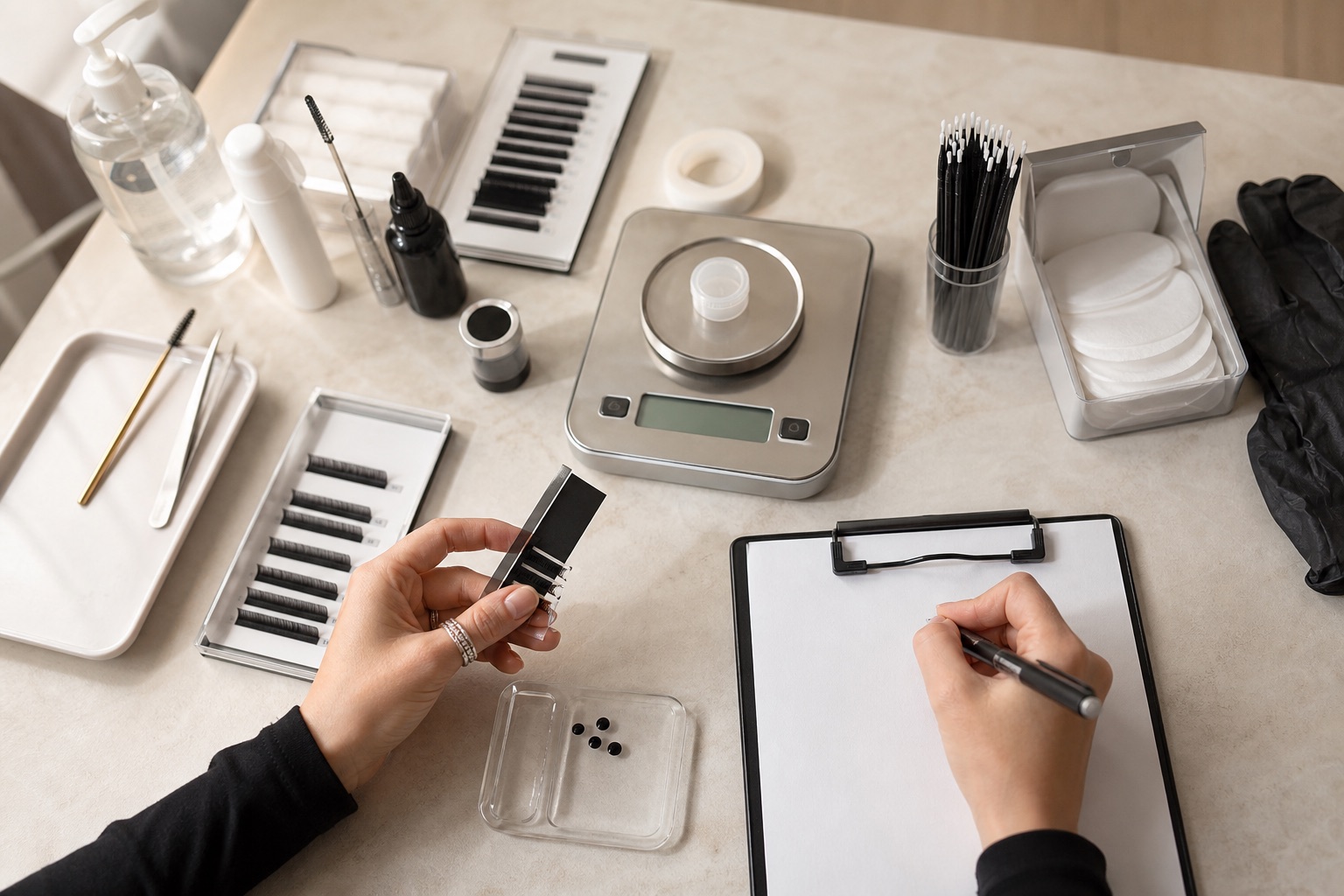
Client-facing treatment time is only one part of the economic cycle. Add service-specific preparation, welcome, consultation, cleansing, mapping, treatment, checks, payment, record completion and turnover. Allocate a rational share of appointment messages, stock ordering, laundry, cleaning, bookkeeping and other recurring work that exists because the service is offered.
Time at least ten reasonably comparable appointments in each service family. Record planned and actual minutes and note the reason for material differences. Do not combine classic full sets with volume sets, short infills with corrective infills or lift-only appointments with lift-and-tint combinations. Use a cautious central measure and a buffer that reflects normal variation rather than the single fastest result.
Complete-cycle labour = complete minutes divided by 60, multiplied by the target gross labour value per hour. If a full cycle occupies 150 minutes and labour is valued at 18 currency units per hour, the labour component is 45 currency units. That value is not promised personal take-home pay and does not settle employment, tax or social contribution questions.
Turnover cannot disappear from the calculation. The lash workstation hygiene guide maps the clean-to-service-to-used flow. If the next client is booked before tools, surfaces and materials can be handled correctly, the diary and price are based on capacity that does not exist.
General business time also needs a denominator. Divide recurring non-client hours by realistically completed services, or include them in the hours used to establish the gross labour target. Do not include the same hour twice. Document the chosen method so another reviewer can trace why the price changed when booking volume or administration changed.
Real variable cost: products, consumables and discard
Create a bill of materials for every service family. Include fibres, adhesive used and discarded, pads, tape, microbrushes, applicators, cleanser, remover, lift sachets or measured doses, tint mixture, protective products, single-use barriers, laundry where it changes per service, travel where directly attributable and proportional payment fees when those are not handled later in the formula.
Cost per real use equals net acquisition cost divided by safe, saleable uses actually obtained. A bottle that theoretically contains many drops may be replaced much earlier because of opened-life limits, performance change, environmental control or deliberate discarded drops. Use real replacement history, not theoretical package volume. Update the yield whenever system, supplier, storage or protocol changes.
Keep durable equipment separate. A treatment bed, lamp, stool, trolley, hygrometer and tweezers should not be charged entirely to the first appointment. Estimate useful working life, maintenance and replacement, then assign a periodic reserve or overhead share. The professional lash kit guide separates core tools, working stock, backup and unnecessary duplication.
Record waste without blaming the client or hiding a process issue. Normal discard can be priced from evidence; repeated premature replacement, expired excess stock or unsuitable purchasing needs correction. A technical reserve is not permission to ignore poor stock rotation. Compare purchased quantity, opening date, safe-use window, services completed and residual discard by product.
Allocate fixed and periodic overhead by practical capacity
Overhead may include premises, base utilities, booking software, insurance, licences where applicable, accounting, communications, cleaning, education, recurring marketing and shared support. Classify mixed costs carefully: a base platform fee may be fixed while a transaction charge is proportional. Do not count room rent twice when a revenue-share agreement already replaces a conventional rent.
A useful hourly method is monthly overhead divided by realistic sellable service hours. If periodic overhead is 640 currency units and practical sellable time is 80 hours, the overhead allocation is 8 currency units per service hour. A 2.5-hour full cycle carries 20 units; a 1.5-hour lift carries 12. The denominator must exclude hours that cannot genuinely be sold.
Practical hours are not every hour a business is open. Remove breaks, maintenance, training, administration, closures and a realistic contingency. If actual paid demand regularly fills only part of the available diary, use scenario analysis before committing the full unused capacity to current clients. The lash artist earnings guide explains capacity, occupancy and period-level break-even.
Annual and irregular costs can be spread over management periods while their real payment dates remain in a cash forecast. Economic allocation and tax treatment are not automatically the same. A management reserve for lamp replacement may be sensible even where local accounting uses a different depreciation rule. Ask a local accountant to reconcile the internal model with formal reporting.
Labour, technical reserve, fees and operating margin
Set a gross labour value from total working hours, required compensation and the business model. It should recognise consultation, service, turnover and allocated general work. It is not a universal hourly rate and it is not net pay. An employee, room renter, mobile professional and studio owner have different cost boundaries, so copying one person's labour target can distort another model.
A technical reserve absorbs evidenced normal variation such as small additional product use, routine assistance or shorter-than-planned equipment life. It can be a fixed amount per service or an evidence-based percentage of base cost. Keep it separately visible. It cannot replace insurance, quality investigation or an honest policy for corrections and complaints.
Proportional fees may include card processing, marketplace charges or a room share based on the final price. Identify whether tax is also calculated on the client price and whether any fee has fixed and percentage components. If a fee is already in variable cost, do not add it again through the denominator. Each charge should enter the model once.
Operating margin remains after variable cost, labour, overhead and reserve. It supports reinvestment, uncertainty and business result; it is not interchangeable with labour. If fees and target margin occupy 15% of the final price, divide base cost by 0.85. A combined percentage equal to or above 100% is mathematically impossible and signals a classification or business-model problem.
Use the free BeautyLearn beauty pricing calculator to test service time, variable materials, fixed-cost allocation, labour and margin. Save the assumptions and date beside the resulting rate. A calculator improves consistency; it does not validate local tax, licensing, client suitability or demand.
Mark-up and margin are not the same calculation
Mark-up and margin use different denominators
Adding a percentage is not the same as dividing by the remaining share
Base cost
Variable + labour + overhead + reserve
Mark-up
Difference divided by cost
Margin
Difference divided by price
Control
One input, one place in the model
Mark-up percentage equals profit divided by cost. Margin percentage equals profit divided by selling price. With a base cost of 80 currency units, a 20% mark-up adds 16 and produces a price of 96. The resulting margin is 16 divided by 96, or about 16.7%. To produce a 20% margin before other proportional charges, divide 80 by 0.80 and obtain 100.
The distinction matters when discounts are applied. A 10% discount is calculated from the sale price, while cost does not automatically fall. Model the exact discounted amount, payment fee and contribution rather than saying that the margin falls by ten points. If a promotion takes the price below recognised base cost, product coverage alone does not make it sustainable because labour and overhead remain.
Keep a formula dictionary in the workbook. Define variable cost, base cost, gross labour, overhead, reserve, proportional fee, technical price, final client price, contribution and operating margin. A clear dictionary prevents a future collaborator from treating labour as profit or applying percentage fees twice.
Four currency-neutral service models
One formula, four independent service models
Full sets, infills, removals and lash lifts do not share identical inputs
Full set
Design and longest placement cycle
Infill
Condition, removal and replacement
Removal
Remover, assessment and reset
Lash lift
System, tint and instructed timing

The following models demonstrate structure, not market rates. They use currency units so readers can substitute one consistent local currency. All examples assume a gross labour value of 18 units per hour, overhead allocation of 8 units per hour, a small service-specific reserve, a 3% proportional fee and a 12% target operating margin. The denominator is therefore 0.85.
Defined service | Complete cycle | Variable cost | Labour + overhead | Reserve and formula |
|---|---|---|---|---|
Classic full set | 150 minutes | 9 units | 65 units | 5-unit reserve; base 79 divided by 0.85 |
Standard infill | 105 minutes | 6 units | 45.5 units | 3.5-unit reserve; base 55 divided by 0.85 |
Straightforward removal | 50 minutes | 3 units | 21.67 units | 2-unit reserve; base 26.67 divided by 0.85 |
Lash lift with tint | 100 minutes | 12 units | 43.33 units | 4-unit reserve; base 59.33 divided by 0.85 |
These figures are intentionally abstract. They do not say what a classic set, infill, removal or lift should cost in any city. Replace time, material yield, labour, overhead, reserve and percentages with traceable records. Then apply current local tax treatment and decide how to present an understandable final total.
Price a new eyelash extension set
Separate only the technique families that create material differences in cycle, product and competence. Classic, hybrid and volume can be useful groups; individual density labels do not each need a separate menu line. The guides to one-to-one extensions and volume, hybrid and mega volume clarify technique and prerequisites without turning each density into a price claim.
Measure consultation, mapping and isolation difficulty instead of promising a universal fibre or fan count. Natural-lash health, available attachment area, direction and desired effect influence the design. A sustainable price cannot promise unsafe density. Use a consultation-confirmed band where the project varies materially and tell the client what determines that band before work begins.
Complex styling, colour, lower lashes or a documented extended cycle may justify a supplement only when they add measurable time, material or specialised work. Avoid a maze of small charges. A simpler structure uses a few complete service bands, clear inclusions and a confirmed quote. Mapping remains a technical decision; see the lash mapping guide for design principles.
If a review or correction window is offered, state duration, scope and exclusions in proportionate language. Track assistance and repeated fixes by cause. A reserve can cover normal service variation, but repeated premature loss requires review of consultation, environment, adhesive, application and aftercare rather than a hidden price increase.
Price infills by condition and time, not weeks alone
The booking window proposes a band; assessment confirms it
Price the infill from retained work and complete time
Open the possible booking band
Assess useful retained work
Confirm scope and complete cycle
Requote removal or new set if needed
An infill includes assessment, cleansing, removal of outgrown or unstable work, re-isolation, replacement, checks and turnover. Its cost follows the complete cycle and actual material use. A fixed fraction of the full-set price is unreliable: a service sold at half the full-set price can be unsustainable when it occupies three quarters of the time and much of the overhead.
Time bands can make booking practical. A short, standard and extended infill may each have a maximum cycle and condition threshold. The elapsed weeks open a possible band, but remaining useful work, cleanliness, direction, natural shedding and required correction confirm it. Publish what happens when the appointment becomes a removal and new set.
Review actual overruns by band. If standard infills repeatedly need extended time, adjust the condition rule, booking duration or price. If a shorter band consistently finishes earlier without compromising technique, it may deserve its own line. Do not fill the menu with distinctions that neither the diary nor cost records support.
Work from another provider requires assessment. Unknown adhesive, placement, stickies, outgrowth and design can change the safe service. A transparent external-work policy protects both the quote and technical decision. It must never imply that every external set can be infilled or corrected.
Price professional extension removal
Removal occupies the bed, light, products, practitioner time, documentation and reset even when it precedes another service. Calculate it every time. It may be included transparently inside a combined quote, but calling it free merely moves its cost into another line or removes it from labour.
Use separate bands only when evidence shows different cycles: for example, documented work of your own versus unknown external work assessed on arrival. Avoid promising to remove any set for one price before inspection. Product type, attachment, residue, discomfort or inability to proceed can change the sequence and create stop criteria.
A combined removal and new-set booking must explain what happens if the new service is not suitable after removal. The second service is not guaranteed by the bundle. State how the completed removal, reserved time and any unopened or opened materials are treated, subject to local consumer and contract rules.
Price lash lifts, tint and combinations
Build the lift bill of materials from the actual system: safe dose or sachet yield, shield-related consumables, applicators, pads, cleansing, bonding product where used, final product, protection, tint mixture where included and discard after opening. Do not base yield on using an opened product beyond its instructions.
Tint can be included, optional or unavailable. If optional, calculate incremental consultation, preparation, mixture, application, timing, removal and cleanup rather than charging only for product weight. Review the professional eyelash tinting guide for product-system boundaries and safety.
A combined service can cost less than two separate appointments when it genuinely shares welcome, consultation, setup and turnover. Measure the incremental minutes and products. If the bundle saves no time or cost, the difference comes from operating margin. A discount should be a deliberate, measured choice rather than an automatic expectation.
Include a stop pathway. The consultation may identify a reason not to proceed, or the service may need to stop under product instructions and professional limits. Price policy must not pressure the practitioner to continue because a package was sold. Explain applicable consultation, booking and opened-product terms before the appointment.
Benchmark after the internal calculation
A market check is useful only after the cost floor is visible. Compare current public information from genuinely comparable providers in the same relevant area, service scope, experience level and business model. Record date, inclusions and source internally. Do not turn the cheapest observed number into a target; another business has different rent, labour, demand, tax and service definitions.
If the technical price sits above the observed range, investigate the reason: unusually high product discard, low practical capacity, slow cycle, expensive premises, a service with more included work or a premium position. If it sits below, check for omitted labour, overhead, reserve or tax presentation. The market does not make missing costs disappear.
Do not link to competitors in the client-facing rate-card explanation or use their names to intercept searches. Build an autonomous page with accessible text, your inclusions, current date and booking rules. BeautyLearn's educational pages link to its own related guides and to official sources where a general method needs support.
Show a clear final price and service conditions
The public menu should be simpler than the internal workbook. For each line show a recognisable service name, principal scope, indicative duration where useful, total price and the conditions that can change the quote. Keep cost formulas, labour targets and margin internal. A client needs enough information to compare and consent, not the entire operating model.
A useful structure contains a few new-set technique families, infill bands with assessment criteria, removal, lift with tint status, and only measurable supplements. State whether external work is accepted, when a quote is confirmed, what lateness can change and which safety decision can stop a service. Avoid additions revealed only at checkout.
Keep website, booking platform, active social information and direct messages consistent. Add an effective date and archive old versions. Explain how already-confirmed appointments, deposits or prepaid packages are handled after a change. Local consumer law governs price display, cancellation terms and unfair practices, so obtain jurisdiction-specific advice.
The UK Competition and Markets Authority's price-transparency work and the European Union's consumer pricing guidance illustrate a broad principle: mandatory charges and the total payable amount should not be hidden until late in the transaction. Their legal scope is jurisdiction-specific; they are not a worldwide template. Apply the law that governs your clients and sales channel.
Discounts, model rates and packages
Calculate a discount in currency units against contribution, not as an attractive percentage alone. If a technical price is 90 units and a 15% promotion reduces it to 76.5, compare that amount with base cost and proportional fees. A payment that covers fibres and adhesive can still fail to cover labour, room and turnover.
A model rate has a documented educational or portfolio purpose, defined supervision, time window and scope. Decide which cost the business deliberately funds. Do not represent a training appointment as identical to the usual commercial service when timing, support or expected outcome differs. Image consent remains separate from treatment consent and should never be presumed because the rate is lower.
A package is sustainable when appointments share real cost, increase planning reliability or support an appropriate service cycle. Do not pre-sell maintenance that may later be unsuitable. Explain validity, booking, transfer, refund, stop criteria and price allocation with advice appropriate to local contract and consumer rules.
Give every promotion one measurable purpose, such as filling a defined quiet period or introducing a newly competent service. Record discounted contribution, new-client suitability, repeat behaviour and displacement of full-price bookings. A permanent promotion becomes the perceived normal price and makes the headline menu less credible.
Review the rate card with a repeatable control loop
A rate card is a model to verify, not a number to forget
Actuals, variance, stress test and a dated new version
Actuals
Collected price, time and cost
Variance
Find the cause by service
Stress test
Cost, capacity and duration
Version
Update and communicate the date
Every month compare listed price, average amount collected, complete minutes, variable cost, allocated overhead, proportional fees, contribution and corrections for each line. A profitable total can conceal a removal that loses money or an infill band that routinely overruns. Use several comparable periods unless a clear supplier increase, calculation error or legal change requires immediate correction.
Recalculate when product system, supplier price, actual yield, rent, room share, software fee, labour target, service scope or duration changes. Update the bill of materials first, then the formula and public price. A uniform percentage increase across every service is not evidence-based when only one input family changed.
Run three stress tests: product costs rise by 10%; practical sellable hours fall by 15%; or the median service cycle rises by 15 minutes. The exercise does not predict the future. It identifies fragile lines where a small change removes the reserve or margin and where a clearer scope, improved process or revised price is required.
Compare the revised menu with period capacity in the lash earnings guide. If the desired monthly result requires more complete appointments than the diary can safely deliver, price, cost, mix and business model do not align. Do not solve the contradiction by shortening consultation, product timing, hygiene or breaks.
Rate-card checklist before publication
Every service has a written scope, complete cycle and current effective date.
Variable cost uses real safe yield, including normal discard and replacement.
Labour, overhead, reserve, fees and operating margin are separate fields.
Practical sellable hours, not theoretical opening hours, allocate fixed cost.
Infills use condition and time thresholds as well as booking windows.
Removal, tint, external work and measurable extras are explicitly handled.
The public menu shows the applicable total and conditions before booking.
Tax, consumer, cancellation and record rules have local professional review.
The internal workbook records evidence, assumptions, owner and review date.
Common lash pricing mistakes
Mistakes 1–5: copying the cheapest local menu; counting only fibres and adhesive; timing only the treatment; dividing overhead by every theoretical opening hour; and treating gross labour as personal take-home pay. Each omission creates an artificially low base cost before commercial decisions begin.
Mistakes 6–10: confusing mark-up and margin; pricing every infill as a fixed fraction of the full set; including removal or tint without calculating them; charging many unexplained extras; and using permanent discounts to hide an unclear service proposition. These errors make the menu difficult to compare and difficult to manage.
Mistakes 11–15: ignoring discarded product and proportional fees; using package yield after safe performance has ended; compressing safety to meet an unrealistic cycle; revealing predictable charges only at payment; and changing all prices without reviewing individual service data. A rate card should be auditable, not intuitive.
Frequently asked questions
How much should I charge for a full set of eyelash extensions?
There is no universal amount. Define the technique and inclusions, measure the complete cycle, calculate real product use, value gross labour, allocate practical overhead, add an evidenced reserve and account for proportional fees and target operating margin. Then compare the resulting total with relevant local demand and display rules. A local competitor's number cannot replace your own cost boundary.
What formula should a lash artist use for pricing?
Begin with base cost: variable products and consumables plus complete-cycle labour, allocated overhead and technical reserve. When fees and target margin are percentages of the final price, divide base cost by one minus their combined percentage. Add or reconcile local tax only according to qualified advice. Keep each input visible so a future update changes the relevant assumption rather than an unexplained final number.
Should an infill cost half the price of a full set?
Not automatically. An infill may require assessment, cleansing, removal of outgrown extensions, re-isolation and significant replacement. If it uses three quarters of the complete time and much of the overhead, a half-price rule can underpay the work. Time each band, record materials and define the condition threshold. Weeks can guide booking, but retained useful work and required cycle confirm the final service.
Can I price infills by two, three or four weeks?
Time windows can organise the diary, but they are not a technical guarantee. Publish maximum windows together with retained-work, cleanliness, direction and time criteria. Assess on arrival and explain when the appointment becomes an extended infill, removal or new set. Calculate every band independently. A calendar label should not force the practitioner to work over unsafe or unsuitable existing extensions.
How do I calculate adhesive cost per appointment?
Divide the net purchase cost by the number of safe, saleable appointments actually completed before replacement, not by theoretical bottle volume. Include deliberately discarded drops and unused remainder when the adhesive reaches its instructed opened life or no longer performs consistently. Track opening date, environmental conditions, services and replacement reason. Recalculate whenever product, storage, protocol or booking volume changes.
How should I include rent and utilities in lash prices?
Total the relevant fixed and periodic overhead for one consistent period, then divide by realistic sellable service hours rather than every open hour. Multiply that hourly share by each service's complete cycle. If a room-share percentage replaces some premises costs, document what remains and avoid double counting. Keep a cash forecast too, because annual bills may be allocated monthly but paid in one instalment.
Why divide by the remaining percentage instead of adding margin?
Because target margin and proportional fees are measured against the final selling price. Adding 15% to cost makes the increase 15% of cost, not 15% of price. When base cost must occupy 85% of the final amount, divide it by 0.85. Label whether a percentage is mark-up, margin, payment fee, tax or room share; different denominators produce different results and cannot be interchanged.
Should removal always have a price?
Removal should always be calculated because it uses appointment time, remover, tools, records and turnover. It can be shown separately or transparently included in a combined price, but it is not costless. Assess external or complex work before confirming the band, and state what happens if a planned new set cannot proceed. The price must never override discomfort, residue or another reason to stop.
Should tint be included in the lash lift price?
That is a service-scope decision, not a universal standard. Tint may be included, offered as an option or not performed. The public description must say which applies, while the internal model includes mixture, preparation, application, timing, removal and consumables. A combination may share setup and turnover, but the saving should follow measured incremental time and cost rather than an automatic package discount.
How do I price work performed by another lash artist?
Assess it before confirming the service. Unknown adhesive, attachment, outgrowth, stickies, cleanliness and design can change time and whether an infill is appropriate. You can publish an external-work assessment policy, removal band or quote process, but do not promise that every set can be corrected. Explain any price change before beginning and retain the right to stop when safe, competent work is not possible.
How should I round a calculated lash service price?
Choose a clear amount that remains above the required cost boundary after proportional charges and any included tax treatment. Record the technical result and rounded public result so the effect on margin is visible. Rounding is a commercial presentation choice, not permission to reveal additional mandatory charges later. Test the rounded number against discounts, payment methods and the actual service mix before publication.
Can I publish a price from amount?
Only where the starting amount is genuinely available and the criteria that create a higher total are understandable. Explain the base service, relevant technique or time bands, measurable extras and when consultation confirms the quote. A rarely applicable headline that grows through predictable mandatory charges can mislead. Verify local consumer and advertising rules for your channel and show the applicable total before commitment.
Do taxes belong inside the lash price formula?
The client should understand the applicable total, but how sales tax, VAT, income tax and contributions enter an internal model depends on jurisdiction, registration and entity. They are not one worldwide percentage. Ask a qualified local accountant to define the price basis, collection, invoices, reserves and filing. Keep operating margin distinct from money collected for an authority and from personal tax on profit.
How often should a lash price list be reviewed?
Review service performance monthly and complete a formal rate-card review at a documented interval suited to the business. Recalculate sooner after a supplier, system, rent, fee, labour, scope, tax or timing change. Use several comparable months for normal variation, but correct obvious omissions promptly. Keep versions and effective dates so confirmed bookings and packages can be handled consistently.
Should I copy competitor prices when I am new?
No. Comparable local menus can show how services are described and the range clients encounter, but they do not disclose another business's labour, rent, tax, product yield, booking demand or inclusion boundaries. Calculate your service first, then investigate why it differs. If the market will not support the cost floor, redesign cost, location, scope or business model rather than assuming unrecorded unpaid work will solve it.
Can a home-based lash artist charge less?
A home model may have different premises cost, but it still has utilities, fit-out, equipment, insurance, cleaning, booking, products, records and working time. It may also have local planning, licence or property restrictions. Calculate the real business share and verify lawful operation. Lower visible rent does not require a lower price, and an unauthorised model is not made sustainable by low overhead.
Are discounts a good way to fill empty lash appointments?
They can serve a defined, measured purpose, but may also reduce contribution, displace full-price demand and train clients to wait. Calculate the discounted amount after fees against base cost, set dates and eligibility, then track new bookings, repeat behaviour and capacity used. If the service is unsustainable at its normal price or unclear to the client, a permanent discount does not repair the underlying model.
How should I price a model appointment?
Define its training or portfolio purpose, supervision, duration, service limits and image arrangements. Calculate the full economic cost, then record which portion the business deliberately subsidises. Do not describe it as identical to the normal commercial appointment where timing or expected outcome differs. Treatment consent, image consent and privacy remain separate, and the reduced rate must not weaken suitability or hygiene decisions.
Can I include a free correction in every lash price?
You can cost a defined review or assistance policy, but no wording can make every reported issue the same. State the time window, assessment and scope without automatically blaming client or practitioner. Track corrections by probable cause and actual cost. Repeated events need technical review of consultation, application, environment, product and aftercare; increasing a hidden reserve should not conceal a persistent quality problem.
How do no-shows and late cancellations affect prices?
They reduce occupancy and contribution because the reserved cycle may not be resold. Measure them separately from normal variable service cost and test their effect in the period model. Use reminders and clear, proportionate terms that comply with local contract and consumer law. A deposit, advance payment and cancellation charge may have different legal and accounting treatment, so do not invent one universal rule.
What if the calculated price is higher than local competitors?
Audit the inputs before lowering it. Check product waste, complete cycle, sellable-hour denominator, premises, included work and target margin. Then assess whether the service proposition and market can support that structure. You may need a different location, scope, process, technique mix or cost commitment. Do not reduce consultation, manufacturer timing, hygiene or natural-lash safeguards to make an external number fit.
What if the calculator gives a price that feels too low?
Check for missing general hours, payment fees, actual discard, replacements, insurance, education, room costs, corrections, tax presentation and an adequate operating margin. Confirm that labour is gross and covers all working time. Then compare positioning and demand. A formula supplies a cost-informed threshold; it does not forbid a higher value-based price where claims remain honest and the client sees the total and inclusions.
Does a higher lash price guarantee better quality?
No. Price can reflect time, costs, location, experience and inclusion, but it does not prove suitability, hygiene, technical quality or regulatory compliance. Clients should compare consultation, practitioner evidence, service description, maintenance, records and stop criteria. Practitioners should support the price with a measurable process and accurate claims rather than presenting cost alone as evidence of a superior or risk-free result.
Official sources and practical next steps
The US Small Business Administration planning guidance provides a general break-even framework. Its formula supports transparent business planning; it does not set lash prices or apply tax rules internationally. The UK Competition and Markets Authority price-transparency guidance and Your Europe pricing and payments information illustrate disclosure principles only within their legal scope.
Build a first draft with the BeautyLearn pricing calculator, test period viability with the lash earnings guide, browse all professional lash guides and compare current BeautyLearn lash courses. This guide does not replace local accounting, tax, legal, consumer, employment or financial advice.
For a repeatable capture workflow covering permission, lighting, focus, honest before-and-after comparison, colour and editing limits, use the professional lash photography guide. It documents completed work without replacing live technical or safety checks.
To turn real work into a coherent path through evidence, authentic reviews, enquiry, booking, follow-up and appropriate return, use the lash portfolio and client acquisition guide. It measures qualified appointments without promising demand or income.
To adjust the complete lash workstation and plan static-load interruption, reach, light, tools and recovery without prescribing treatment, use the lash artist ergonomics guide. It complements technical and hygiene controls without replacing individual assessment.
For a cautious framework on apparent lash breakage or thinning, serum limits, treatment pauses and clinical referral, read the fragile or thinning eyelashes guide. It supports a stop-or-proceed decision without diagnosing the cause or promising regrowth.