To find clients as a lash artist, start with work you have actually completed: select clear examples, explain the service and make it easy to ask about availability. Even as a beginner, you can prepare a few complete case sheets, state the practice context and present only services you can genuinely offer.
This guide explains how to build a portfolio and attract clients. For photography, see photographing extensions and lash lifts; for pricing, use the lash service price list. Here you will find examples, copyable replies and a measurement template, rather than a promise of bookings.
Last substantive update: 23 September 2026. This is an organisational and editorial framework, not a guarantee of clients, revenue or rankings. Check the professional requirements, terms and data practices that apply to your business and location.
Quick answer: from completed work to an appropriate returning client
Define the services you can provide and who they may suit.
Choose current examples of your own work with permission to publish; connect each example to its service.
Show timing, price or a transparent pricing basis, inclusions and aftercare.
Provide a clear contact route and distinguish an enquiry from a confirmation.
Gather genuine reviews and measure enquiries, bookings and attendance.
Position the service before choosing a channel
Before choosing profile colours or a posting frequency, define your offer. List services you can perform within your competence and the applicable requirements: lash lifts, classic extensions, volume where you have the prerequisites, infills, removal and any permitted additional services. For each, describe the visible cosmetic result, indicative wear, maintenance, appointment time, exclusions and potential client needs. The guide to extensions versus lash lifts helps keep the two options distinct.
Write a verifiable positioning statement: who you help, which services you offer and how you make decisions. For example: “I design personalised extensions and lash lifts for adults seeking a noticeable yet manageable result, with consultation, a client record and an aftercare plan.” This explains more than “the best lash artist in town”, which does not describe a method and makes a superiority claim that is difficult to substantiate.
How to find your first clients when you do not have a portfolio yet
Select your practice work. If available, choose two or three clear cases as a starting point: this is an organisational example, not a minimum requirement. If you have no work to document yet, first arrange practice that fits your training and applicable rules.
State the context. Write “work completed by me during training, under supervision” when that is accurate. Distinguish your own contribution from the tutor’s work; do not present a tutor’s demonstration as your result.
Prepare a few complete case sheets. Include the service, request, choice, clear photographs, date or stage of the result and aftercare. Publish only with the necessary permissions.
Create a simple introduction. Your name, service area, available treatments and contact details are enough to accompany the photos; leave out treatments you cannot yet perform.
Share the next step with people who ask and relevant local contacts. Show the service page, make your beginner status clear where relevant and invite an availability enquiry. Do not turn a personal address book into a promotional mailing list.
After your first appointments, update the case sheets with new work and actual observations. Invite optional reviews of the real experience, without exchanges, gifts or suggested ratings.
Adapt this introduction to the facts: “I’m [name], I work in [area] and I offer [service I can perform]. Here are examples of my work, with their context and description. To discuss a suitable option and check availability, contact me at [contact].” For skills and requirements, see how to become a lash artist.
Build a lash portfolio that demonstrates evidence
A photograph attracts attention; a case supports a decision
Your portfolio should answer four questions
Owned
Your real, authorised work
Relevant
Service and need are recognisable
Credible
Matched views and stated limits
Current
Still reflects technique and style
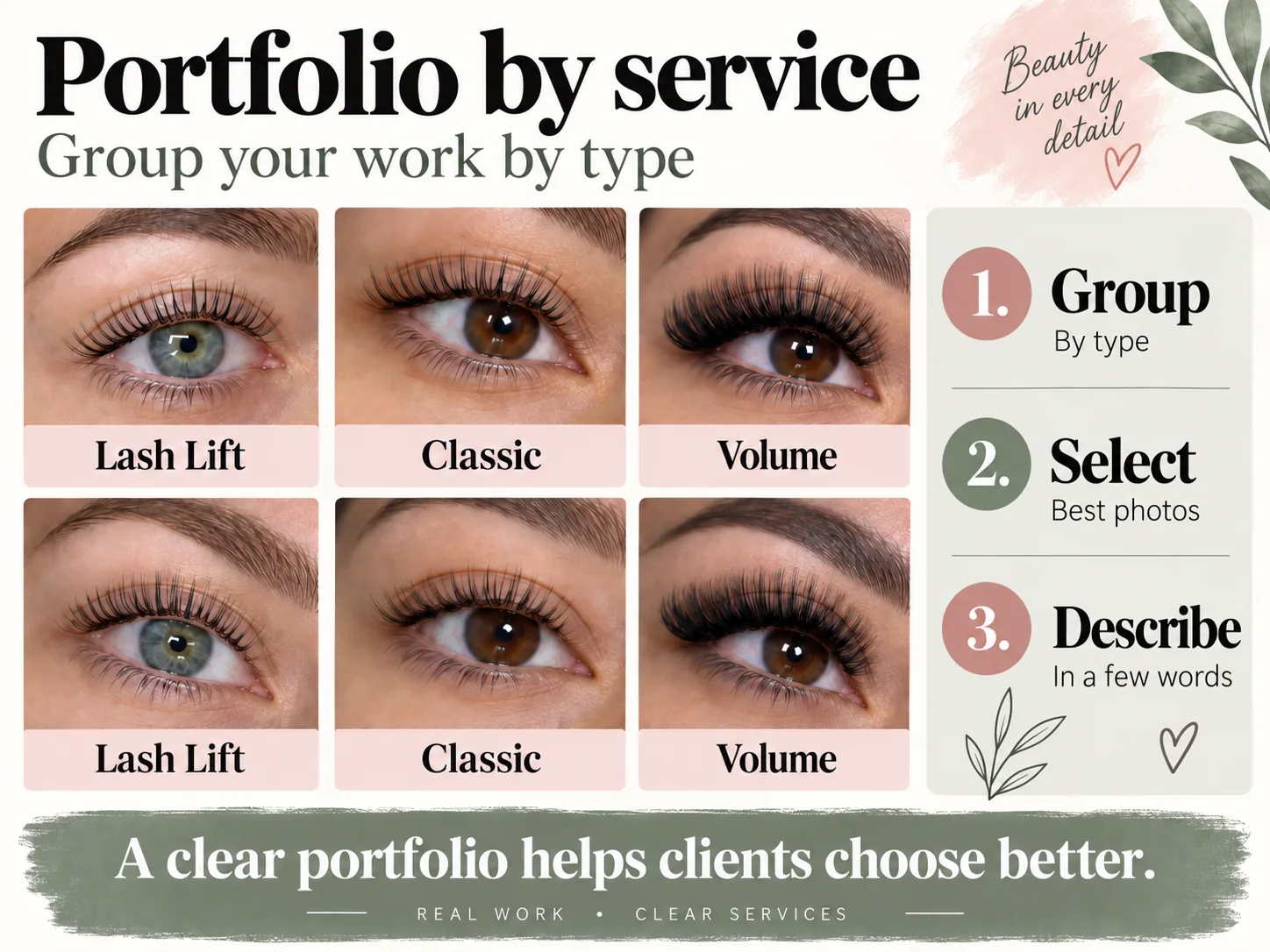
A portfolio should answer four questions: is the work yours, is it relevant to the requested service, is it credible under the conditions shown, and is it current? Organise work by service so that someone seeking a natural effect does not have to search an undifferentiated gallery.
 Open the full-size image (new tab)
Separate lash lifts, classic extensions and volume only if you actually offer them.
Choose varied, useful images for each group: repeating the same photograph does not add another case.
Use short captions with the service, client request and stage of the result; link to the complete case sheet.
Use only work you completed and can put in context. Do not use a tutor’s, brand’s or colleague’s photographs, or generated images, to simulate your own results. AI images may illustrate clearly stated concepts, but they are not evidence of your practical skill. Keep the date, service, technique, useful non-identifying notes and permission appropriate to the publication channel for each case.
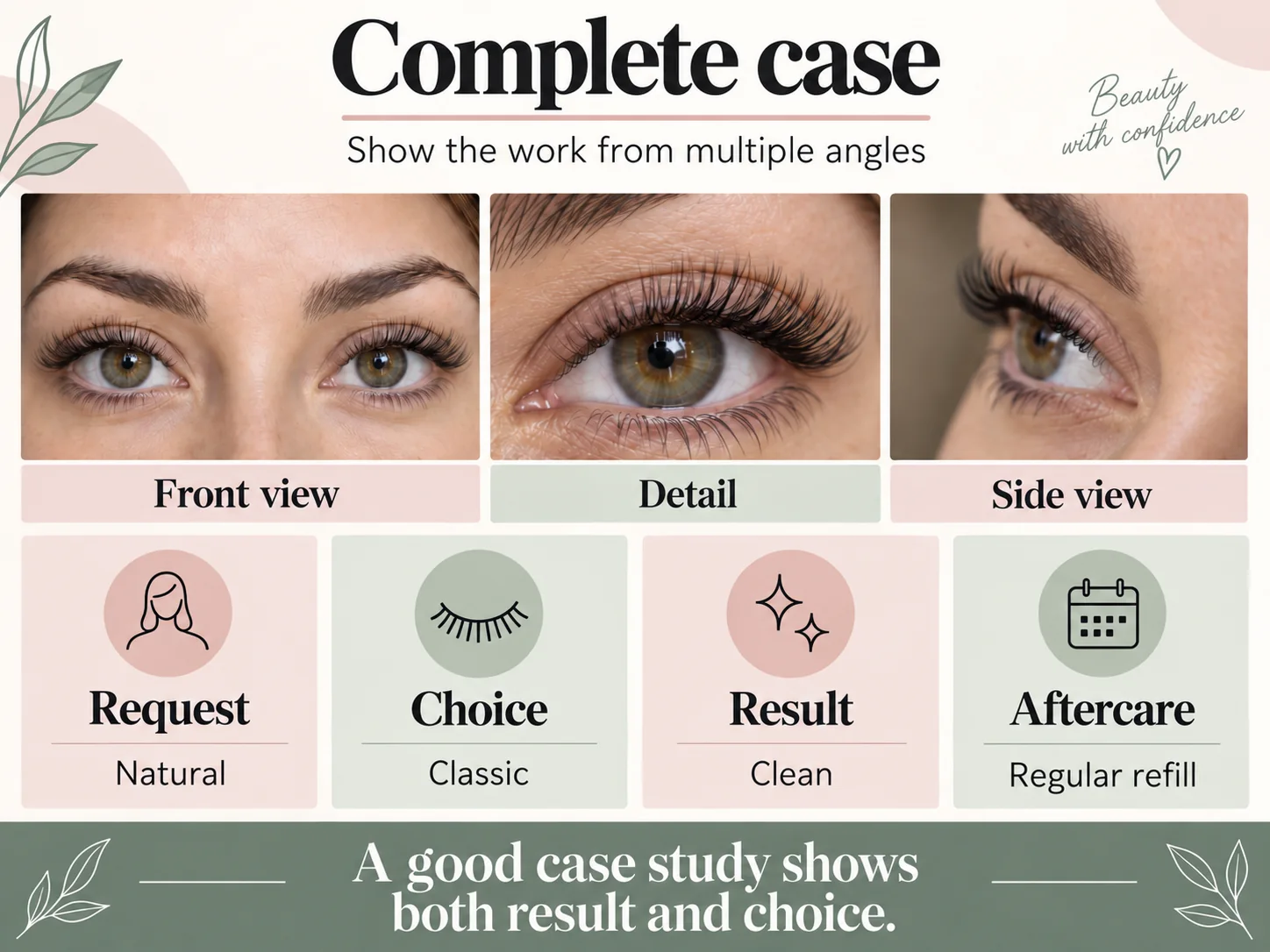
Prefer a few complete cases to many repetitive photographs. A general view, detail and side view can describe the same work. Keep dates, context and permissions in your records, publishing only necessary information.
Before-and-after images are useful only when lighting, distance, focal length, pose, exposure and editing are comparable. Do not darken the after image, smooth skin, add fibres or deliberately choose a worse before image. Show ordinary, manageable results as well as dramatic work. Honest images set clearer expectations and reduce requests that do not fit your style.
Element | What it should show | What to avoid |
|---|---|---|
Result view | Effect on the face, balance and consistency | A crop that hides the other eye |
Technical detail | Direction, uniformity and visible finish | Blur or retouching that invents fibres |
Before and after | A change attributable to the service | Different lighting, scale or pose |
Case note | Request, choice and aftercare | Sensitive information or absolute promises |
Turn isolated images into concise case studies
A gallery shows what happened; a case study explains the reasoning. Choose work you actually completed and briefly describe the client’s request, non-diagnostic professional observations, options discussed, agreed choice, technical constraints, immediate result and follow-up plan. Connect it to the relevant service without turning it into a complete technical lesson.
 Open the full-size image (new tab)
Case-sheet field | How to complete it |
|---|---|
Request | Describe the desired effect without unnecessary personal information. |
Choice | State the service performed and the reason for choosing it; do not infer technical measurements from a photograph alone. |
Result | Match views of the same work and state whether they show the immediate result or a follow-up. |
Aftercare | Record the agreed guidance. “Regular refill” does not mean a universal interval. |
Context | State practice or supervision where relevant and keep the origin verifiable in your records. |
For an extension set, explain why eye shape, natural-lash condition and maintenance led to a particular lash map and specific diameters, curls and lengths. For a lash lift, describe the assessment, shield choice and later observations without disclosing client information or turning processing times into a universal recipe.
Always state what the photograph cannot prove. An immediate image does not demonstrate retention, comfort in the following weeks, freedom from stickies or complete lash integrity. When you have an authorised follow-up, add its date and describe what was observed. Otherwise, limit the caption to the immediate result. Precision supports credibility better than an exaggerated claim.
Request authentic reviews without manipulating the sample
Reviews describe an experience; they are not something to buy. Use the same process for real clients, without preselecting those who seem satisfied or prescribing a rating or wording. Google allows invitations based on genuine experiences but prohibits incentives such as payments, discounts or free services, pressure for a particular rating and selectively requesting positive reviews. Check the official Google Maps policy before organising the process.
European consumer rules also address fake or misleadingly presented reviews. The EU directive amending unfair commercial practices rules covers commissioning fake reviews or misrepresenting consumer reviews. Do not buy review packages, ask relatives or collaborators to pose as clients, or copy testimonials from private conversations without permission and context. Check the rules applicable to your market.
Timing depends on the service. Send a neutral invitation after the client has had time to consider the experience and result, rather than during treatment or while they are standing in front of you. For extensions and infills, a useful follow-up may precede the invitation; for a lift, choose timing consistent with what you are asking them to describe. One clear invitation, with an optional discreet reminder, is enough.
Neutral example: “Thank you for visiting the studio. If you would like to share your experience, here is the review link. It is optional: we value genuine feedback and do not ask for a particular rating or wording.” If the channel is promotional or the message contains offers, distinguish it from a service message and check the applicable legal basis.
Reply without publicly confirming client status or revealing services, dates or consultation information. Thank the person in general terms. For criticism, acknowledge the concern, offer a private contact route and check the records and facts before proposing a solution. Do not discuss diagnoses, reactions or clinical images publicly; do not make support conditional on changing a review.
Design one clear route from discovery to booking
 Open the full-size image (new tab)
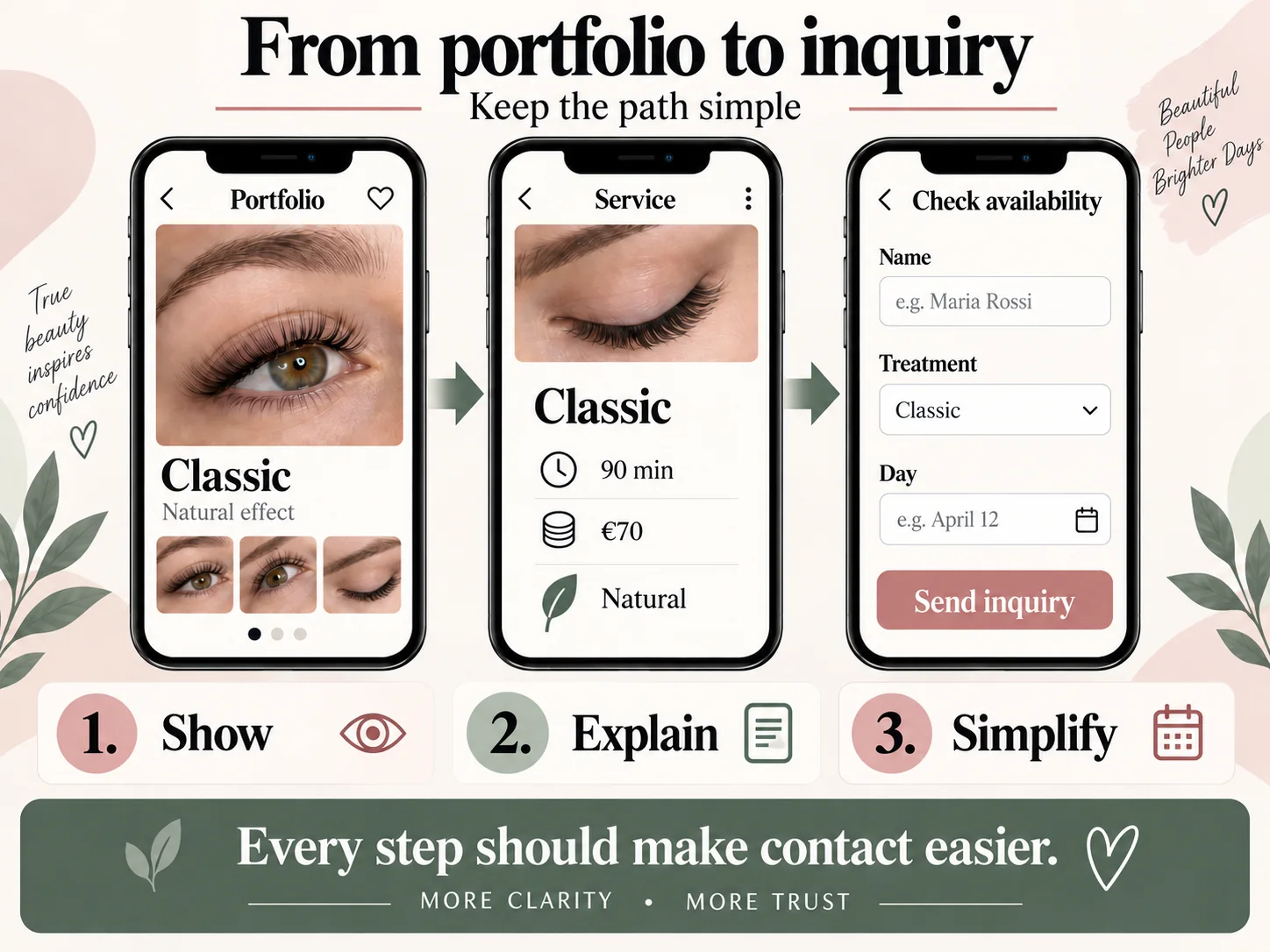
The illustration has three steps: show the work, explain the service and enable an enquiry. The displayed price and duration are examples. Submitting the form should produce a message such as “enquiry received”: the booking becomes confirmed only after availability and the necessary steps have been checked.
Keep the journey short: service page or complete profile; comparison of options; one “check availability” or “request a consultation” button; service choice; minimal information; consultation if needed; availability; summary of price and terms; confirmation. Do not call an unapproved request a booking: keep “enquiry sent” visible until confirmation.
Each service page should explain the realistic result, estimated appointment duration, price or transparent pricing basis, maintenance, inclusions, situations requiring assessment and a link to general information. For the client’s perspective, see the cost of extensions and lash lifts; to set your own prices, use the professional pricing model.
Keep initial fields to a minimum. A name, contact method, service of interest and availability may be enough for an enquiry; information for the client record belongs at the appropriate stage and for the appropriate purpose. Do not request eye-area photographs or sensitive information in a chat that is not designed to handle them. State realistic reply times and a contact route for scheduling issues, not medical emergencies.
Explain deposits, cancellations, lateness and no-shows before payment, and apply terms consistently. State amounts, deadlines, rescheduling arrangements, relevant circumstances, refund timing and a contact route. Avoid improvised or punitive terms; have a competent adviser check the conditions and documents for your business and location. A reasonably timed reminder can reduce forgotten appointments without blaming the client.
Qualify enquiries without diagnosing or oversharing
Replace the bracketed fields before sending. These texts start an enquiry and do not replace consultation; collect personal or sensitive information through an appropriate channel.
New extension client
Hi [name], thank you for getting in touch! What effect would you like, and do you currently have extensions? Please also tell me which days and times suit you. You can find services, prices and indicative timings here: [services link]. Before confirming a treatment, we will assess your natural lashes, expectations and maintenance together: a photograph alone cannot establish whether a set is suitable. I will reply within [realistic timeframe] with the next step; the appointment is confirmed only after the summary.
Client wearing a set applied elsewhere
Hi [name], thank you! To arrange an assessment, please tell me when your current set was applied, whether you have had an infill and what result you would like. Please include your availability. I cannot confirm an infill, timing or final price from a photo: I first need to assess the existing work and your natural lashes. After that, I will explain the available options and costs, including removal if appropriate. This enquiry is not yet a confirmed booking.
Lash lift enquiry
Hi [name], thank you for your interest! Would you like a more noticeable curl or to make your lashes look more orderly? Do you currently have extensions, or have you recently had a lift or tint? Please tell me when and which days suit you. Here is what the service includes, its price and indicative duration: [service link]. Suitability and treatment choice are assessed during consultation, not from a photo. I will suggest the next step within [realistic timeframe]; you will receive an explicit confirmation before the appointment.
Ask open, descriptive questions: what effect would you like, what maintenance can you manage, do you have an existing set, when was it applied, and did you experience discomfort during previous services? Do not diagnose allergies or conditions or promise suitability by message. The guide to consultation before extensions or a lash lift separates cosmetic observation, relevant history, consent and reasons to stop.
Record the enquiry source using a simple choice: search, local profile, social media, word of mouth, existing client, collaboration, course or another source. There is no need to interrogate the person. Appropriately linking this information to booking and attendance helps distinguish a channel that generates curiosity from one that brings suitable clients.
Local discovery, website and social channels have different jobs
Owned channels are those you control most directly: website, service pages, appropriately collected contact list, portfolio and studio materials. Earned channels include genuine reviews, word of mouth, mentions and unsolicited content. Local channels include your business profile, geographical searches and relevant collaborations. Paid advertising buys distribution, not trust: check the page, booking process and tracking before committing a budget.
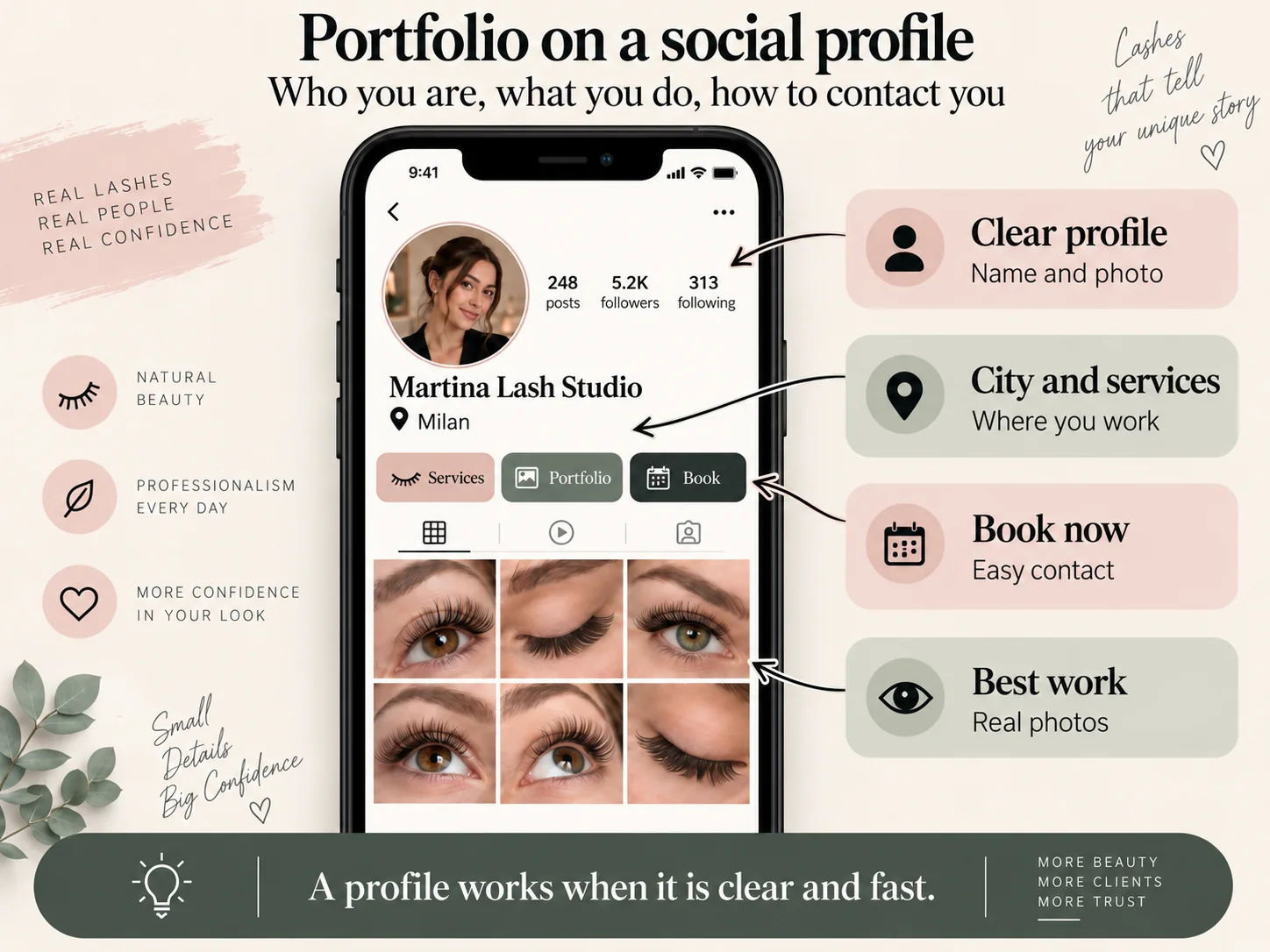
Social profile: name, area, services and contact
 Open the full-size image (new tab)
The name, follower count and post count in the illustration are graphic examples, not business results. Check that a new visitor can understand where you work, what you offer, where to see cases and how to check availability. Test the link on a phone.
Google Business Profile: four areas to check
According to Google’s local search guidance, complete and accurate information helps a business appear in relevant searches. It does not guarantee a position: relevance, distance and prominence also matter. First check that your business is eligible for a profile.
Local collaborations work when audiences are relevant and the benefit is transparent: photographers, make-up artists, hairstylists, boutiques or other professionals may create educational content, events or disclosed referrals. Agree responsibilities, data handling, payment and image use. Do not exchange reviews or present a collaborator’s testimonial as an independent client’s experience.
First visit: turn the promise into an experience
Retention starts before the appointment with a useful confirmation: address, time, duration, preparation, access details, accepted terms and a way to report changes. Avoid overwhelming the client with messages. Put the information in one readable summary and promptly communicate any changes.
On arrival, verify identity and service without announcing personal information in front of others. Revisit consultation and consent; explain the main stages and how to report discomfort; record products and batches where required; maintain timing, hygiene and comfort. A good experience comes from preventing avoidable surprises.
At the end, show the result in neutral light, check comfort, provide the aftercare guidance and explain which signs call for contact or assessment. Do not use the mirror reveal to obtain a review. If taking photographs, reiterate the purpose and permission; payment and the receipt must not depend on permission to publish.
Rebooking is a service-planning suggestion, not a medical deadline. For extensions, explain that infill timing depends on the natural cycle, usable remaining extensions, alignment and maintenance; the guide to retention and infills explains when a new set may be needed. For a lift, do not automatically schedule another treatment at a short interval: reassess regrowth, integrity and the system instructions.
Follow-up, aftercare and appropriate rebooking
Define follow-up by purpose. A service message may check comfort, understanding of aftercare or appointment arrangements; a promotional message offers deals or new services. Do not routinely mix the two. Technical follow-up should be brief, consistent with the service and include the correct reply channel.
Retention does not mean keeping a client at any cost. Make continuity easy when the service is still wanted and appropriate. Keep necessary preferences and information, remember agreed decisions, maintain quality between visits, use a process for delays and complaints, and leave room to change frequency or stop.
Useful word of mouth comes from an experience people can describe. Provide an information link or card a client can share without disclosing personal data. If you offer a referral incentive, disclose it to both parties and keep it separate from reviews. Do not ask for friends’ phone numbers or add contacts to marketing lists without an appropriate basis.
Privacy: images, booking and marketing have different purposes
One general consent should not indiscriminately cover technical records, publishing a face, advertising, newsletters and promotional messages. Define purposes, data, access, retention and channels. Collect only what is necessary and let the client understand what is required for the service and what is optional. Keep evidence of choices and enable withdrawal of permission for future uses where applicable.
Direct marketing rules depend on the jurisdiction. For businesses operating in Italy, the Italian Data Protection Authority explains that promotional emails generally require consent, with a limited exception for an existing customer’s email used to market your own similar products or services, subject to an opportunity to object. Within the EU framework, the European Data Protection Board explains that a person may object to direct marketing without giving reasons, after which processing for that purpose must stop. Do not assume these examples cover every English-speaking market; verify the rules where you operate.
Use lists with recorded origins and choices, an identifiable sender and a simple way to stop promotions. Do not import personal address books into marketing software, treat an appointment phone number as automatic marketing permission, or continue sending offers after an objection. Have privacy notices, forms and retention arrangements checked for your particular business.
Minimise metadata and indirect identifying information in photographs and reviews too. A close-up may identify someone through eyebrows, tattoos, dates, captions or social links. Keep originals in storage with defined access, separate public copies, record the origin of testimonials and do not turn a private message into public content without permission.
Measure the client journey, not vanity metrics
Distinguish total enquiries, qualified enquiries, confirmed bookings and attendance. Here, a qualified enquiry contains enough information to assess the service and next step; a new client is someone who completed their first appointment. Use stable definitions and do not duplicate an enquiry across sources.
Worked example: 20 enquiries, 8 bookings, 6 attendances
This is a calculation example, not a promised result. Of 20 qualified enquiries, 8 become confirmed bookings: 8 ÷ 20 × 100 = 40% booking conversion. If, after all appointments in that group have reached an outcome, 6 were attended: 6 ÷ 8 × 100 = 75% attendance.
The denominators differ. An appointment that has not happened yet is not a no-show: wait for its outcome or label the figures provisional. Six attendances do not automatically mean six new clients: check who completed their first service and count each person once.
Your sources: enquiries, bookings and attendance
Use a group of enquiries without duplicates and follow appointments through to an outcome. Count each new client once and assign one main source. Data stays on this page: it is neither sent nor saved. Download the CSV before closing it.
| Source | Enquiries | Qualified | Bookings | Attended | New clients |
|---|---|---|---|---|---|
Booking conversion: — · Attendance rate: —
Complete at least one row. A zero denominator does not produce a percentage.
Connect each source to costs and outcomes. Channel acquisition cost includes advertising spend and directly attributable costs divided by actual new clients; do not confuse it with cost per message. Lifetime value is an estimate based on observed revenue or, preferably, margin, frequency and duration, not a certain forecast. The guide to lash artist earnings helps distinguish takings, costs and margin.
Read indicators together. Many enquiries but few qualified ones suggest unclear messaging or targeting; many bookings and no-shows call for a review of confirmations and terms. Strong rebooking with weak later attendance may indicate appointments made too early or ineffective reminders. High retention with insufficient margin calls for reviewing time and pricing, not simply more promotion.
Indicator | Simple formula | Useful question |
|---|---|---|
Qualification | Qualified enquiries / all enquiries | Does the message attract suitable people? |
Booking | Confirmations / qualified enquiries | Is the decision clear enough? |
Attendance | Attended appointments / confirmed appointments | Are reminders and terms working? |
Return | Returning clients / eligible clients | Are experience and aftercare consistent? |
A practical 30, 60 and 90-day plan
When | Practical action | Check |
|---|---|---|
First 30 days | Define services, a few portfolio cases, replies and the enquiry route. | Make a test enquiry on mobile and record sources. |
Days 31–60 | Complete cases, update the local profile and gather genuine reviews. | Check which questions remain unanswered. |
Days 61–90 | Compare enquiries, confirmations, attendance and costs. | Change one variable at a time and record the date. |
These periods organise the work; they do not guarantee a number of clients by a deadline. Choose any investment in response to an observed problem, without adding tools before the journey is clear.
Common mistakes that reduce trust and conversion
Avoid other people’s work, filters that alter the result, purchased reviews, hidden prices and pressured bookings. Follower counts alone do not tell you how many enquiries become appointments. Do not turn retention into automatic treatments: every return requires reassessment.
Checklist before publishing and promoting
Tick each item after checking it. Selections are not saved.
For technique, hygiene, consultation, photography and professional organisation, explore all the lash guides. To strengthen your skills before defining your offer, compare online lash courses by curriculum, tutor, practice and feedback; do not confuse a course certificate with a public professional qualification or local licence.
Frequently asked questions
How much work do I need, and can I include work completed during a course?
You do not need a large gallery to start. Select a few recent cases of your own work, with permission, useful views and complete notes. State training or supervision where relevant; a tutor’s demonstration is not your result. The first-client workflow explains where to begin. Go to the practical section.
Should I show only dramatic work or always include before-and-after images?
No: choose examples relevant to services you can offer, including subtle effects. Before-and-after images are useful only when conditions are comparable; otherwise show the result with a note about the design. An immediate photograph does not prove wear over the following weeks. Go to the practical section.
How do I request and manage reviews without incentives or pressure?
Use the neutral invitation in the review section consistently with real clients. Do not offer discounts or gifts, suggest ratings or select only satisfied clients. Respond to criticism in general terms and offer a private channel, without making support conditional on a changed review. Go to the practical section.
Is a social profile enough, and how often should I post?
A clear profile can be the first contact point; a page you control gives portfolio, terms and services a more stable home. Use a sustainable posting frequency and keep your city, services and contact route visible. No posting frequency guarantees bookings. Go to the practical section.
Price, form and confirmation: manual enquiry or automatic booking?
Show the price or transparent pricing basis, inclusions and duration before confirmation. Collect a few useful details in the first form. Use an assessed enquiry when the requested service or existing work needs consultation; a selected time is not an appointment until confirmed. Go to the practical section.
How do I reduce no-shows and suggest rebooking without pressure?
Make confirmation, reminders, contact and appointment changes simple. Suggest a return based on the service and assessment, without making it automatic or guaranteeing an infill. Continuity does not necessarily need a loyalty card. Go to the practical section.
Can I use every contact for promotional messages?
Contact details collected to manage an appointment do not automatically authorise promotional messages. Separate service and marketing purposes, check the applicable basis and respect objections. The privacy section provides references for checking your process. Go to the practical section.
Which channel brings clients, and how do I measure conversion?
Compare sources with the same definitions and a consistent observation period: enquiries, qualified enquiries, confirmations, attendance and new clients. The fillable model calculates booking conversion and attendance; complete the outcomes before interpreting them. Collaborations and influencers are not essential: assess relevance, cost and transparency. Go to the practical section.
Should I accept every enquiry, and when will I see results?
Do not accept services outside your competence or incompatible expectations just to fill the diary. The 30, 60 and 90-day plan organises work and observation; it is not a deadline guaranteeing clients or revenue. Go to the practical section.
Can a lash course teach client acquisition too?
It depends on the curriculum: first check technique, safety, practice and feedback, then compare any modules on portfolios, pricing and organisation. Good communication should represent skills you actually possess. Go to the practical section.
To organise your work, also see lash artist posture and ergonomics; for cosmetic lash care, see fragile lashes and when to seek medical advice.