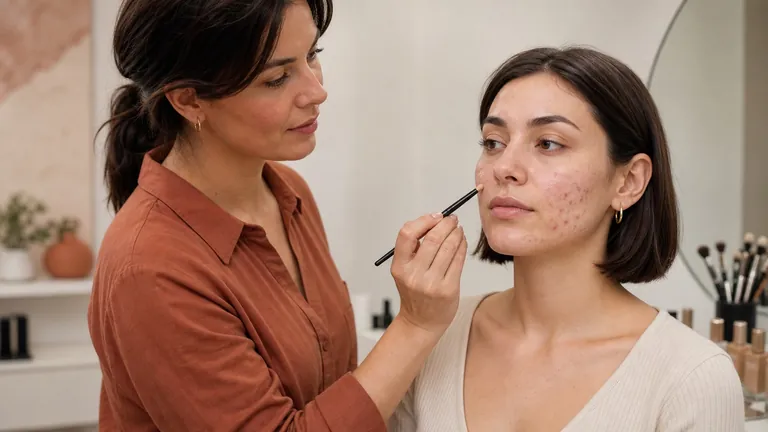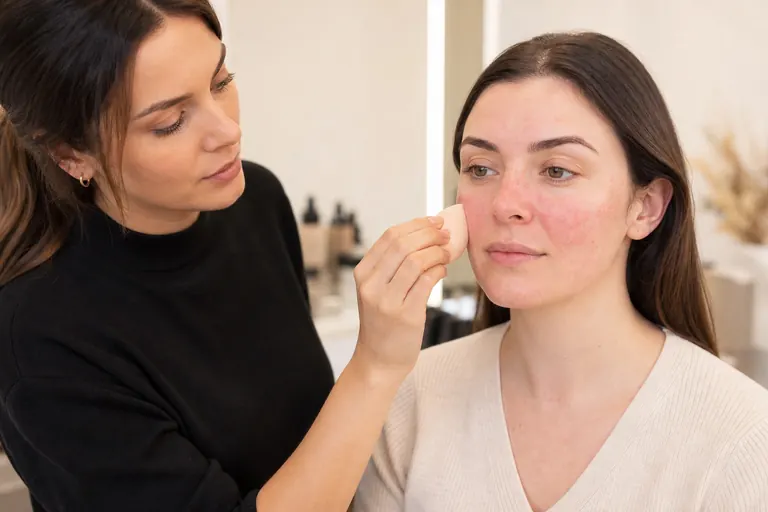
Burning, itching, new redness, swelling or eye discomfort during cosmetic application should not be hidden beneath more product or treated as a finish problem. A makeup artist is not expected to decide by appearance whether the cause is allergy, irritation, infection or another condition. The professional responsibility is narrower and important: notice the change, stop exposure, avoid making it worse, document facts and direct the person to appropriate medical care.
Quick answer: stop the application, put down the product and do not add concealer, spray or skincare to see whether the sensation passes. Remove the suspected product gently only when this can be done without rubbing and in line with its instructions. Keep the packaging, ingredient list and batch number. Sudden swelling of lips, mouth, tongue or throat, breathing or swallowing difficulty, wheezing, confusion, severe dizziness, fainting or rapid deterioration requires immediate emergency help through the local emergency number.
This is an educational service-safety guide, not medical advice. It has not been independently reviewed by a physician and does not diagnose conditions, prescribe medication or replace emergency services, a doctor, dermatologist or allergist. Professional training in makeup hygiene and product use can reduce preventable mistakes, but no cosmetic can be promised risk-free for every person.
Reaction, irritation and allergy are not interchangeable diagnoses
Observe the event; do not diagnose it
Technical film failure and biological symptoms require different responses
Pilling
Technical check only if comfortable
Burning
Stop and remove if safely instructed
Swelling
Stop and seek healthcare assessment
Breathing
Call emergency services now
Reaction is a useful descriptive word: something unexpected appeared during or after use. Irritant contact dermatitis and allergic contact dermatitis are different clinical processes. Irritation may follow direct damage to the skin barrier or mucosa; allergy involves an immune response after sensitisation. Their appearance, timing and intensity can overlap, so neither a photograph nor cosmetic experience is sufficient to distinguish them reliably.
The FDA notes that cosmetic allergy can involve itchy red rash, hives, flaking, facial swelling and irritation of eyes, nose or mouth; severe reactions can involve breathing symptoms or anaphylaxis. Irritation may also burn, sting, dry or crack. The studio response does not depend on guessing the correct label: a new symptom means stop and avoid renewed exposure.
Observation | What it means in the studio | Prudent action |
|---|---|---|
Pilling or base separation without discomfort | May be a technical film problem | Troubleshoot layers only while skin remains comfortable |
Growing burning, itching or stinging | A symptom that should not be normalised | Stop, gently remove if safe and document |
Redness, raised rash, swelling or blisters | Possible reaction requiring healthcare assessment | Do not reapply; recommend qualified care |
Breathing difficulty or mouth and throat swelling | Possible life-threatening allergic reaction | Call the local emergency number immediately |
Stop at symptoms, not only at dramatic visible signs
The person may feel burning, itching, unusual heat, tightness, eye pain or breathing discomfort before a strong visible change develops. Take that report seriously, stop the hand movement and do not add layers while watching what happens. Asking someone to tolerate a sensation until the look is finished extends exposure and removes a useful early warning.
Burning, itching or stinging that begins after a product and increases or persists.
Sudden redness, raised rash, swelling, flaking, blistering or discharge.
Strong tearing, eye pain, lid swelling, altered vision or difficulty keeping an eye open.
Cough, wheeze, chest tightness or breathing discomfort after spray, powder, fragrance or adhesive.
Rapid worsening or symptoms appearing away from the original application area.
Use an even lower threshold around eyes and lips. The false-eyelash guide covers adhesive placement and mechanical removal, while the skin-preparation guide covers comfort and compatible layers. Neither authorises continued application on reacting skin or mucosa.
Follow a six-step STOP protocol
Stop, listen, reduce exposure and document
Do not add another cosmetic to test or calm the reaction
Stop product and tools
Ask what changed
Remove only if safely instructed
Refer, record and isolate
Stop the application and place tools and product away without contaminating the clean area.
Ask what the person feels, where it began and how quickly it is changing; do not suggest a diagnosis.
Remove the suspected product only when label instructions allow it and removal will not add friction or risk.
Do not apply a second product to soothe, neutralise, conceal or test the cause.
When there are no emergency signs, recommend appropriate medical advice and provide exact product information.
Record symptoms, timing, products, batch numbers and actions; isolate used tools and disposables before resetting the station.
The protocol does not include antihistamines, steroid creams, essential oils or home remedies supplied by the makeup artist. Treatment decisions belong to qualified healthcare professionals. If the person has a prescribed emergency plan or adrenaline auto-injector, they should follow their medical instructions while emergency help is contacted where required.
Know the emergency warning signs
Anaphylaxis is a life-threatening allergic reaction that can develop quickly. NHS emergency signs include sudden swelling of lips, mouth, throat or tongue; struggling to breathe or swallow; wheezing or noisy breathing; sudden confusion or severe dizziness; and fainting. A raised itchy rash may occur, but a rash is not required before emergency action.
Call the local emergency number immediately and clearly describe the symptoms and suspected exposure. In the European Union, 112 is the common emergency number; the UK also uses 999, and the United States and Canada use 911. Do not wait for redness to disappear, let the person drive or walk away alone, or use the studio protocol as a substitute for emergency instructions.
Remove product without adding friction or new ingredients
Removal should reduce exposure, not create another irritant event. Stop sprays and airborne powders, move used applicators away and check the product instructions. On skin, use the simplest instructed method that is tolerated. Around eyes, avoid rubbing, pointed tools and fluids not intended for the area. Eye pain, altered vision, a substance in the eye or substantial swelling requires medical advice.
Do not use perfume, acids, aggressive solvents, essential oils or another cosmetic as an antidote. Even familiar skincare adds ingredients and can complicate the history. The primer and foundation compatibility guide applies to pilling and technical separation only; once biological symptoms appear, compatibility troubleshooting stops.
Document the event factually
Record facts, not an unconfirmed allergy
Traceability starts with product, batch, area and timing
Person
Reported and visible symptoms
Product
Full name, INCI and batch
Sequence
Area, order and onset time
Action
Removal, referral or emergency call

A concise factual record helps the person, their clinician and, where relevant, cosmetic adverse-event reporting. Collect only pertinent information and protect personal data. Do not write ‘confirmed allergy’ without a medical diagnosis. Record what was reported and observed, the application site, time, product sequence, removal method and referral or emergency action.
Record | Useful wording | Avoid |
|---|---|---|
Symptom | Client reported eyelid burning at 11:20 | Definite glue allergy |
Product | Full name, INCI, batch, PAO and package image | Black mascara |
Sequence | Products, area and minutes between each step | It happened during makeup |
Action | Application stopped; product removed gently | Problem solved |
Photograph skin only with informed consent and a legitimate documentation purpose. Keep the package and do not rely on transferred or unlabelled product. When a palette is involved, record the individual shade code as well as the palette name. A future clinician needs traceability, not a brand-level guess.
Use the appropriate cosmetic adverse-event system
Cosmetic surveillance systems collect reports of undesirable effects so regulators and responsible companies can identify safety signals. In the EU, Regulation 1223/2009 defines serious undesirable effects and assigns notification duties within the market. The FDA accepts US cosmetic adverse-event reports through its reporting routes. Other countries have their own regulator and process.
A report does not replace clinical assessment and the makeup artist does not need to prove causality. Useful details include exact product identity, batch, intended and actual use, chronology, symptoms, care received and the responsible company shown on the label. Use the official system for the country where the event occurred rather than a social post or informal database.
Ingredient lists support avoidance after diagnosis, not studio diagnosis
There is no short blacklist that predicts individual response. The FDA groups commonly reported cosmetic allergens into classes such as fragrance, preservatives, dyes, metals and natural rubber. Makeup work can also involve lash adhesives, fragranced products, sprays, cleansers and metal or latex-containing tools. A class being present does not mean every user will react; its absence does not guarantee universal tolerance.
Reading INCI is valuable when a person has a diagnosed allergen and knows what to avoid. It does not enable the makeup artist to diagnose from a label. Terms such as natural, vegan, hypoallergenic, fragrance-free or sensitive-skin do not amount to an absolute safety promise. Use the public INCI Analyzer as an educational ingredient-name aid only, and verify labels and manufacturer instructions directly.
A diagnostic patch test is not a last-minute studio swatch
Clinical testing and product instructions are different
A quick behind-the-ear swatch does not diagnose allergy
Clinical
Healthcare-led diagnostic process
Product test
Only when explicitly instructed
Studio swatch
Not an allergy diagnosis
Limit
No universal safety guarantee
Medical patch testing is a clinical process using prepared allergens, controlled exposure and scheduled readings. The FDA describes application followed by later physician inspection and notes that several visits may be required. It is not equivalent to placing foundation, adhesive or pigment behind an ear shortly before a service.
Follow a preliminary test only when the manufacturer explicitly requires it for that product and follow the exact instructions. Do not describe it as diagnosing allergy or guaranteeing a future reaction will not occur. If a person reports a previous allergy, request the precise medically identified substance and any healthcare guidance; do not re-expose them to a suspected product to confirm the story.
Prevent avoidable exposure before the service
Keep products identifiable, intact, within PAO and stored according to the label.
Record relevant diagnosed allergies without collecting unnecessary health data.
Do not cover broken, inflamed or actively reacting skin for an event or photograph.
Decant cream products and avoid double-dipping into shared containers.
Use clean tools, suitable disposables and adhesive only in its intended area.
Ask about comfort during the service, especially around eyes and lips.
The professional makeup products course supports label and formula literacy, while the bridal makeup course connects trial, records and touch-up planning. Neither training nor a successful trial guarantees that no later reaction can occur.
Avoid common mistakes during a suspected reaction
Mistake | Why it is unsafe | Safer alternative |
|---|---|---|
Finish the look quickly | Extends exposure and obscures the sequence | Stop immediately and record facts |
Apply a soothing cosmetic | Adds ingredients and may worsen or confuse the event | No studio treatment; seek suitable care |
Retest on a small area | Renewed exposure is not a diagnostic test | Retain product information for medical review |
Switch brand and continue | Similar or additional allergens may remain | Resume only with appropriate guidance |
Do not set a universal time for resuming makeup
The visible disappearance of redness does not prove that the cause is known or the skin is ready. After a significant reaction, the person should follow healthcare advice and share any identified allergens. The makeup professional can then review ingredient lists, discard contaminated materials and update the factual client record.
Do not reuse the suspected product on the same person as an experiment. Alternatives should stay within received medical guidance and never be presented as guaranteed safe. Postpone the service while skin is broken, inflamed, swollen, painful or otherwise symptomatic.
Frequently asked questions about cosmetic reactions during makeup
How can I tell allergy from irritation?
Appearance alone cannot confirm the difference. History, timing, distribution and clinical testing may be needed. During a service, stop, avoid reapplication and recommend appropriate healthcare assessment.
Is slight tingling normal?
Do not declare it universally normal. Stop when it is new, grows, persists or accompanies redness, itching, swelling or eye discomfort. Finishing the look is not more important than the warning.
Do hypoallergenic products prevent every reaction?
No. Marketing terms do not guarantee tolerance for every person. Check the full label and instructions and, for a diagnosed allergy, avoid the precise substances identified by healthcare professionals.
Can a makeup artist perform a diagnostic patch test?
No. Medical patch testing uses standardised allergens and scheduled clinical readings. Follow only a product-specific preliminary test explicitly required by its manufacturer, without presenting it as diagnosis or a guarantee.
What information should be given to a clinician?
Provide full product names, ingredient lists, batch numbers, PAO, package images, application order and area, onset time, reported symptoms and actions taken. A brand name alone is not enough.
When should emergency services be called?
Call immediately for sudden mouth, lip, tongue or throat swelling, breathing or swallowing difficulty, wheeze, confusion, severe dizziness, fainting or rapid general deterioration.
Can a reaction appear hours after makeup?
Yes. Some contact reactions appear or worsen later. The person should record timing and products and obtain medical advice; comfort during application does not prove permanent tolerance.
Can new redness be covered with concealer?
Not when it is new, symptomatic or evolving. Concealing adds exposure, hides change and complicates assessment. Stop until skin is intact and the situation has been appropriately evaluated.
Should the suspected product be discarded immediately?
Isolate it from service, but preserve the labelled package and batch information for traceability unless a regulator or healthcare professional instructs otherwise. Do not use it again on the person.
How is a cosmetic adverse event reported?
Use the official regulator for the country where it occurred. Provide exact product identity, batch, use, chronology, effects and care received; reporting does not require the makeup artist to prove medical causality.
When can the person wear makeup again?
There is no standard interval. Skin should be intact and symptom-free, and significant reactions require healthcare guidance. Never reuse the suspected item simply to see whether symptoms return.
Can a natural or vegan cosmetic still cause a reaction?
Yes. Origin and ethical positioning do not predict individual tolerance. Natural fragrances, plant extracts, preservatives, dyes, metals and other materials can still be relevant to a diagnosed sensitivity.
Does a successful bridal trial rule out a later reaction?
No. A documented trial improves planning and can reveal immediate problems, but sensitisation, formula changes, exposure differences and later reactions remain possible. Keep traceable products and a stop plan.
What if the client asks for an antihistamine or cream?
A makeup artist should not prescribe or supply treatment. Follow emergency instructions for severe symptoms and refer non-emergency treatment questions to a qualified healthcare professional.
Institutional sources and review status
NHS — Anaphylaxis: emergency signs and immediate action.
U.S. Food and Drug Administration — Allergens in Cosmetics: allergen classes, symptoms, labels and clinical patch testing.
American Academy of Dermatology — Contact dermatitis signs and symptoms: clinical variability and signs.
European Commission — Regulation (EC) No 1223/2009: cosmetic safety and serious undesirable-effect framework.
Editorial review: 5 September 2026. Prepared by Irene Tomasi, makeup artist with 10 years of professional experience, using institutional health sources. Independent medical review is still required and has not yet been completed. Continue with the English makeup guide library for technical topics, but use healthcare and emergency services for symptoms and diagnosis.
Keep the physical label and batch after a reaction
When symptoms occur, healthcare and reporting need traceable details; follow how to record label, INCI, batch and PAO.
Keep safety procedure distinct from contractual administration
A contract cannot override a safety stop; connect documentation to the Italy-specific quote and booking guide.
Record reactions without creating a clinical file
After the immediate safety response, preserve proportionate facts through the makeup client-record and privacy guide.
Escalate a reported reaction through the business process
After urgent care and factual recording, follow the makeup insurance and complaint procedure.
Separate acne from an acute reaction
Compare the signs with the acne-prone skin application guide.
Treat burning during removal as a stop signal
Follow the makeup-removal stop criteria.
Separate heat discomfort from a cosmetic reaction
Use the heat-and-humidity stop criteria.
Stop rather than concealing sunscreen irritation
Follow the sunscreen-and-makeup stop criteria.
Separate reactivity, rosacea and cosmetic reactions
Use the rosacea makeup service protocol.
Stop rather than concealing a cosmetic reaction
Follow the colour-corrector stop criteria.
Apply stop criteria before specialist coverage
Continue with the cosmetic camouflage protocol.