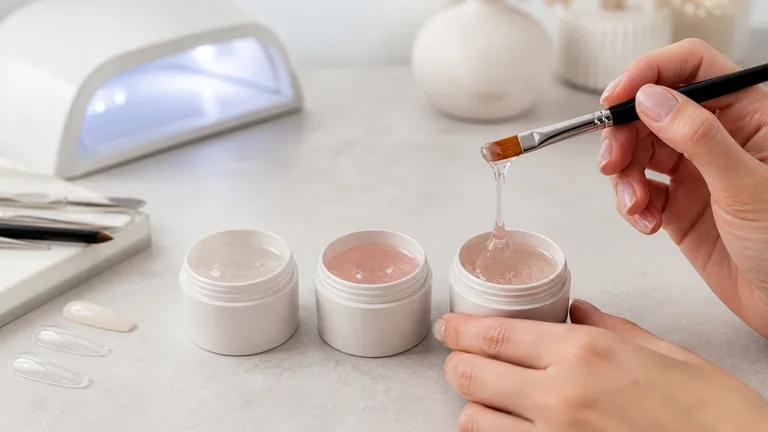
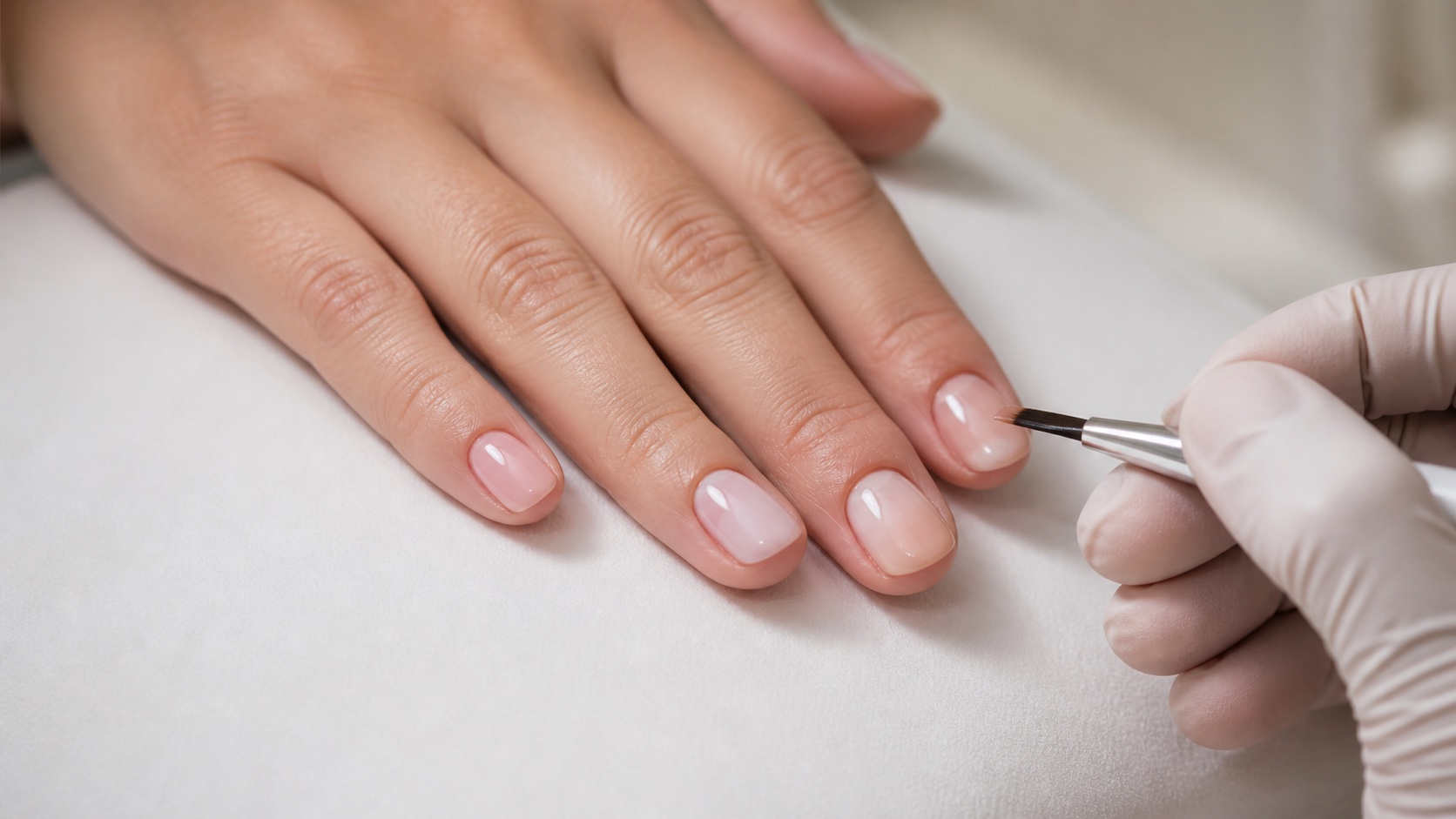
Builder gel, rubber base and a structured gel manicure can all produce a smooth overlay on the natural nail, but they are not interchangeable names. They differ in the amount of architecture they can support, their flexibility, permitted thickness, maintenance and removal. A responsible choice starts with the natural plate, length, shape and real-life load—not the product currently receiving the most attention online.
Short answer: choose a true builder gel when the service needs controlled architecture, a defined apex or meaningful correction. Consider a compatible rubber or builder base for a short-to-moderate overlay when its instructions permit the required thickness. Treat ‘structured gel manicure’ as a service description, not one universal formula. No system is automatically best for every natural nail.
This guide owns the decision between natural-nail overlay services. The gel extension guide owns sculpted length; the gel polish safety guide owns thin colour application. Product-family comparisons between rubber, builder-in-a-bottle and fibre bases remain a separate intent. Here the question is which level of support the complete service requires.
What a natural nail overlay actually is
Overlay describes the service, not one formula
Support can increase without adding extension length
Colour
Thin finish with minimal correction
Level
Smooth small irregularities
Support
Control stress-area distribution
Structure
Build apex and correction
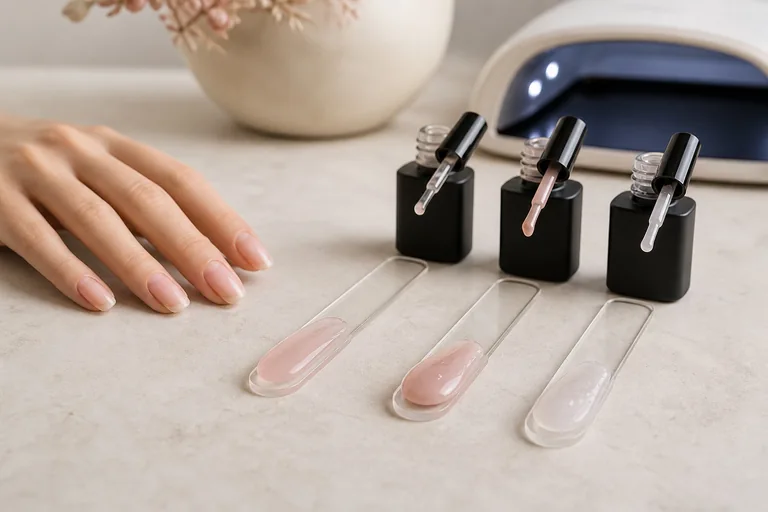
A natural nail overlay is an artificial coating applied over the existing plate without necessarily adding length. It may provide colour and light support, level small surface irregularities or create a complete architecture with an apex and deliberate thickness distribution. An overlay is therefore a service category, not the name of one chemical formula.
Overlay does not mean making every nail thick. A coating that is too rigid for a highly flexible plate, too thin for its free-edge leverage or poorly maintained can crack or lift. Aggressive preparation and removal can thin the plate regardless of whether the bottle says rubber, builder or soak-off. Assessment comes before brand language.
Builder gel, rubber base and structured gel manicure compared
Option | Primary role | When to assess it | Limit to verify |
|---|---|---|---|
Builder gel overlay | Architecture, apex and correction | More leverage, higher load or shape correction | Rigidity, base compatibility, cure and filing |
Rubber or builder base | Adhesion, levelling and limited reinforcement | Short or moderate nails when the instructions permit | Flexibility, maximum thickness and removability vary |
Structured gel manicure | Natural-looking colour with light-to-moderate support | Manageable length without major structural correction | The real formula determines every technical step |
The last row describes an application outcome, not a regulated product category. One technician may use a tinted builder base; another may use a separate clear support layer and colour. Compare the documented system and final architecture rather than assuming every service with the same menu name behaves alike.
Marketing names do not define material behaviour
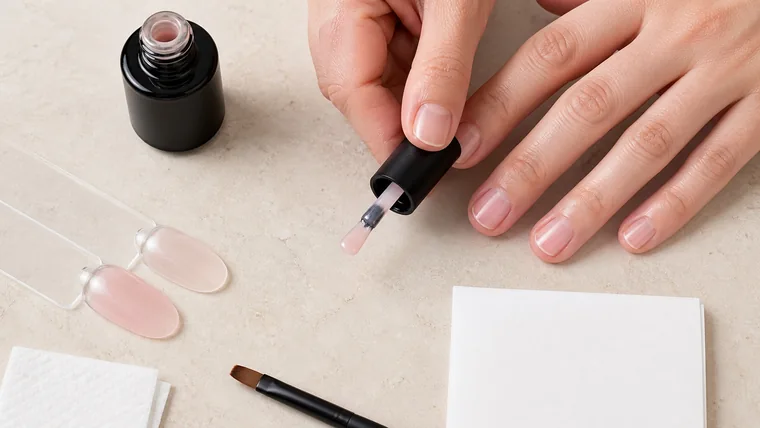
Rubber base, builder base, fibre base, builder in a bottle and reinforced base are commercial descriptions. They do not guarantee one flexibility, viscosity, maximum layer, soak-off time or lamp. Two products carrying the word ‘rubber’ can behave differently under impact and require different application or removal procedures.
Do not infer chemistry from the packaging. Read the instructions, safety information and complete-system compatibility for the exact product. If the manufacturer specifies thin layers only, a large self-levelling bead is not made safe by calling the result an overlay. If a builder is file-off, leaving it longer in solvent will not turn it into soak-off material.
How to choose the right overlay system
Choose from the nail and service backwards
A bottle name is the last check, not the first
Assess plate, skin and symptoms
Define length, shape and load
Choose support and architecture
Verify system and maintenance
Plate and surrounding skin: do not cover pain, inflammation, separation, wounds or an unexplained colour change.
Natural flexibility: decide whether the coating and plate can move together without repeated cracking or separation.
Length and shape: increased free-edge leverage requires more deliberate architecture and adequate sidewall support.
Growth direction: downward, upward or asymmetric growth may change product distribution and maintenance needs.
Daily load: manual work, sport, repeated water exposure, solvents and impact alter the service plan.
Maintenance: the client must be able to return before imbalance, lifting or cracking becomes significant.
Documented system: base, builder, colour, top and lamp need confirmed roles and compatibility.
Use the nail morphology guide to separate observable proportions from aesthetic preference, and the nail apex guide when the overlay requires genuine structural support. A short healthy nail may need little levelling; a longer nail with greater leverage cannot be assessed from product viscosity alone.
Short, flexible natural nails
A compatible flexible base may move more coherently with a short plate, provided its instructions allow the applied thickness. Flexible does not mean unbreakable. Lengthening the free edge, repeated impact or combining layers with very different movement can still create cracks or separation.
Moderate nails needing levelling
When the plate is healthy and does not require major correction, a documented builder base or structured gel manicure may provide an even surface and controlled support. The goal is not a high dome on every nail. Read side profile, stress area, free edge and sidewalls together.
Longer nails or meaningful correction
When length, load or growth correction increases, a true structural gel usually provides more deliberate control. Match product rigidity and architecture to the natural nail and planned maintenance. An overlay remains on the natural plate, but its structural demands may be close to those of an extension.
When a builder gel overlay makes sense
Builder gel is useful when the overlay must place a defined apex, repair a corner, rebalance growth direction or resist greater leverage. Strength does not come from making the entire surface thick. A balanced structure concentrates useful material where load requires it while keeping the perimeter and free edge readable.
Builder gels may be more rigid or flexible, self-levelling or thixotropic, soak-off or file-off. These properties cannot be deduced reliably from the word gel. Review the complete gel nail system comparison and use only the base, lamp and removal route supported by the product documentation.
Rubber base: useful qualities and important limits
Rubber base is often selected for adhesion, self-levelling and efficient reinforcement on short nails. A compatible formula can smooth small irregularities and provide more support than a thin colour base. It should not automatically be used for extensions, major correction or a thickness the manufacturer has not validated.
The name suggests elasticity but provides no shared measurement across brands. A very flexible layer on excessive length can flex beneath a less flexible colour or top; a comparatively rigid coating on a mobile plate can crack or lift. Product instructions and observed service history are stronger evidence than a category label.
What a structured gel manicure actually reinforces
A structured gel manicure adds more deliberate support than a very thin gel-polish application. That support may come from a levelling base, a builder in a bottle or another product designed for the purpose. The term describes the service result; it does not change the chemistry or permit every formula to be applied as a thick bead.
It can suit a client who wants a natural silhouette with controlled product distribution and no extension. Once the design must create substantial apex, sidewalls and stress-area support, it becomes structural work and should be planned, maintained and priced as such rather than hidden behind a quicker service name.
A seven-check overlay workflow without a universal recipe
Inspect the plate, surrounding skin, colour, free-edge attachment and growth direction.
Agree a sustainable length, support level, finish and maintenance expectation.
Complete the documented preparation without digging into or thinning the natural plate.
Use only adhesion products that are compatible and necessary for the selected system.
Distribute product for the actual length and stress area while keeping it off living skin.
Cure with the specified compatible lamp, hand position, layer and exposure schedule.
Inspect profile, sidewalls, free edge, surface, comfort and absence of skin contact.
The professional nail-prep guide explains plate assessment and surface preparation. The primer guide separates dehydrators, acid primers, acid-free primers and bonders. Adding more liquids does not repair an unsuitable material or poor architecture.
Lamp compatibility and complete cure are safety controls
Complete cure depends on the whole gel–lamp system
A hard-looking surface is not a cure measurement
Formula
Photoinitiators and pigmentation
Layer
Thickness and product position
Lamp
Validated output and geometry
Placement
Even hand and thumb exposure
Gel cure depends on the complete system: photoinitiators, lamp wavelengths and irradiance, LED position, pigment, layer thickness and hand placement. A glossy or apparently hard surface does not prove that deeper product has cured as required. Use the lamp specified or validated for that formula and follow the full exposure schedule.
FDA guidance emphasises following labelled directions and avoiding skin contact to reduce the chance of allergic reaction. Keep uncured product off the plate folds and skin, remove accidental contact before curing and stop using a product after a suspected reaction. The guide on how to cure gel nails explains why wattage or a generic timer cannot confirm compatibility.
Maintenance, rebalance and removal
An overlay is a managed cycle
Application quality cannot compensate for neglected maintenance
Inspect
Growth, impact, lift and symptoms
Stabilise
Remove compromised product
Rebalance
Restore support and length
Remove
Use the documented route
Checkpoint | What to inspect | Professional decision |
|---|---|---|
Regrowth | Apex migration, length and free-edge load | Rebalance before leverage becomes excessive |
Lifting or crack | Location, depth, moisture, impact and symptoms | Remove unstable product; never seal over it |
Removal | Documented soak-off, file-off or safe residual layer | Follow the route specified for that exact product |
There is no single maintenance interval for every client. Growth rate, length, impact, product and architecture alter the appropriate return point. Use the nail infill and rebalance guide to assess a stable service, and the complete product-removal guide to distinguish soak-off, file-off and combined routes without using resistance as permission to scrape.
Overlay errors that encourage lifting or damage
Choosing by viscosity or trend without checking the formula's intended function.
Using a highly flexible base for a length and load that require architecture.
Building a thick structure with a product documented only for thin coats.
Mixing brands, lamps or primers without confirmed compatibility.
Curing product on the skin or cleaning it only after light exposure.
Sealing a lift, over-filing the plate, peeling or forcing removal.
Blaming every failure on an ‘oily nail’ without mapping its position and timing.
Repeated separation needs diagnosis of the service, not diagnosis of the client. The nail-lifting troubleshooting guide connects location and timing to preparation, product contact, structure, cure, impact and maintenance without treating one explanation as universal.
When not to cover the natural nail
Do not use an overlay to conceal pain, swelling, inflamed skin, plate separation, a new green or unusual yellow colour, wounds, bleeding or a progressive change. Nail technicians do not diagnose disease. Pause the cosmetic service and recommend assessment by an appropriate healthcare professional when a change is symptomatic, unexplained or outside professional scope.
Itching, blisters, redness or swelling after nail products may be consistent with irritation or sensitisation. Stop exposure, do not cover the reaction and advise the client to seek healthcare advice. Record the products and batch details without attempting to identify an allergen through salon experimentation.
Frequently asked questions
Is builder gel better than rubber base for natural nails?
Not universally. Builder gel generally offers more structural control, while a suitable rubber base may support shorter, more flexible nails. The plate, length, load and exact product instructions decide.
Is a structured gel manicure the same as BIAB?
No. Structured gel manicure describes a service approach. BIAB is used as a commercial product name. Similar-looking services may use different formulas, thickness limits, lamps and removal methods.
Which overlay lasts longest?
There is no reliable universal ranking. Retention depends on plate condition, preparation, architecture, cure, length, impact and maintenance. Greater rigidity does not automatically last longer on a flexible nail.
Does rubber base permanently strengthen natural nails?
No. It can create a supportive coating while worn, but it does not permanently alter the nail plate. Removal and repeated preparation also affect how the bare nail appears and feels.
Can rubber base be used on long nails?
Only when length, stress and the exact product instructions are compatible. Increasing leverage may require a structural builder and a deliberately placed apex rather than a thicker base layer.
Does a natural nail overlay add length?
Not by definition. It covers the existing plate. A small corner repair may be part of some services, but a designed extension has its own support, architecture and search intent.
Does builder gel ruin natural nails?
Damage is often associated with aggressive filing, peeling, forced removal, skin contact or unsuitable curing rather than the product name alone. Any overlay can be misapplied or removed poorly.
Can base, colour and top from different brands be mixed?
Only with explicit compatibility information. Adhesion, flexibility, surface inhibition and cure may differ. A documented complete system removes variables and clarifies which instructions govern the service.
How do I know whether an overlay is soak-off or file-off?
Check the manufacturer’s instructions for the exact product. Do not infer removal from viscosity, bottle shape or marketing name, and do not prolong solvent exposure for a system not declared soluble.
How often does an overlay need maintenance?
The return point depends on growth, length, apex movement, lifestyle and integrity. Bring the assessment forward after impact, lifting or cracking instead of waiting for a generic calendar interval.
Can an overlay correct a downward-growing nail?
It can improve the temporary visual line when correctly designed, but it cannot change the matrix or future growth direction. Significant correction requires structural skill and appropriate product choice.
Should weak or damaged nails always be covered?
No. Covering can hide progression and may worsen some problems. Unexplained fragility, pain, separation, inflammation or colour change requires a pause and suitable healthcare assessment rather than cosmetic concealment.
Learn overlay assessment in context
BeautyLearn's online nail courses connect natural-nail assessment, preparation, product control, architecture, curing and removal in progressive learning paths. Use the English nail guide library to compare each decision with the dedicated anatomy, system and troubleshooting resources before selecting a course.
Sources and scope
Product safety and skin-contact precautions: U.S. FDA nail care products. Dermatology guidance on artificial nails and concealment of nail problems: American Academy of Dermatology and its manicure safety guidance. Follow current manufacturer instructions, safety data and local professional limits for the exact system used.
Editorial boundary: this page compares service-level support for an overlay on the natural nail. Detailed rubber-base, builder-base and fibre-base formulation choices, gel extensions, thin gel-polish application, nail pathology and medical treatment remain separate intents.