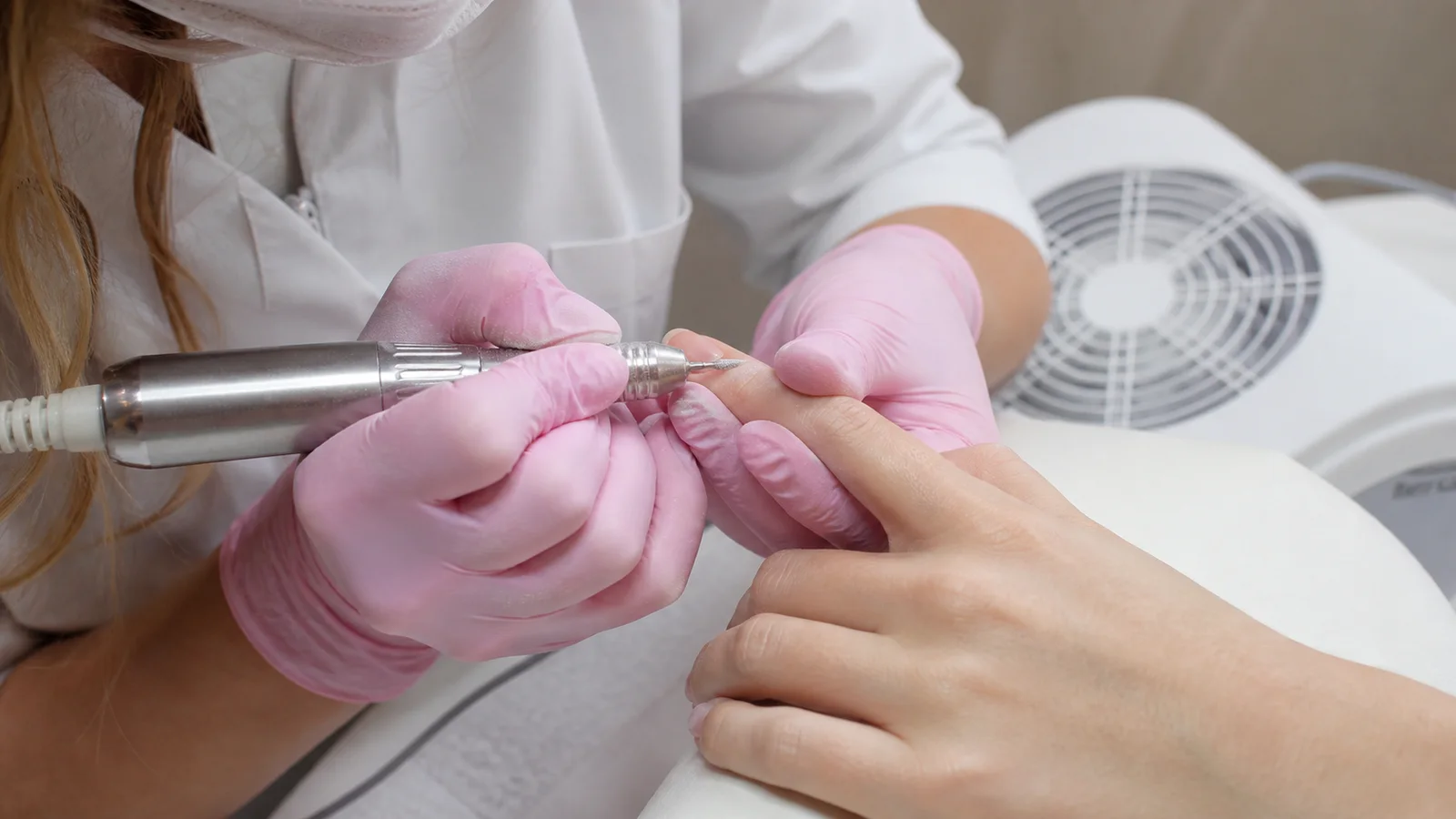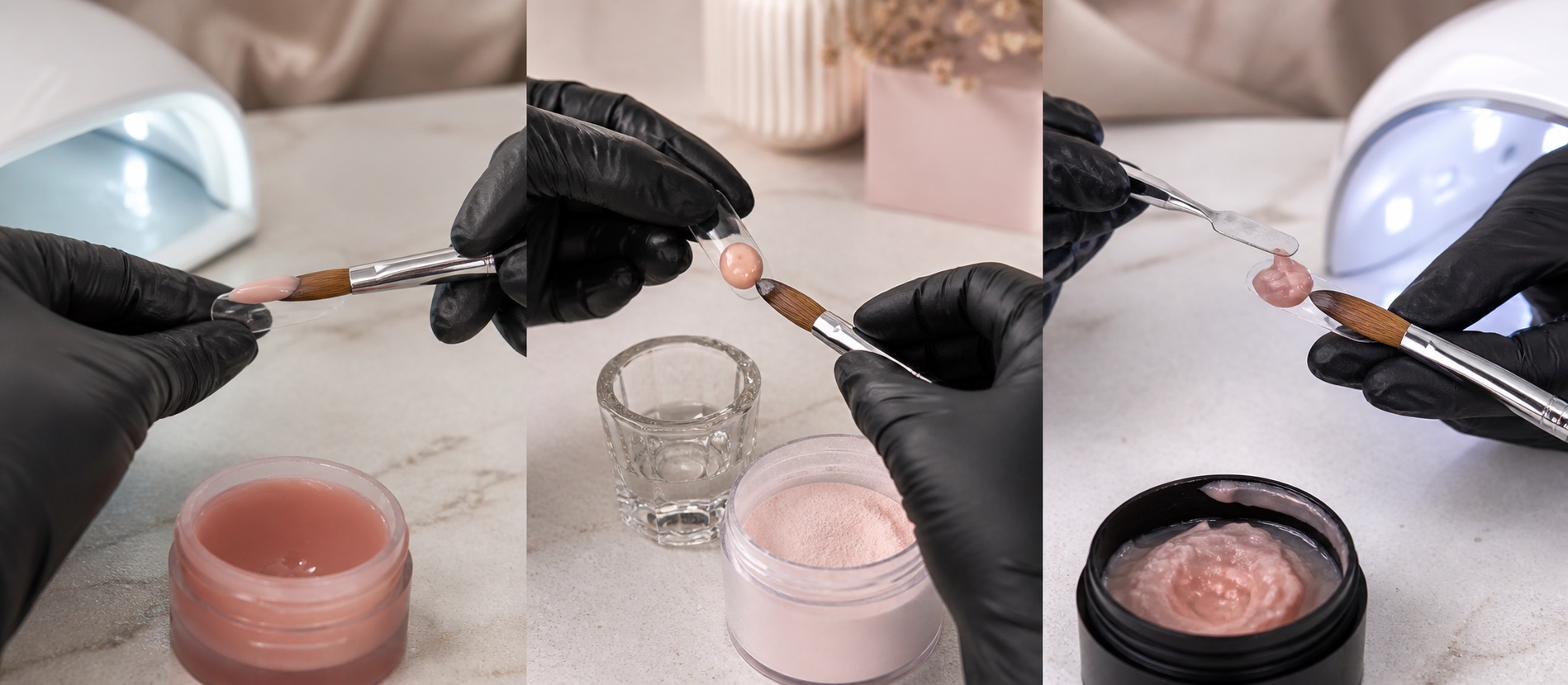
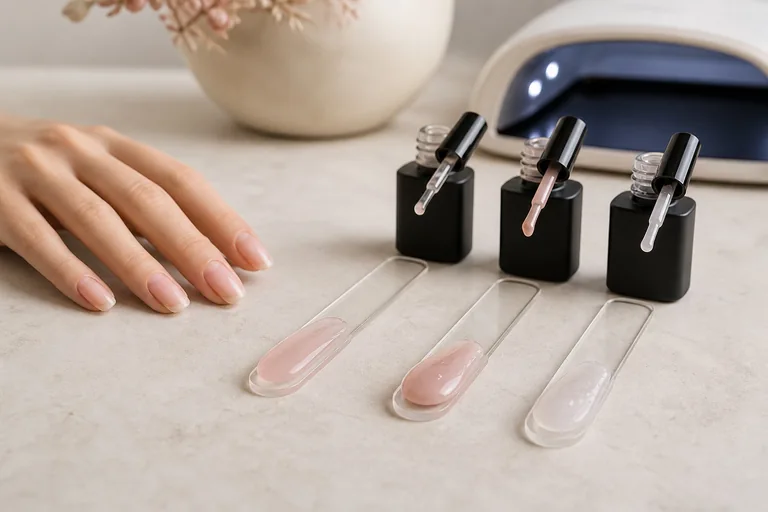
Rubber base, builder in a bottle and fibre base are not three strength levels. The names describe different ideas: expected flexibility, packaging and building function, or a claimed reinforcement within the formula. A single bottle can sit in more than one group, while two products carrying the same broad label can require different bases, thicknesses, lamps, maintenance and removal. Product-specific instructions therefore outrank the category name.
Short answer: choose by documented service, not by the most reassuring product name. Confirm whether the exact bottle is a base, a builder or both; the permitted thickness and length; the compatible lamp and cure; the infill rules; and whether removal is soak-off, file-off or a controlled combination.
This guide owns the comparison between these bottled reinforcement families. The separate natural-nail overlay guide helps choose the service, while the builder-gel families guide compares hard, soak-off, self-levelling, thixotropic and fibre gels. Substantively reviewed on 5 September 2026, this educational page does not replace the label, technical sheet, safety assessment, instructions for use or medical advice. English courses, teachers and availability are separate market records; browse the current online nail courses without inferring content or terms from the Italian catalogue.
The three names answer different questions
Three labels, three different ideas
Flexibility, format and reinforcement are not strength grades
Rubber
Usually a flexible base claim
Bottle builder
Format plus building function
Fibre
Reinforcement claim in a formula
Proof
Exact label and instructions
A useful comparison begins by asking what each name is trying to communicate. ‘Rubber’ usually suggests a flexible, relatively viscous base intended to move with a short natural nail. ‘Builder in a bottle’ describes a brush-on building format and a structural purpose. BIAB is a widely searched brand-derived term used conversationally for this area, but it should not be treated as the universal technical name for every bottled builder. ‘Fibre’ suggests that a product makes a fibre or reinforcement claim; it does not identify one standard material, concentration or performance.
Label family | Main idea | Does not prove | Verify on the exact product |
|---|---|---|---|
Rubber base | A flexible or strengthening base | Universal adhesion, an apex or extension capacity | Layer, base, lamp, infill and removal |
Builder in a bottle / BIAB-style | Brush-on building and overlay function | One protocol across brands, shades or formulas | Base, maximum structure, cure and maintenance |
Fibre base | A formula marketed with fibres or reinforcement | Greater strength, biological repair or safer wear | Function, surface, compatibility and removal |
These are market descriptions rather than one universal grading system. ‘Thick’, ‘strong’, ‘hard’, ‘flexible’, ‘soak-off’ and ‘builder’ are not interchangeable. Viscosity describes flow before curing; flexibility describes how the cured film responds to force; building capacity concerns the shape and thickness the manufacturer supports; adhesion concerns the interface; and removal describes a later process. Keep each property separate.
Rubber base: flexibility is not a universal guarantee
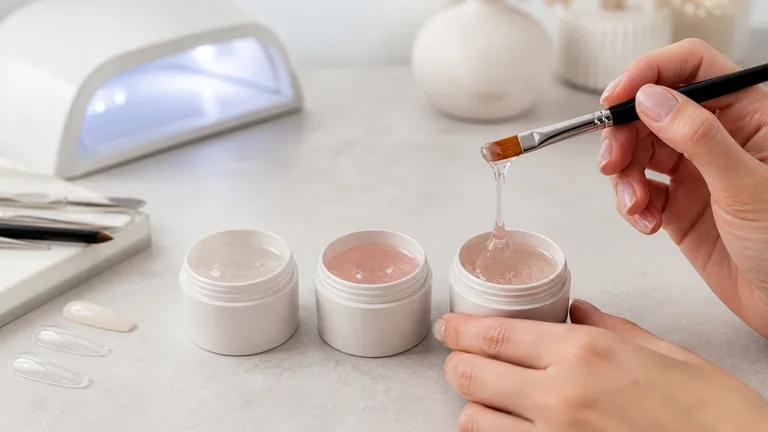
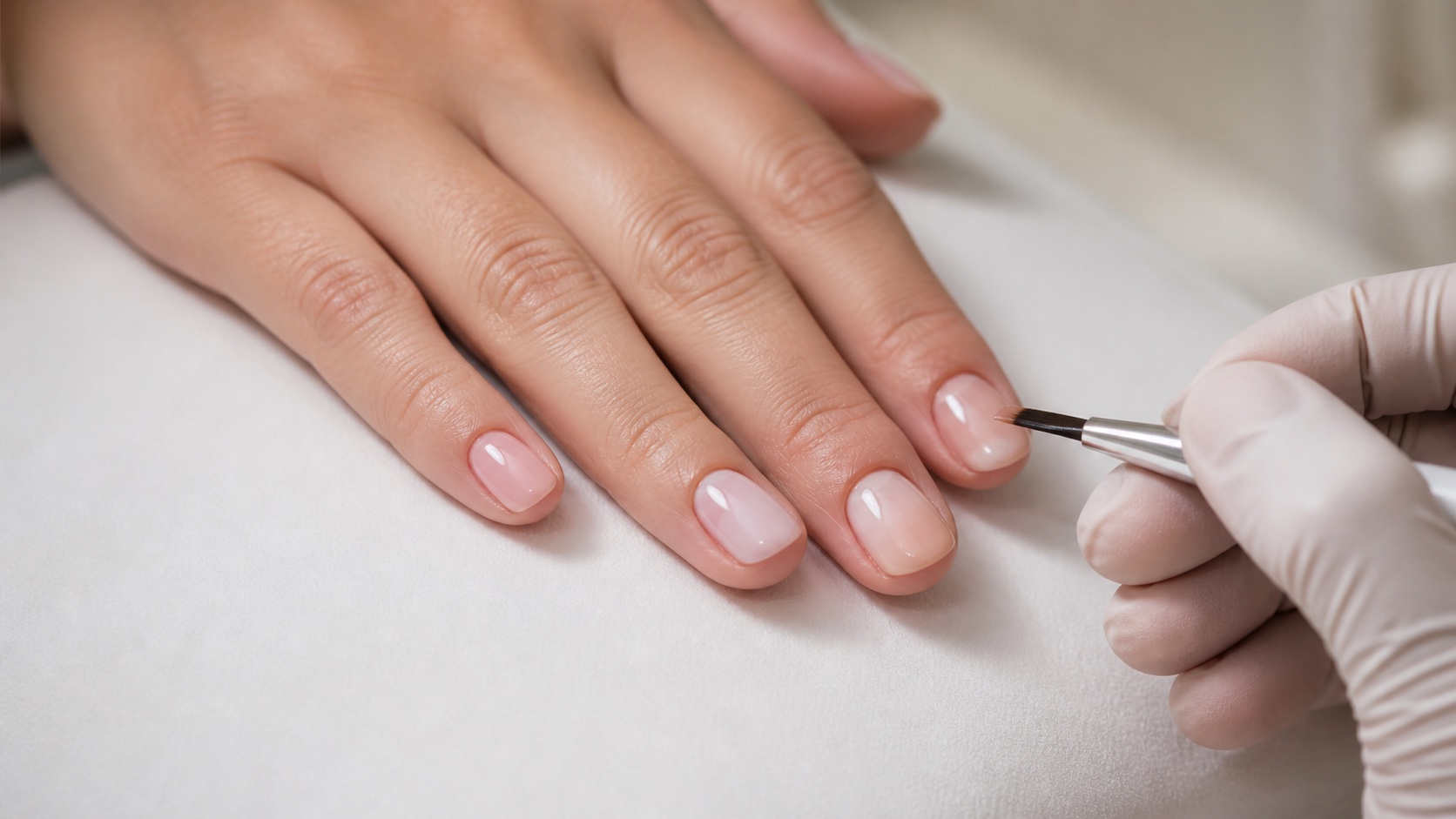
Rubber base commonly refers to a more substantial and flexible base than a very thin gel-polish base. In a documented system it may smooth minor surface irregularity, support a short natural nail or create a restrained reinforcement beneath colour. Its relatively comfortable bottle-and-brush application makes it attractive for structured gel manicures, but the word rubber alone says nothing reliable about the amount to apply.
Some formulas permit a small levelling bead; others specify a thin slip layer. Some can be maintained by infill, while others are intended for full removal. A dense base may flow slowly without being especially flexible, and a flexible base may still be unsuitable for a long free edge. Never turn a base into an extension gel by applying more product than its instructions support.
The natural nail does not need aggressive thinning to make a rubber base adhere. Accurate skin and cuticle-area preparation, controlled dehydration where instructed, a clean free edge and a product-free margin matter more than extra abrasion. Use the natural-nail preparation guide to distinguish removable surface tissue from living tissue and the Gel Polish Course for guided practice in thin application, margins, curing and removal.
Builder in a bottle: the package does not define the mechanics
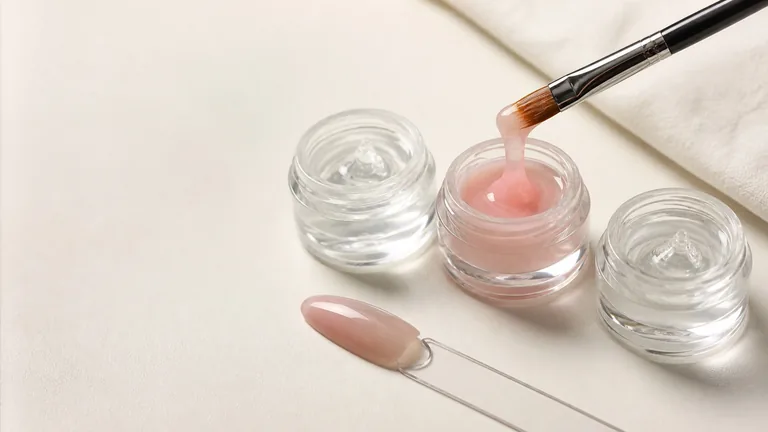
Builder in a bottle is a useful generic description for a brush-on gel that the manufacturer authorises for building a controlled overlay or other stated structure. The integrated brush can reduce decanting and speed up short services, but it does not make the formula equivalent to every other bottle builder. Products vary in self-levelling, pigmentation, heat generation, flexibility, maximum layer, extension permission and removability.
The search term BIAB is often used as shorthand for bottled builder services. In professional records and client explanations, name the actual brand, line, shade and batch instead of using the shorthand as though it described one standard substance. That precision matters when checking a lamp, investigating lifting, repeating a service or identifying what must be removed.
A builder can make an apex possible, but it does not place the apex for the technician. Length, lateral balance, stress area and free-edge thickness remain design decisions. A product allowed for a short overlay may not be authorised for an extension or major correction. Review nail architecture and stress-area balance before using viscosity as a substitute for structure. For supervised progression, compare the Beginner Gel Nails Course — Level 1 and the complete English nail pathway.
Fibre base: reinforcement is a claim, not a ranking
Fibre base is used for products marketed with dispersed fibres or another reinforcing concept. The broad family is highly variable: one product may be a soak-off base for short natural nails, another a builder base, and another a layer designed to sit under a separate builder. The word fibre does not reveal the fibre type, how the cured film behaves, whether a base is required or how the product should be removed.
Visible fibres do not biologically mend a split or damaged nail. They may contribute to a cosmetic film in the service assessed by the responsible manufacturer, but they cannot correct poor architecture, incompatible curing or a contraindicated service. Do not use a reinforcement claim to cover pain, inflammation, unexplained colour, active separation or broken skin. The weak and damaged nails guide and the guide to onycholysis and green nail changes define when cosmetic coverage should stop.
After application, inspect the surface and side profile. Fibres or particles must not leave exposed roughness, sharp edges or locally excessive thickness. Do not add unplanned layers merely to hide texture; follow the finishing sequence and limits documented for the formula.
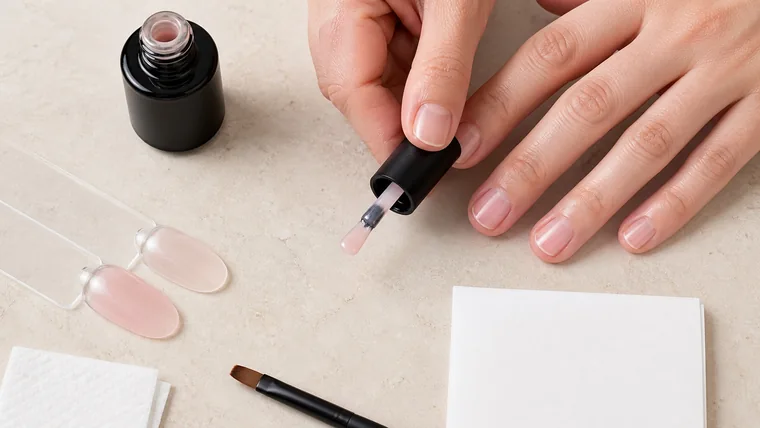
Where rubber, builder and fibre overlap
The families overlap
One bottle can be flexible, buildable and fibre-labelled
Flexible
Cured response to force
Buildable
Permitted volume and architecture
Reinforced
A documented fibre claim
Intersection
Still not one universal protocol
Picture three overlapping circles. One groups formulas described as flexible; one groups brush-on products authorised to build; one groups formulas carrying a fibre claim. A product can occupy the centre of all three. Another can be a flexible rubber base but not a builder, or a fibre builder in a pot rather than a bottle. The overlap explains why a salon cannot safely keep one memorised protocol for every product bearing a familiar word.
Intended service | Family worth comparing | Deciding evidence |
|---|---|---|
Short gel polish with light reinforcement | Validated rubber or fibre base | Permitted layer, flexibility and removal |
Natural-nail overlay with controlled apex | Builder in a bottle or documented builder base | Building capacity, length and infill rules |
Short nail needing a specified reinforcement | Fibre base or compatible builder | Complete formula protocol, not the word fibre |
Extension or substantial correction | Builder expressly authorised for the task | Maximum length, architecture and maintenance |
Choose the service before choosing the bottle
Select from the service backwards
A bottle name is the last filter, not the first
Assess
Nail, history and stop criteria
Define
Colour, reinforcement or extension
Match
Product and structural limits
Verify
Lamp, infill and removal
Begin with the visible natural nail and the client’s maintenance reality. Record length, growth direction, apparent flexibility and thickness, previous product, lifting pattern, occupation, hobbies and realistic return interval. Stop if the nail or surrounding skin shows a change outside cosmetic scope. Then define whether the requested service is thin colour, light reinforcement, structured overlay, correction, extension or infill.
Only compare products intended for that same service. A short flexible nail may benefit from a compatible flexible base, but the slogan ‘flexible nail equals rubber base’ is still too crude. A very long or mechanically demanding shape may require a different builder and architecture. Conversely, applying a very rigid system to a flexible natural plate without considering length and stress can concentrate force rather than solve it.
Colour and opacity also affect use. A pigmented builder can make the service visually efficient, but greater opacity can change the curing conditions specified by the manufacturer. Clear and coloured versions in the same family need not share every instruction. Check the exact shade rather than assuming the clear-product protocol transfers automatically.
Thickness and levelling must remain controlled
Bottle products can encourage technicians to add a large bead because the brush makes volume feel easy. More material does not automatically produce more strength. Excess thickness can distort the stress area, flood the skin, create uneven heat and move the deepest product beyond the cure conditions tested for the system. A very flat layer may also fail when the intended service needs structure.
Use a slip layer only when the protocol includes it. Control the bead before it reaches the lateral folds or proximal margin. Turn or angle the finger only as a deliberate levelling step and recheck the sidewalls, lower arch and free edge before curing. If the product repeatedly runs, change quantity, timing or viscosity according to the manufacturer’s method instead of creating an invisible contact with skin.
Curing is a product-system decision, not a wattage shortcut
Curing is a complete chain
A hard surface and lamp wattage cannot prove the layer below
Formula
Photoinitiators and pigment
Layer
Depth, shape and quantity
Lamp
Spectrum, output and geometry
Exposure
Position, mode and stated time
‘UV/LED’, lamp wattage and a timer do not prove that a gel has cured as intended. Photoinitiators, emitted wavelengths, irradiance, distance from the diodes, hand position, pigmentation, layer depth and lamp condition all contribute. A surface that feels firm or wipes clean can still be an inadequate indicator of conversion below it. Follow the exact product and lamp instructions rather than adding arbitrary seconds.
Keep the hand centred and flat, ensure the thumb receives the required exposure, inspect for shadowing and maintain the lamp. Do not mix a base, colour and top merely because each label says LED. Use the UV/LED lamp compatibility guide and the step-by-step gel curing guide to audit the complete curing chain.
Preparation and adhesion problems need separate diagnosis
If a bottled base lifts, switching immediately to the ‘strongest’ product hides the cause. Lifting at the cuticle area can involve remaining tissue, product contact with skin, over-filing or an incorrect margin. Sidewall lifting may reflect flooding or missed preparation. Free-edge separation can involve length, capping instructions, delamination, mechanical use or an unsuitable structure. Whole-sheet release can suggest compatibility, preparation or curing issues.
Map the location and timing before changing one variable. The nail-lifting troubleshooting guide separates symptoms by zone. It is more useful than blaming oily nails or assuming a fibre base will compensate. Never reseal a lifted pocket, because it prevents proper inspection and can trap contamination.
Cross-brand combinations require evidence
A rubber base from one line, builder from another and top from a third can look successful after one cure. Appearance does not demonstrate intercoat adhesion, solvent compatibility, wear or complete curing. If brands are combined, obtain explicit compatibility information or a technically supported protocol. Record exactly what was used so the service can be investigated rather than reconstructed from memory.
The guide to mixing nail-product brands explains why an apparently glossy finish is weak evidence. When documentation is absent, stay within the validated base, builder, colour, top and lamp system. Do not transfer the protocol from a familiar BIAB-style service to a different bottle solely because the product description sounds similar.
Infill and removal depend on the exact formula
Before an infill, identify the existing product, inspect every area of adhesion and confirm that the system permits maintenance. Remove all lifted or doubtful material rather than trapping it under fresh product. Rebalance the structure for the new growth; simply filling the gap leaves the old apex moving towards the free edge. A flexible base that was suitable at the first short appointment may not support an unmanaged increase in length.
Soak-off means a formula is designed to soften under a specified procedure, not that every layer dissolves at one standard time. Top coat, colour, structure thickness and remaining product change access. File-off requires controlled reduction and a safe residual layer, not aggressive contact with the natural nail. Never peel or scrape attached material. Follow the professional gel and gel-polish removal guide and stop if the underlying nail cannot be assessed safely.
Skin contact and adverse reactions are never a normal shortcut
Uncured or partly cured nail product should not be left on the skin. Flooding is not corrected by curing first and filing later. Remove accidental contact before the hand enters the lamp, improve bead control and use the quantities the system supports. Repeated exposure to reactive ingredients can contribute to sensitisation; a product being labelled HEMA-free, fibre or rubber does not establish that it is allergy-proof.
Stop the service for burning that does not settle promptly, swelling, blistering, persistent itching, broken skin or another concerning reaction. Do not diagnose or recommend medication. Document the product, batch, timing and exposure, advise appropriate healthcare evaluation and use the gel-allergy and methacrylate guide for professional boundaries.
Read the label before believing the front of the bottle
On the EU market, cosmetic labelling includes information such as the responsible person, nominal content, durability or period after opening where applicable, precautions, batch reference, product function where not obvious and an ingredient list. Marketing names cannot replace those controls. Match the bottle to its box or leaflet and keep the batch traceable when the outer packaging carries essential instructions.
Use the guide to reading a professional nail-product label. The INCI can help identify declared ingredients, but it does not reveal exact percentages, cured mechanics, compatible lamp or application thickness. Product claims should be supported, yet the technician still needs the full instructions for the precise bottle and shade.
A seven-question buying checklist
Is the product a base, a builder or a combined system, and which services are expressly listed?
Does it require a separate dehydrator, primer or base, and are shade-specific instructions available?
What layer, apex, correction or extension limits does the manufacturer state?
Which lamp, mode, exposure and hand position belong to the documented system?
Is infill permitted, and how should sound residual product be prepared and rebalanced?
Is removal soak-off, file-off or staged, and which top or colour layers change the process?
Are the responsible person, batch, PAO or durability, INCI, precautions and technical support traceable?
Reject products that offer an attractive family name but no traceable instructions, batch or responsible operator. A complete label does not prove suitability for your client, but missing essential evidence prevents a controlled professional decision. Photograph or record the bottle and lot before discarding packaging needed for traceability.
Frequent mistakes with rubber, builder and fibre bases
Using BIAB as a generic protocol and transferring one brand’s base and cure to another product.
Treating viscosity as strength, flexibility as adhesion or fibres as biological repair.
Building an apex, correction or extension that the exact base is not authorised to support.
Applying an oversized bead to level damage and moving beyond the documented curing depth.
Curing product on skin, then filing the visible overflow while leaving the exposure unexplained.
Assuming every bottled builder is soak-off or every builder must be completely filed away.
Sealing over lifting, discolouration or pain because a reinforcement is described as protective.
Frequently asked questions about rubber base, BIAB-style builders and fibre base
Are rubber base and BIAB the same thing?
No. Rubber base usually describes a flexible or strengthening base, while BIAB is a widely used brand-derived search term associated with builder in a bottle. A builder may also have flexible properties, but base requirements, building limits, curing and removal must be checked on the exact product.
Is BIAB the generic technical term for every bottle builder?
It is used conversationally that way, but ‘builder gel in a bottle’ is clearer when discussing the general format. For a service record, use the actual brand, line, shade and batch. Do not assume that a different product follows the method learned for another BIAB-style system.
Is fibre base always stronger than rubber base?
No universal ranking exists. Fibre is a formulation or marketing claim, while performance also depends on cured mechanics, thickness, architecture, compatibility and intended service. Compare technical instructions and the nail’s real requirements rather than selecting by the most structural-sounding name.
Can rubber base be used for nail extensions?
Only when the manufacturer expressly permits a defined extension method and length. Many rubber bases are intended for a short natural-nail reinforcement, not for creating free edge. Extra thickness does not convert an unsupported base into an extension builder.
Do I need a separate base under builder in a bottle?
It depends on the exact formula and sometimes the shade. Some builders integrate the base function, while others require a dedicated base or primer. Follow the current product instructions and do not transfer the answer from another line, older packaging or social-media demonstration.
Can all three product families be removed with acetone?
No. Some are soak-off, some require filing, and some use staged reduction followed by soaking. Top coat, colour and thickness affect access. Identify the product and follow its procedure rather than deciding from the bottle format or the words rubber, builder or fibre.
Which base is best for thin or flexible nails?
First establish whether a cosmetic service is appropriate and whether previous filing caused the thinness. Match a documented formula, length and architecture to the observed flexibility without adding abrasion. Pain, inflammation, separation or unexplained changes require a stop and appropriate healthcare referral.
Can I mix a rubber base with a builder and top from other brands?
Only when compatibility is documented or technically supported. A glossy result after curing does not prove complete polymerisation, stable intercoat adhesion or safe wear. In the absence of evidence, use the validated base, builder, colour, top and lamp system.
Does fibre base repair a damaged natural nail?
No. It forms a cosmetic coating in the service for which it was assessed; it does not biologically reconstruct the nail plate. Do not use it to hide a split involving living tissue, separation, suspected infection, inflammation, bleeding or pain.
How long should rubber base cure?
There is no universal time. Formula, shade, layer, lamp, operating mode and hand position all matter. Use the current instructions for the exact product and compatible lamp. Do not assume that a longer arbitrary exposure can rescue an excessive or incompatible layer.
Why does builder in a bottle feel hot in the lamp?
Polymerisation releases heat, and a larger bead can make the sensation more intense. Follow the system’s layer and lamp protocol, keep the nail plate appropriately prepared and never instruct a client to endure severe pain. Stop, assess and use the manufacturer’s documented heat-management method.
Is a HEMA-free rubber base allergy-proof?
No. A HEMA-free claim concerns one ingredient and cannot guarantee that no person will react to the finished product or another acrylate. Prevent skin contact, cure with the compatible system, record products and stop for a concerning reaction rather than relying on a front-label claim.
Official sources and editorial limits
The article compares product families without recommending a manufacturer or linking to a competing training provider. Commercial naming and formulas can change, so verify the current label, responsible-person information, instructions, shade, lamp, batch and service limits immediately before use. For a complete learning path, explore the Complete Nail Technician Course and the full English nail guide library. Where English enrolment is closed, the course page is an informational preview, not an invitation to infer price, teacher, content or availability from another market.