A professional skincare and facial-massage kit is not a universal shopping list of fifty products. It is a controlled system sized to the service, client volume, workplace and activities the practitioner is trained and permitted to perform. The right kit keeps movement readable, supports stable posture, limits waste and contamination, and preserves the identity and traceability of cosmetics, textiles, tools and consumables.
Quick answer: begin with a stable adjustable treatment bed, supportive stool, simple trolley, diffuse task light, sufficient clean textiles, washable containers, controlled dispensing tools, necessary single-use applicators and a small functional cosmetic range in intact packaging. Add equipment only after checking professional scope, instructions, conformity, maintenance and total ownership cost. A professional kit supports a safe protocol; it is not the kit with the most objects.
This guide owns the professional skincare and facial-massage kit intent: equipment, consumables, cosmetics, quantities, suppliers, stock and buying order. The workstation-hygiene guide owns cleaning, reprocessing and turnover; the cosmetic facial-massage guide owns hands-on sequence and contraindications. Here the task is to build the inventory that makes those protocols possible without treating purchasing as a shortcut to competence.
Qualifications, permitted treatments, equipment rules, product law, waste routes and workplace requirements differ between countries and regions. Verify each real service locally before buying. Manufacturer instructions and the current product label take priority over this general educational guide.
Define the service, location and professional scope first
Write the journey from arrival to close: consultation, observation, cleansing, cosmetic application, massage, removal, written advice and turnover. For each step mark client contact, product, textile, reusable tool, single-use item, waste and record. That map generates the shopping list. Information-only advice does not need a treatment bed or massage medium; hands-on work changes space, qualification, insurance and material requirements.
Before adding an item, explain its function, directions, contraindications, cleaning or disposal route, maintenance, liability and reason for belonging in the permitted service. If any answer is missing, delay the purchase. Device categories and conformity marks do not grant operator competence or authorisation by themselves.
Connect the cosmetological skin-analysis method to the skincare consultation protocol and client record before turning inventory into a service. If training is still being selected, use the online skincare-course checklist before purchasing its suggested kit.
Use three kit levels instead of one oversized list
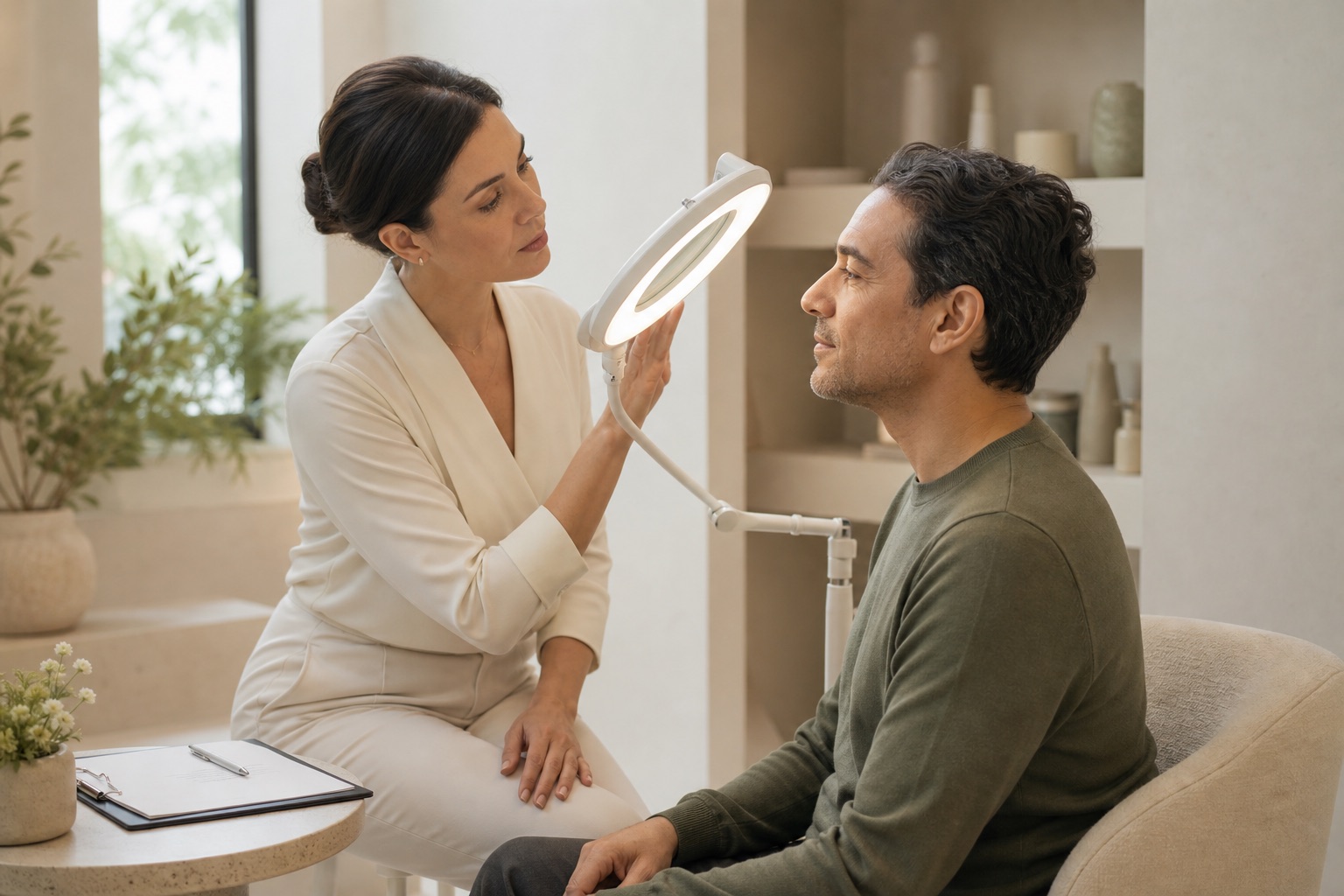
Level one supports information-only consultation: reliable light, mirror, secure questionnaire and record, access to product labels, a clean tray for items brought by the client, written-plan system and protected data storage. It does not need a collection of shared testers. This is intentionally a light kit and should not be staged to resemble a treatment room.
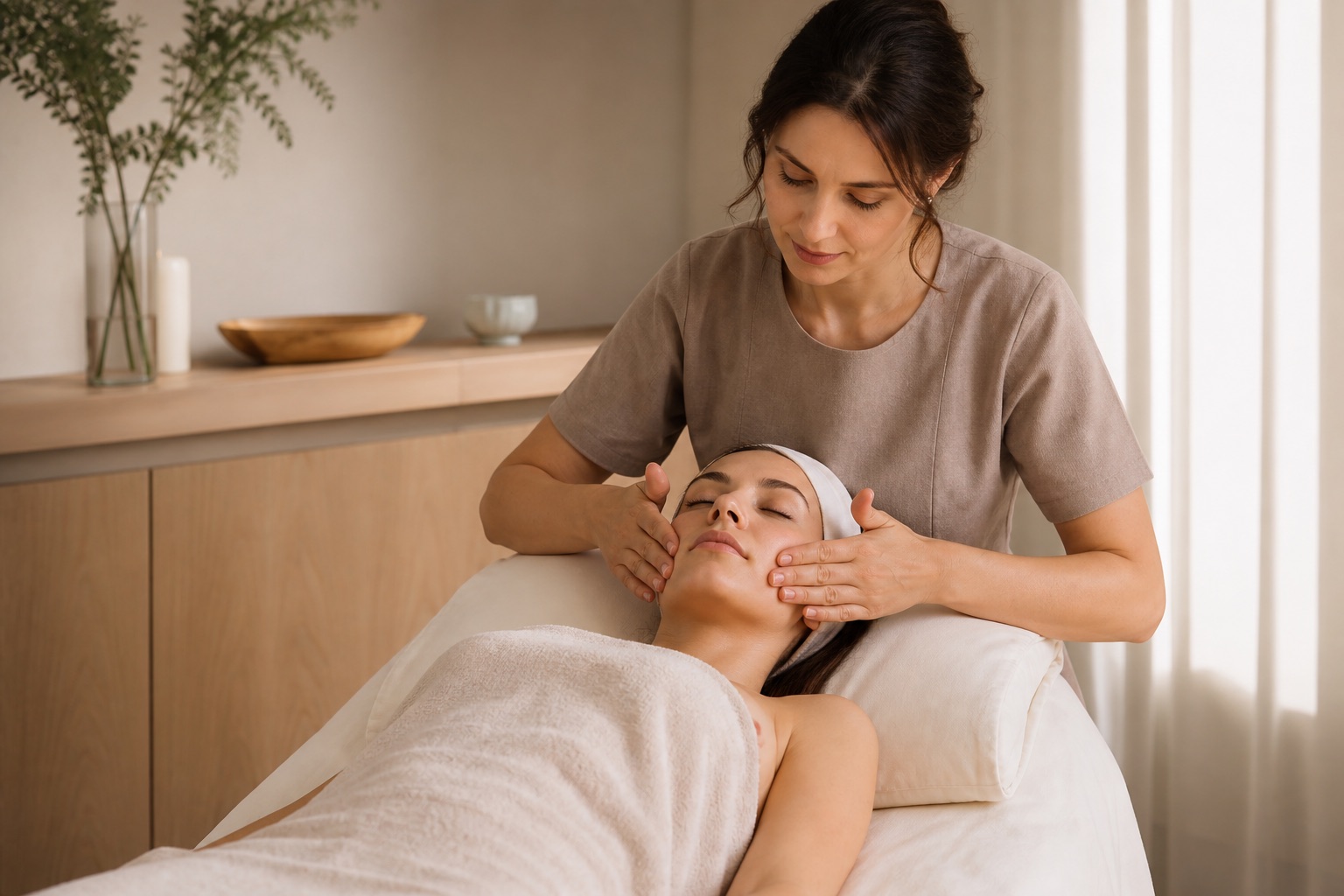
Level two supports an authorised cosmetic manual service: bed, stool, positioning aids, trolley, task light, textiles, bowls, spatulas, compatible brushes, relevant disposables, cleanser and massage medium, timer, storage and clear clean-to-used flow. Every item needs a defined place before and after use. Duplicate reusable tools may be necessary to complete correct reprocessing, not to decorate the trolley.
Level three contains optional equipment. It is not a graduation step and is never required merely to look professional. Each device needs a service rationale, local permission, manufacturer documentation, product conformity where applicable, operator training, maintenance, hygiene, space, insurance and fault procedure. Calculate total cost and realistic use before expected revenue.
Design zones before organising product categories
Divide the workplace into protected reserve, active trolley, client zone, used-item collection, reprocessing and records. Reserve stock stays closed and protected. The trolley carries only the current service. The client area remains clear. Used materials move away without crossing clean stock. Reprocessing has its own containers and workflow. Records do not sit inside the splash or product zone.
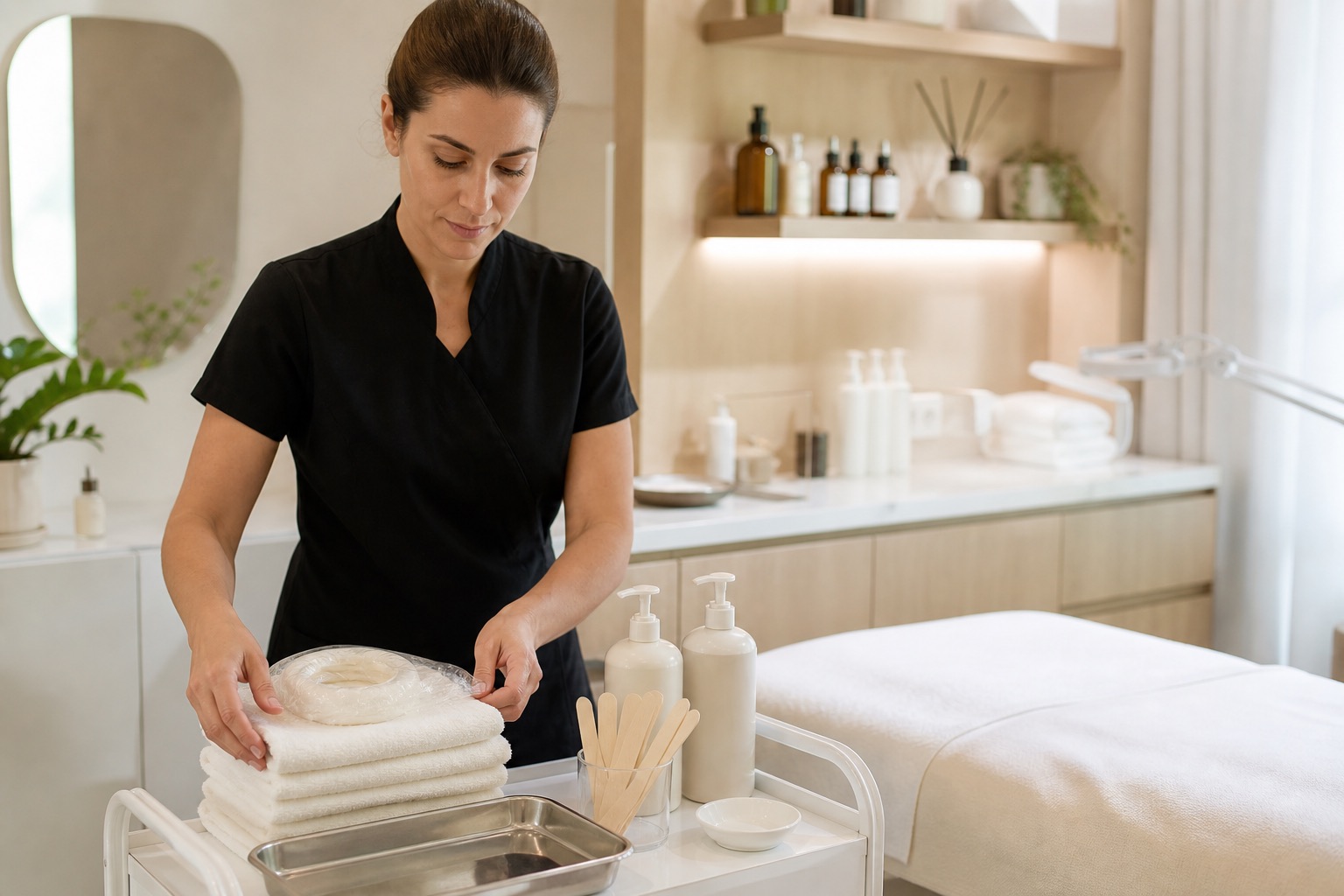
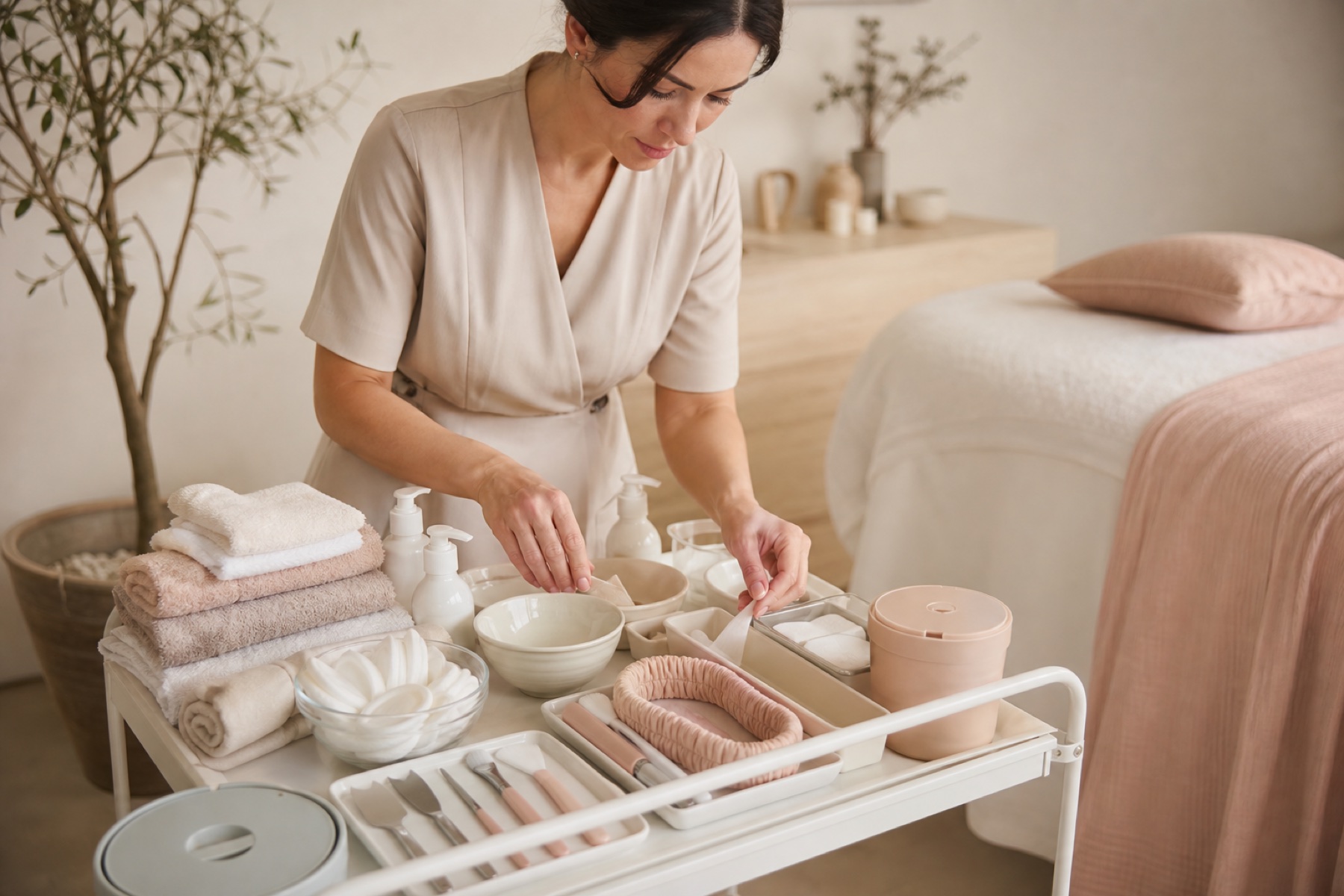
Prepare the single-service kit in order of use rather than moving the entire store beside the bed. Reduce reaching over the client and preserve space for hands. Closed products and protected consumables stay apart from used bowls, textiles and tools. A crowded trolley increases accidental contact, double dipping and forgotten turnover steps.
Photograph the correct setup without client data and use it as a standard. Record starting quantities, position, accepted substitutes and replenishment triggers. Standardisation does not mean treating everyone identically; it makes planned changes visible. Adding a step also changes materials, time, consent, price and reset.
Prioritise the treatment bed, stool, trolley and light
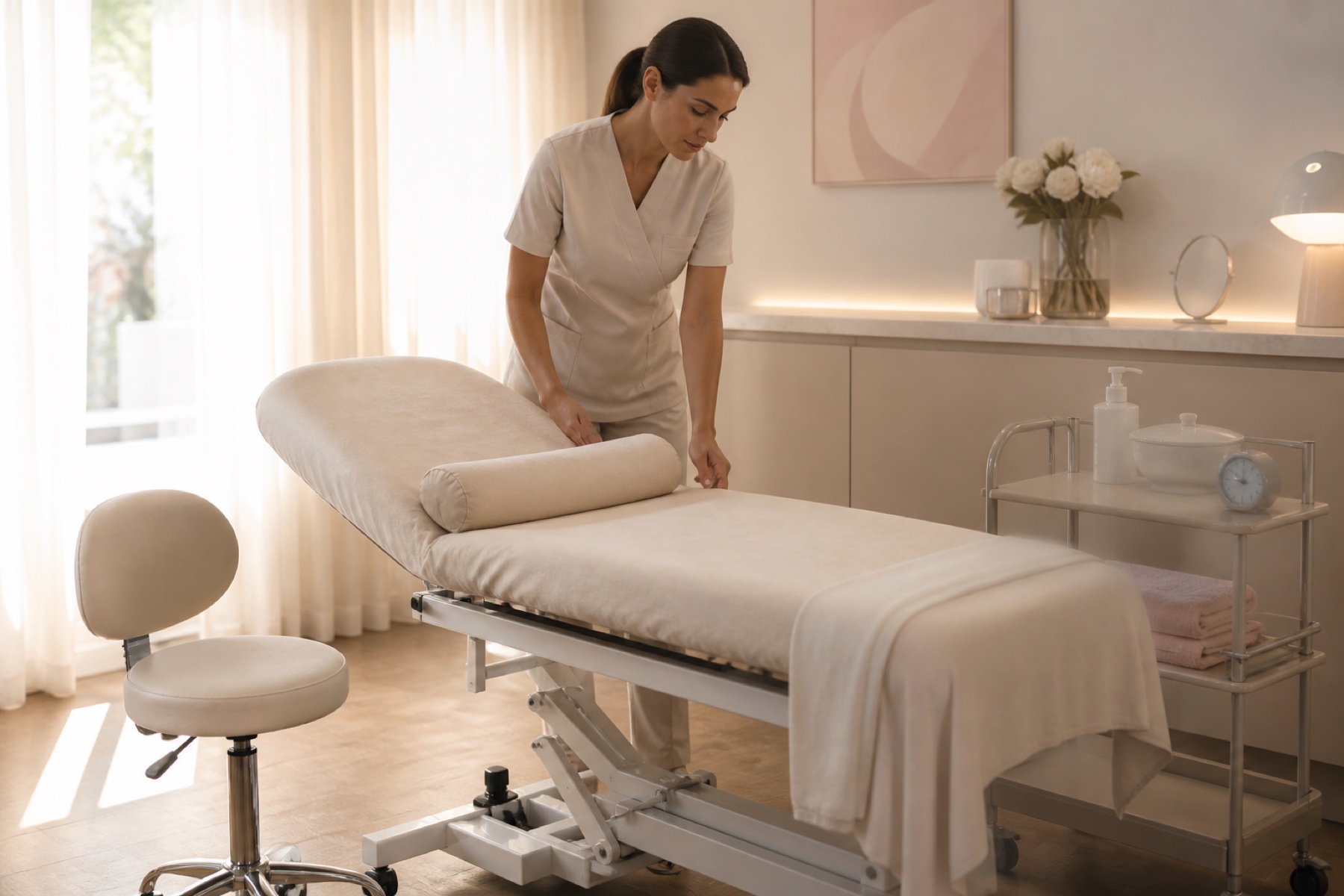
The bed must be stable for its rated load, adjustable enough for the service, compatible with the room and covered by clear instructions, warranty and parts support. Check dimensions, weight, moving mechanisms and cleanability. An overly soft surface reduces stability; fixed height can transfer load to back, shoulders and wrists. Test real working positions rather than sitting beside it for a minute.
The stool should support neutral sitting and close access without twisting. Check height range, base, casters for the floor and cleanable surfaces. Bolsters can support comfort and alignment but must not obstruct breathing, circulation or safe transfer. Plan options for different bodies, mobility and preferences. Accessibility cannot be a late accessory.
Choose a trolley with controlled movement, sufficient shelves and surfaces compatible with the processing method. General and task lighting should be stable and diffuse, reducing shadow without glare. A magnifying light may aid cosmetic observation but does not authorise diagnosis. Keep cords and pedals out of movement paths. A simple timer avoids bringing a personal phone into the active zone.
Calculate the minimum operating quantity of textiles
Count sheets or covers, face towels, headbands, blankets and supports used per service. Multiply by the maximum client number between complete laundry cycles and add a reserve for delay, contamination and damage. If each service uses two towels, one headband and one cover and four clients are booked before laundering, the minimum is not one attractive set but four full sets plus reserve.
Select textiles that tolerate the validated wash and drying process, shed little fibre and remain intact. Uniform colour helps visual inspection but does not prove cleanliness. Separate clean and used routes and do not leave damp textiles compressed in uncontrolled storage. Replace torn, rough, persistently odorous or stained pieces.
Single-use and reusable textiles have different cost, waste, water, energy, transport and processing profiles. Neither is automatically more sustainable. Choose according to risk, local rules and a process you can perform correctly. A disposable layer does not replace surface cleaning; a reusable towel is not sustainable if it cannot be processed and dried safely.
Choose few reusable tools that can be processed reliably
Bowls, spatulas, measures, trays and brushes need a clear function and material compatible with both cosmetics and the intended reprocessing method. Prefer intact, non-porous, simple surfaces without joints that hold residue. Washable does not mean compatible with every chemical, temperature or method. Separate product-retrieval tools from anything that contacts the person.
Dispense with a pump or clean spatula and dedicate the amount to one service. Exposed leftover product never returns to the original package. Inspect brush bristles, handles and ferrules. An expensive tool that cannot be processed reliably is still a poor choice. Purchase enough duplicates for the complete turnaround cycle, using measured appointment volume rather than guesswork.
Stones, rollers and shaped massage tools are optional. They change grip, pressure, skin contact, cleanability and sometimes contraindications. Porous, cracked or chipped materials may be harder to manage than a simple tool. Ask what process outcome the object improves beyond trained hands, how that outcome is controlled, how the item is processed and when it should not be used.
Stock consumables from measured use
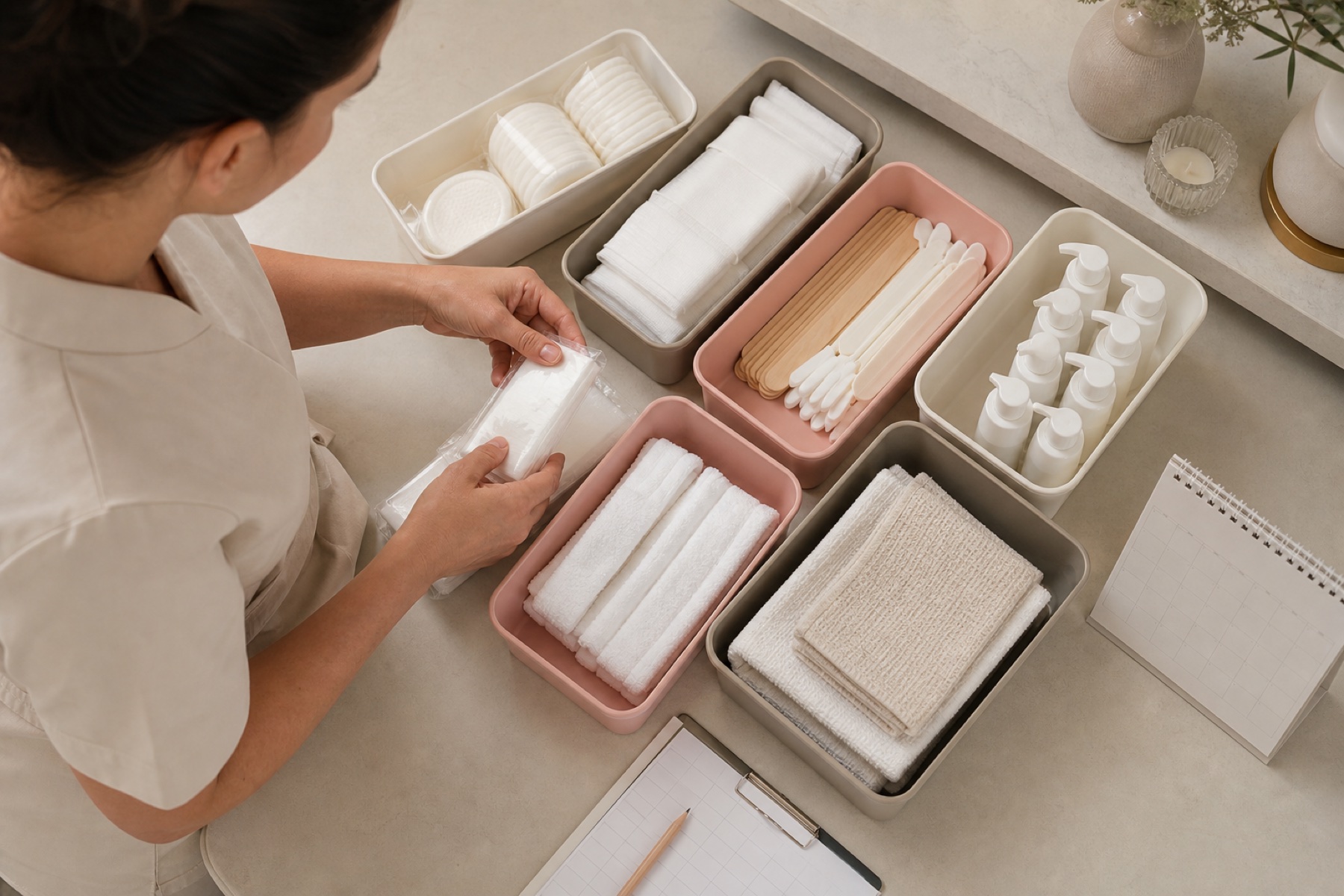
Consumables may include pads, gauze, tissues, single-use spatulas or applicators, protective layers, bags and record materials. The protocol decides the list. Do not buy swabs or disposable brushes just because they appear in a pre-built kit. Record units per service, pack size, supplier lead time, shelf life where relevant, storage and disposal route.
Gloves are not a professional uniform for an entire facial. Their use depends on task, risk assessment, product directions and local requirements. WHO states that gloves do not replace hand hygiene and should not be reused. When indicated, choose the right size and material, inspect them, change between dirty and clean tasks and remove them without spreading contamination.
Set a reorder point: average use during supplier lead time plus a measured safety quantity. Four spatulas per treatment, ten treatments each week, two weeks to delivery and one week of variability suggests 120 spatulas. Recalculate with actual data, pack sizes, seasonal delays and expiry. Safety stock must still fit controlled storage and expected use.
Build a functional professional cosmetic range
Begin with functions rather than trend ingredients: makeup or sunscreen removal and compatible cleansing as explained in the facial-cleansing guide; a suitable massage medium; a finishing moisturiser selected by function using the skin-hydration guide; and daily face sunscreen only when the protocol and product directions support it. Every additional formula should meet a defined need and avoid duplicating existing stock. A smaller range improves product knowledge, rotation and traceability.
Buy through traceable channels, retain packaging and directions, and record batch and opening when useful. Follow temperature, light, period-after-opening and intended-use information. In the EU, the Cosmetics Regulation governs product safety, labelling and responsible-person duties; other markets use their own frameworks. Do not use anonymous decants or raw materials to improvise treatment-room mixtures.
Read formula and directions together. The skincare actives guide explains introduction and combinations, while the damaged skin-barrier guide shows when simplification matters. Layering more products does not prove service value. A professional cosmetic remains a cosmetic, not a treatment for disease.
Protect identity and traceability when dispensing
Pumps and tubes can reduce exposure compared with open jars, but no package corrects contaminated hands, nozzles or spatulas. Do not touch the dispenser to skin or bowl. Close packages promptly, process exterior touch points as instructed and return stock to controlled storage. Use a fresh retrieval method every time an open jar is accessed.
Avoid permanent decanting that loses name, batch, opening period, warnings and directions. A secondary container prepared for one service is not new stock and leftovers are not poured back. Shared testers need a dispensing method compatible with their packaging; if contamination cannot be controlled, do not apply them to a person. Provide intact samples with their information.
If colour, odour, texture, separation or packaging changes, isolate the item and investigate. Smell alone cannot demonstrate safety. Record product, batch, opening, storage and people involved where relevant. Follow the supplier and local adverse-event reporting route instead of attempting to repair a formula.
Select suppliers and verify what arrives
A supplier check includes legal identity, traceable invoice, reliable contact, product labels or instructions, responsible economic operator where required, returns, warranty, parts and technical support. Compare delivered model, batch and documentation with the order before use. Marketplace photographs and reviews cannot replace traceability.
For equipment, obtain the manual, declaration or conformity documents applicable to its market, serial number, maintenance schedule, service route, parts availability and fault process. CE marking is relevant to products covered by EU harmonisation rules but does not mean the EU approved a device, prove treatment efficacy or grant professional permission. Similar distinctions apply to marks in other jurisdictions.
Check official product-safety and recall channels for the market, such as the EU Safety Gate where applicable. Record supplier and purchase data so affected stock can be identified. Extremely low price, missing manufacturer details, altered labels or incompatible plugs and manuals are reasons to stop and verify, not opportunities to experiment on clients.
Calculate total ownership cost before adding equipment
Purchase price is only the start. Add delivery, tax, training, installation, room changes, consumables, water or energy, maintenance, calibration, cleaning time, insurance, software, downtime and end-of-life disposal. Divide the annualised cost by a realistic number of paid uses rather than a fully booked diary. Include the longer turnover or consultation that the device creates.
Define one operational outcome before buying: reduced physical load, more consistent light, improved dispensing control or a permitted service clients already request. Review it after a trial period. If the device mainly makes the room look advanced, delay it and invest in stability, lighting, textiles, documentation and training.
Build a mobile kit around transport and return flow
A mobile kit needs protected original packaging, separate clean, active and used containers, temperature control where required, secure records, a stable working surface and a documented return route. Confirm water, lighting, privacy, waste and emergency arrangements at the destination. If basic controls are unavailable, do not perform the service.
Use an outbound checklist and a return checklist. Count sealed products, protected textiles and processed tools before travel; isolate used and uncertain items immediately afterwards. A wheeled case can improve handling but must itself be cleanable and kept out of the active clean zone. Do not store used textiles or opened cosmetics in a hot vehicle.
Buy in a staged order
Confirm service, permissions, insurance and room requirements.
Stabilise posture, accessibility, lighting and clean-to-used flow.
Buy enough textiles and simple processable tools for full turnover.
Add measured consumables and a small functional cosmetic range.
Test the complete protocol and record actual consumption and time.
Consider optional equipment only after a documented need and cost review.
Keep a replacement reserve for items whose failure stops service, but avoid speculative duplicates. Review stock monthly and remove anything that does not belong to a current protocol. The guide to becoming a skincare consultant helps define the work model before the kit begins to dictate it.
Frequently asked questions
What belongs in an essential professional skincare kit?
For authorised hands-on work: stable bed, supportive stool, trolley, light, positioning aids, sufficient textiles, processable bowls and spatulas, genuinely used consumables, functional cosmetics and separate clean, used, waste and stock systems. The final list comes from the protocol and client volume.
How much does a professional skincare kit cost?
There is no universal total. Information-only consultation, manual treatment and equipment-based services have very different costs. Include furniture, textiles, tools, cosmetics, consumables, maintenance, laundry, utilities, insurance and replacement. Buy in stages and compare total ownership cost.
How do I choose a facial-treatment bed?
Prioritise stability, rated load, adjustment, dimensions, accessibility, cleanability, warranty, parts and fit with your posture and room. Test real movements. A beautiful bed that is unstable, too wide or fixed at the wrong height can create risk and physical strain.
How many towels and headbands are needed?
Multiply the quantity used per service by the maximum clients between complete laundry cycles, then add a reserve for delay and damage. Two towels and one band across four clients means at least eight towels and four bands plus reserve.
Are washable or disposable textiles better?
It depends on risk, local rules, laundering capacity, water, energy, transport, storage and waste. Reusable works only with correct processing; single-use does not replace clean-to-used control. Evaluate the whole cycle rather than price per piece.
Are gloves required for facial massage?
Not universally. Use follows task, risk assessment, product directions and local requirements. Gloves do not replace hand hygiene and disposable gloves are not reused. When indicated, select correct material and size and change between contaminated and clean tasks.
Which bowls and spatulas are suitable?
Choose intact, non-porous simple materials compatible with the cosmetic and processing method. Avoid chipped surfaces and difficult joints. Separate retrieval from application and own enough tools to complete reprocessing without early reuse.
Do I need rollers, gua sha or massage stones?
No. Add one only when it improves a defined permitted step and you can control pressure, limits and processing. Trained hands may remain the main tool. Porous, cracked or difficult-to-clean objects can weaken the protocol.
Which cosmetics should I buy first?
Start with a few functions: removal when needed, cleansing, massage slip, finishing moisturiser and sunscreen only when appropriate. Choose intact traceable packages, clear directions and sizes that rotate before expiry or opening limits. Avoid trend collections and improvised mixtures.
Can professional cosmetics be decanted?
Avoid permanent decants that lose identity, batch, opening period, warnings and directions. A suitable secondary container may hold a one-service portion when the procedure allows, but leftovers do not return to the original and anonymous mixtures are never created for convenience.
How is a consumable reorder point calculated?
Multiply average use by demand during supplier lead time and add safety stock based on real variability. Adjust for pack size, holidays, storage and expiry. Too little stock interrupts service; too much ties up cash and creates waste.
What does FEFO mean?
First expired, first out means using the stock that reaches its relevant expiry first, provided it is intact and correctly stored. It differs from FIFO, which follows arrival order. Record opening where useful and isolate altered or recalled products.
Is CE marking enough reason to buy a beauty device?
No. Where applicable it represents the manufacturer’s conformity declaration, not proof of efficacy, fit for your service or professional authorisation. Verify model, economic operator, manual, documents, training, maintenance, insurance and local permitted use.
Do I need a magnifying lamp?
It may improve visibility but is not essential and does not turn observation into diagnosis. Assess light stability, magnification, heat, reach, cleanability and posture. Diffuse task lighting may be better if a lens creates glare or false certainty.
Is a facial steamer essential?
No. Heat and steam are not universal steps. Before buying, verify professional permission, instructions, water management, maintenance, burn risk, distance, hygiene and a genuine protocol benefit. Do not promise that steam opens pores.
How do I verify a supplier?
Check legal identity, invoice, contact, labels or instructions, responsible operator where relevant, warranty, parts, returns and support. Compare delivered goods with documents and consult official recall systems. Reviews do not replace traceability.
What if a cosmetic changes smell or texture?
Stop using it, isolate the package and check batch, opening, storage, label and supplier advice. Do not attempt to repair the formula. Document affected services where relevant and use the applicable adverse-event route if a reaction occurred.
How do I build a mobile skincare kit?
Carry only the confirmed protocol in separated clean, active and used containers. Protect original packages, textiles, tools and data; verify water, light, privacy and turnover at the venue; use outbound and return checks. Cancel if essential controls are unavailable.
When is optional equipment worth buying?
After identifying a real need, confirming permission and training, and calculating total cost, maintenance, supplies, space and realistic paid uses. Define a success measure in advance. Delay devices bought mainly to make the room look more professional.
How can the kit become more sustainable?
Remove unnecessary steps, measure doses, buy sizes that rotate, use gloves only when indicated, choose durable processable items where suitable and plan stock. Consider laundering, deliveries and waste without weakening safety or traceability.
What should I buy first?
Define the service and flow first. For permitted hands-on work, bed and stool ergonomics, lighting, textiles and clean-to-used separation precede devices. For information-only consultation, invest in method, documentation, light and data protection rather than an unnecessary treatment room.
Authoritative references and next steps
World Health Organization: gloves do not replace hand hygiene. Read the WHO reminder
EUR-Lex: current consolidated EU Cosmetics Regulation where applicable. Read Regulation (EC) No 1223/2009
Your Europe: what CE marking means for products covered by EU rules. Read the official CE-marking overview
European Commission: product safety and Safety Gate for EU recalls. Open the product-safety portal
Browse the English skincare guide library or compare online skincare courses and the current Skincare and Facial Massage Course. Course materials, teacher, price and enrolment status remain on the course page; professional and local requirements must be verified separately.