
Choosing an online skincare course takes more than comparing price, video hours or the word professional. A useful comparison asks what you will be able to explain or perform, who teaches each topic, how clearly demonstrations are filmed, what practice is required, whether anyone reviews your work, how long support lasts and exactly what the final certificate records. This guide turns marketing claims into evidence you can check before paying.
Quick answer: choose the course that connects each important learning outcome to a clear explanation, a readable demonstration, a safe exercise and an assessment or feedback method. Check the curriculum, teacher, entry level, practice, support period, access terms, total cost and certificate wording in advance. A private course can build valuable knowledge and skills, but a completion certificate does not automatically become a government qualification, professional licence or permission to perform regulated services.
This page owns the intent how to choose an online skincare course. It does not build a complete routine or teach individual ingredients. Use the morning and evening skincare routine guide for product order, the cosmetological skin-analysis guide for non-diagnostic observation and the skincare consultation guide for service design. Here the subject is educational quality and fit.
Professional titles, permitted treatments, insurance, workplace standards, consumer rights and qualification systems vary by country and sometimes by region. Verify the rules where you intend to study and work. BeautyLearn course pages describe their current programme and enrolment status; this independent checklist remains useful for comparing any provider.
Start with the outcome you actually need
Learn skincare is too broad to guide a purchase. Write an observable objective instead. You might want to organise a small personal routine, understand cosmetic labels, improve customer conversations in retail, add cosmetic knowledge to an existing beauty qualification or develop a controlled facial-massage service. Each goal requires different depth, supervised practice and professional boundaries. An excellent consumer course may still be unsuitable preparation for working on another person.
Define your starting point just as carefully. A beginner needs vocabulary, skin-type and condition distinctions, routine structure, tolerance and guided product comparison. A qualified beauty professional may need zone-based observation, hygiene, client records, manual technique and follow-up. A retail adviser may need ingredient function, claims literacy and referral boundaries rather than treatment-room skills. If a course says suitable for everyone without explaining different pathways, the fit remains unproven.
Create a one-sentence test: after this course, I need to be able to do X, for Y, within Z boundaries. Use it to remove attractive modules that do not serve the goal. A shorter, coherent course can be a better choice than a huge library assembled for several audiences.
Replace impressive titles with verifiable learning outcomes
Academy, masterclass, specialist and professional can be marketing labels. They do not by themselves explain what a learner can do. Look for action verbs: distinguish skin type from current condition without diagnosing; compare cleanser and moisturiser functions; build a minimal routine; recognise stop signals; prepare a workstation; document an exercise; explain the limits of a cosmetic. Every core verb should have an appropriate way to practise or assess it.
The European Qualifications Framework describes learning outcomes through knowledge, skills, responsibility and autonomy. That framework does not allow a provider to assign an official EQF level to any private course on its own. It is still a helpful reading tool: ask what you will know, what you will perform, under which conditions and with what degree of independence. Vague promises such as learn every secret of skin cannot be checked.
Read the curriculum for sequence, depth and exclusions
A long ingredient list is not a complete curriculum. Look for progression: cosmetic skin structure and functions; skin types and changing conditions; cleansing; hydration and barrier support; sun protection; active ingredients and tolerance; observation; hygiene; communication; client records; practice; stop criteria. The skincare actives guide shows the decision-making depth that a broad actives module should reach. Each unit should show its level, approximate workload, materials, learning activity and relationship to the next unit. Jumping straight to acids and retinoids can teach lists before decisions.
Check depth rather than topic count. Acne, rosacea or pigmentation in a contents list may represent five minutes of generic advice. Cosmetic education should explain what supportive care can and cannot do and when medical assessment is appropriate. Compare the claims with the guides on acne-prone skin, sensitive and sensitised skin and facial dark spots. Responsible teaching defines limits instead of offering universal protocols.
Ask what is deliberately excluded. A clear course may state that it does not cover diagnosis, prescriptions, invasive procedures, medical treatment, laboratory formulation or a professional licence. Exclusions make the educational promise more trustworthy. A course that claims to take a beginner from skincare to dermatology without distinguishing professions and protected activities needs careful scrutiny.
Twelve curriculum checks before enrolment
The audience, starting level and concrete prerequisites are stated.
Learning outcomes describe observable actions, not only topics.
Routine, barrier and tolerance foundations precede advanced actives.
Theory, demonstration, exercise and assessment are mapped where relevant.
Contraindications, out-of-scope cases and stop criteria are explicit.
Hygiene, consent, photography and data handling are not footnotes.
Materials are separated into included, required, optional and replaceable.
Video length, self-study, practice and calendar time are distinguished.
Feedback format, number of submissions and response times are visible.
The certificate states participation, completion or assessed achievement accurately.
Access duration, captions, devices, updates and technical support are specified.
Total price, digital-content terms, cancellations and restrictions appear before payment.
Evaluate the teacher, not the follower count

A useful biography identifies the teacher, relevant education, current professional role, practical experience and the subjects they actually teach. Formulation modules need evidence literacy; hands-on modules need technical practice, hygiene and safety; consultation modules need communication, documentation and scope control. A polished feed and a large audience prove none of these things on their own.
Teaching ability is a separate skill. Does the educator break down a decision, show quantity, pressure and angle, explain alternatives and distinguish evidence from preference? Do they correct realistic mistakes and explain when not to proceed? Strong instruction makes reasoning visible rather than presenting only the final result.
Read reviews for specific evidence: clear explanations, useful exercises, feedback quality, technical support and realistic progress. Ask who answers academic questions: the named teacher, a qualified tutor or customer support. Student work should have context and permission; a gallery of exceptional results does not show the experience of a typical learner.
Use a sample lesson as a quality test
In fifteen minutes you can inspect voice, pacing, camera, lighting and method. Is the objective stated? Are technical terms defined? Can you see texture, amount and hand position? Does lighting preserve skin colour? Does the teacher explain why a step changes? Are variations, uncertainty and medical referral acknowledged? A fast promotional montage is not a sample lesson.
For theory, look for current sources and proportionate claims. For practice, watch hand hygiene, product dispensing, client contact, sequence and reset. If observation or consultation is included, the teacher must not turn a photograph into a diagnosis. A convincing lesson can show a mistake, explain why it matters and demonstrate a safer correction.
Online practice must include a complete learning loop
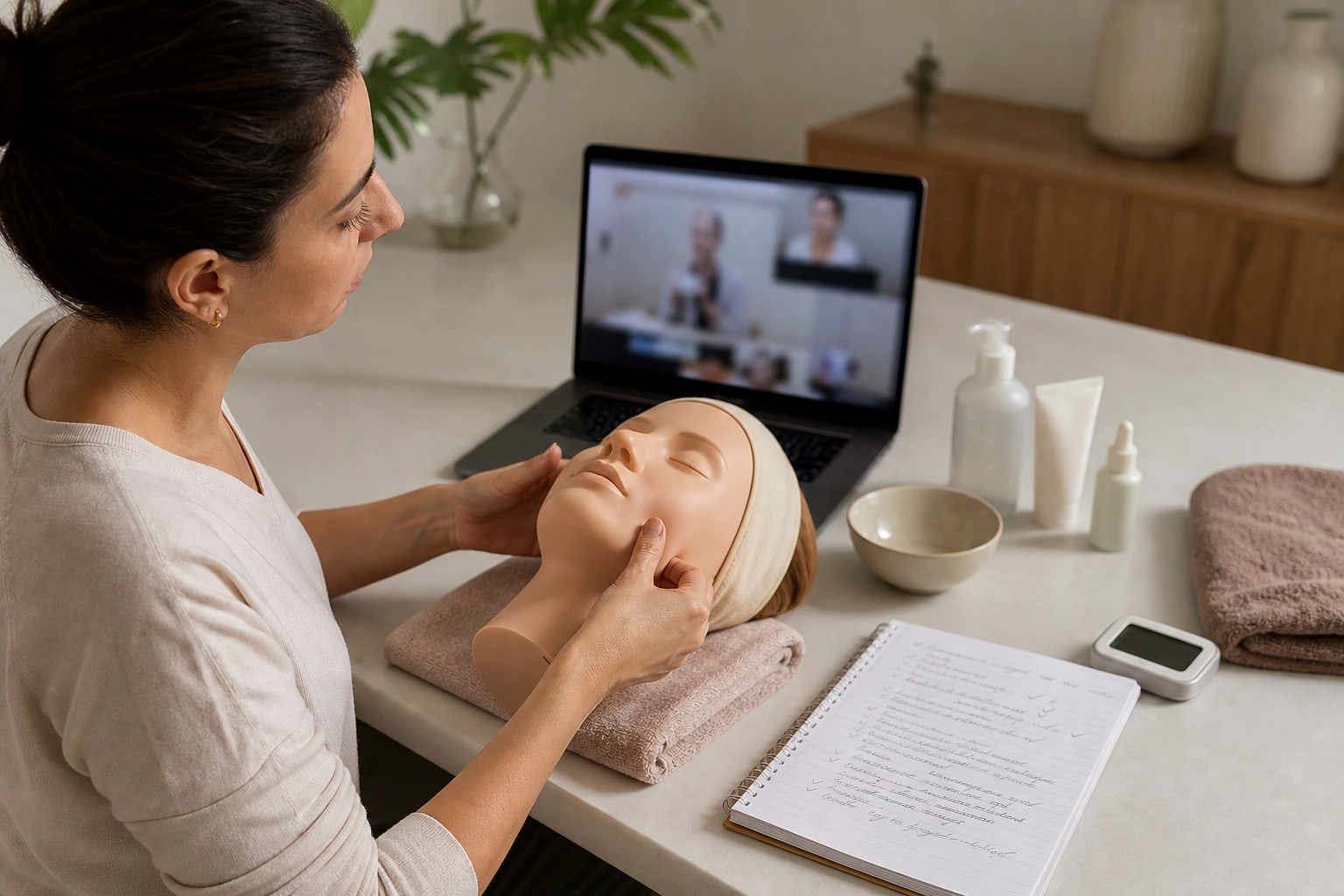
Watching is not practising. A useful assignment defines objective, materials, subject, time, safety conditions and assessment criteria. An early exercise might audit a personal routine; a later one could compare textures, complete a fictional record or rehearse a manual sequence on a training support before involving another person. Every task must remain inside the learner’s competence and local permissions.
Ask how many assignments are required and how many receive individual review. Ten units with practice, feedback and resubmission may teach more than a hundred passive videos. Check the evidence format: consistent photographs, short videos, anonymised records or quizzes. When models or clients appear, consent, privacy, hygiene and stop criteria must be built into the task.
For hands-on depth, compare the curriculum with the cosmetic facial-massage guide and the skincare workstation-hygiene guide. Responsible practice includes preparation, execution, observation, closure and reset rather than an isolated central technique.
Feedback should lead to a better second attempt
Good job and practise more are not enough. Useful feedback identifies visible evidence, proposes the likely cause, gives a specific action and asks for another attempt. For example, pressure cannot be assessed because the frame cuts off the wrists; repeat from the side and show support, speed and thirty seconds per zone. Or three actives were introduced together; return to a stable base and document one variable.
Before enrolling, ask who marks work, how many submissions are included, the expected response time, whether clarification is possible and whether the revised attempt is reviewed. Video access for twelve months does not necessarily mean tutor support for twelve months. Group feedback can help with recurring errors, but it does not replace individual assessment of practical work.
Materials and kits: separate necessary from persuasive
Request the list before buying. Separate learning materials, cosmetics, textiles, disposables, tools and devices. For each item check quantity, cost, replenishment and acceptable alternatives. A large kit raises perceived value but does not guarantee learning; a tiny kit can conceal later costs. The course should teach selection criteria and function rather than force one brand without a clear educational reason.
Personal-routine exercises may use a few suitable products already owned. Manual work needs safe support, slip product, textiles and a controlled station. Consultation practice needs records and cases rather than a warehouse. Check delivery markets, substitutions, intended use, period after opening and storage. Any commercial relationship between the provider and kit brand should be transparent.
Safety and professional scope belong in the core curriculum
Skincare education sits close to health conditions and sometimes regulated services. A responsible course separates cosmetic observation, general information, beauty treatment and healthcare. It does not teach learners to diagnose acne, rosacea, dermatitis or allergy, present cosmetics as treatment, alter medication or guarantee outcomes. It should cover skin integrity, relevant recent procedures, important symptoms, reactions, referral and documentation.
There is no single worldwide rule that a private online certificate overrides. Check the exact service, protected title, training requirement, licence or registration, premises rules, insurance and permitted equipment in the country and region where you plan to work. If the provider sells internationally, it should avoid implying that one certificate grants identical rights everywhere.
The client-record guide, workstation hygiene and professional skin-analysis boundaries are useful quality checks. If a career-focused programme omits them, ask exactly where consent, privacy, contamination control and stop decisions are taught.
Understand what the certificate actually records
Certificate alone is not a value statement. It may document attendance, completed lessons, a passed knowledge quiz or assessed practical work. Ask for the exact wording, issuing body, identity checks, assessment requirements, retake policy and skills listed. Automatic issue after video playback records something different from a rubric-based assessment with correction and resubmission.
Recognised, accredited, certified and valid need a complement: recognised by whom, for what purpose, in which system and under which authority? A private association or industry partner may offer useful standards, but its badge does not automatically create public recognition. Verify any claimed framework level or regulated status in the official register or competent authority for the relevant country.
Evaluate the certificate after the curriculum. Its practical meaning is clearer when it accurately records outcomes, workload, assessment and issuer. Employers and clients may also value a documented portfolio, a live demonstration, experience and responsible scope more than an ambiguous title.
Check access, accessibility, updates and support
Online access should become a list of facts: start date, duration, devices, browser or app, video quality, playback speed, downloads, learning materials, lesson tracking, live-session recordings and expiry. Separate access to content from access to tutoring. Ask what remains available after completion and what happens if the platform or a lesson changes.
Check accurate captions, readable documents, keyboard navigation, visual contrast and a way to slow or pause video. W3C guidance explains why captions and transcripts serve different access needs. For practical demonstrations, spoken instructions alone may be insufficient if hand position, quantity or colour carries meaning. Ask for technical-support contact details, response expectations and the procedure for service interruption.
Calculate total cost rather than the smallest instalment
Add tuition, tax where applicable, kit, delivery, replenishment products, models, extra tutoring, assessment, certificate, renewed access, optional live sessions and travel for any in-person day. Add time for lessons, reading, setup, recording, practice and resubmission. A more expensive course can offer better value when it includes meaningful feedback; a lower-cost course can be right when the goal is honestly introductory.
Treat recurring countdowns, endlessly renewed discounts, nearly full claims with no capacity-limited element and automatic income promises cautiously. Verify seller identity, currency, payment schedule, interest, suspension, invoice or receipt and refund terms. Price does not prove quality, but transparent pricing is evidence of clear pre-contract information.
Read digital-content and cancellation terms before activation
Before paying, save the course description and read seller details, main features, total price, access period, technical requirements, support, complaint route and governing terms. Cancellation rights for online learning differ by jurisdiction and can change once digital performance begins with the required consent. Do not assume either that a refund is always available or that a provider can exclude every remedy. Check the law and procedure that apply to the sale.
Distinguish a change of mind from faulty, unavailable or misdescribed digital content. Keep the order, receipt, course description, terms and correspondence. If an important promise appears only in disappearing social content, request confirmation in a durable form. This page offers a comparison method, not legal advice.
Recorded, live or blended: judge the learning cycle
Recorded lessons allow pausing and repetition but need a separate feedback system. Live classes allow questions and contextual demonstrations but depend on schedule, connection and class size. Blended learning can combine both when the parts are integrated. The decisive feature is the loop between preparation, explanation, demonstration, exercise, feedback and a new attempt, not the delivery label.
Hands-on and observation courses need stronger evidence than a purely theoretical introduction. Camera, light and angle must make skin and movement readable without pretending that a screen replaces every in-person assessment. For classroom days, confirm location, station numbers, models, materials, insurance, make-up sessions and extra costs. For asynchronous study, build a realistic schedule before buying.
Look for content dates, versions and corrections
Product regulation, ingredient restrictions, professional rules and evidence change. Ask when the course was last reviewed, who reviewed it and how corrections are communicated. A recent recording can still contain absolute claims; an older lesson can remain sound when it teaches stable principles and identifies items that require current verification. Version notes and a correction channel are stronger signals than a stream of bonuses.
Check modules on sunscreens, retinoids, claims, professional scope, privacy and hygiene particularly carefully. The course should distinguish recording date from review date and explain whether updates replace or supplement existing lessons. Major safety corrections should be easy for enrolled learners to find.
Score evidence, then apply non-negotiable gates
Give zero, one or two points to ten areas: outcomes, curriculum, teacher, sample lesson, practice, feedback, safety, certificate, access and purchase terms. Zero means absent; one means generic; two means specific and verifiable. Do not follow the total mechanically. Curriculum integrity and safety are gates: if either scores zero, request evidence before allowing attractive extras to compensate.
Two points for curriculum require outcomes, sequence, activities and boundaries. Two for practice require assignments, review and a second attempt. Two for the certificate require exact wording and assessment information. Two for terms require total price, access, cancellation route and support. Write down the evidence source so two courses can be compared on the same basis.
When you are ready to inspect the current offer, browse the online skincare course category and the Skincare and Facial Massage Course. The course page is the source of truth for its current curriculum, teacher, price, access and enrolment status.
Red flags before you buy
It promises diagnosis, treatment, guaranteed results or replacement of a dermatologist.
It claims a recognised certificate without naming the authority, purpose and verifiable record.
The teacher, seller, curriculum, costs or access terms are hidden until payment.
It counts videos, ingredients and bonuses but shows no assignments or assessment criteria.
Advanced procedures appear without hygiene, contraindications, stop rules or local scope.
One brand is compulsory without alternatives or disclosure of the commercial relationship.
The certificate is marketed as an automatic route to clients or guaranteed income.
Questions about feedback, privacy, cancellation or service failures are discouraged.
Frequently asked questions
What is the best online skincare course?
There is no best course for everyone. The right one matches your goal, starting level and permitted activity, with clear outcomes, a coherent curriculum, an appropriate teacher, proportionate practice, real feedback, transparent terms and accurate certificate wording.
Can a complete beginner study skincare online?
Yes, when the course defines basic terms, begins with routine and barrier foundations, gives simple exercises and does not assume professional experience. Check entry requirements and a sample lesson. Suitable for all is not evidence of a supported beginner pathway.
How many hours should a good skincare course take?
Hours alone do not measure depth. Separate video time, reading, exercises, feedback and resubmission. A focused module may be short and complete; a professional pathway needs more application. Ask which outcomes are assessed and what realistic workload they require.
How do I check whether the teacher is qualified?
Look for identity, relevant education, current role, experience in the exact topic, continuing development and teaching method. Verify public registers or awarding bodies where applicable and watch a sample lesson. Followers and polished images are not substitutes.
Do I need a free lesson before buying?
The entire course need not be free, but a real extract is valuable evidence. It should show language, framing, reasoning, technique, hygiene and boundaries. Without one, request a detailed description of an actual unit and its feedback method.
Can facial massage be learned entirely online?
Online teaching can explain sequence and support documented practice, but manual skill needs repetition, correction and adaptation. Look for multiple camera angles, safe exercises, individual feedback and any appropriate in-person component. Local professional requirements still apply.
How many practical assignments should be included?
There is no universal number. Each central skill needs a suitable task, and important manual or decision-making skills should normally receive feedback and a chance to repeat. Ask for the number of individually reviewed submissions, not just total quizzes.
Is group feedback enough?
It helps explain common errors but may not assess your execution. Practical skills benefit from at least some individual review. Check privacy, permission to share work, tutor qualifications, response time and whether a corrected attempt can be submitted.
Does the kit have to be included?
No. What matters is advance disclosure of items, quantities, costs and alternatives. An included kit can simplify setup; compatible alternatives can reduce waste. Be cautious about oversized kits used as the main sales argument and compulsory costs revealed later.
Is an online skincare certificate valid?
It is meaningful for what it truthfully documents: attendance, completion or assessed learning. It does not automatically equal a public qualification, healthcare licence or permission to perform a regulated service. Verify the issuer, assessment and local purpose.
What does accredited or recognised mean?
The claim is incomplete without naming who recognises it, for which purpose, in which country and under which standard or decision. Check the named authority or register directly. A private badge may have industry value without carrying public status.
Can the course qualify me to work as a beauty therapist?
Not automatically. Requirements vary widely and may involve approved qualifications, examinations, licences, insurance or premises rules. A private online course can teach or update skills, but you must verify the exact service and local professional framework before working with clients.
Can I offer skincare consultations after the course?
That depends on the service content, your prior credentials, local law, insurance, privacy process and claims. Cosmetic information is not diagnosis or treatment. Training evidence does not remove the need to define scope, refer appropriately and meet business requirements.
Is a course more complete if it covers acne and pigmentation?
Only when it separates cosmetic support, limits and referral. Naming many conditions does not prove depth and becomes unsafe when paired with cure claims. Look for sun protection, tolerance, a stable routine and medically appropriate stop criteria.
Are recorded or live lessons better?
Recorded lessons support repetition; live sessions support immediate questions; blended formats can connect both. Judge the complete learning cycle and check recordings, absence policy, deadlines, class size and the duration of tutor access.
How long should course access last?
Long enough to study, practise, receive feedback and repeat without rushing. There is no universal period. Compare video access with tutor access, which may differ, and verify renewal costs and what remains downloadable after expiry.
Can I cancel or get a refund for an online course?
It depends on the contract, jurisdiction and whether digital delivery has begun under the required consent. Read the terms before activation, save the offer and distinguish a change of mind from non-conforming or unavailable content. Seek local consumer guidance for a dispute.
How do I compare two very different prices?
Add tuition, kit, shipping, replenishment, assessment, certificate, tutoring, renewal and practice time. Then compare outcomes, reviewed work, safety and access. Low price does not mean poor quality and high price does not guarantee it; evidence decides.
Are reviews enough to choose a course?
No. Use them as one signal and look for specifics about explanations, assignments, feedback and support. Verify the curriculum, teacher, sample lesson, terms and certificate directly. Selected testimonials often describe enthusiasm rather than long-term learning.
What should I ask before paying?
Ask about outcomes, prerequisites, curriculum, teacher, sample lesson, assignments, feedback, kit, access, accessibility, support, updates, total price, certificate, cancellation, privacy and professional limits. Request written confirmation of any point essential to your decision.
Authoritative references and next steps
Europass: the European Qualifications Framework and its learning-outcome descriptors. Read the official EQF overview
Europass: guidance for writing short, observable descriptions of learning outcomes. Read the learning-outcome guidance
European Commission: Consumer Rights Directive overview, including online digital content. Read the Commission overview
W3C Web Accessibility Initiative: captions, transcripts, descriptions and accessible media players. Read the media accessibility guide
Explore the full English skincare guide library to test the technical coherence of a curriculum. When you are ready to compare current programmes, visit the online skincare courses. Keep this checklist beside each course page and score what can be verified rather than what is merely promised.
If you want to turn this knowledge into a defined service, continue with the guide to becoming a skincare consultant: it connects training, demonstrable skills, portfolio, boundaries, work models and a controlled launch without confusing cosmetic consultation, beauty treatment and healthcare.
Turn the protocol into a proportionate inventory with the professional skincare and facial-massage kit guide: it sizes furniture, textiles, tools, consumables, cosmetics, stock and optional equipment to the real service instead of building an unnecessarily complex trolley.