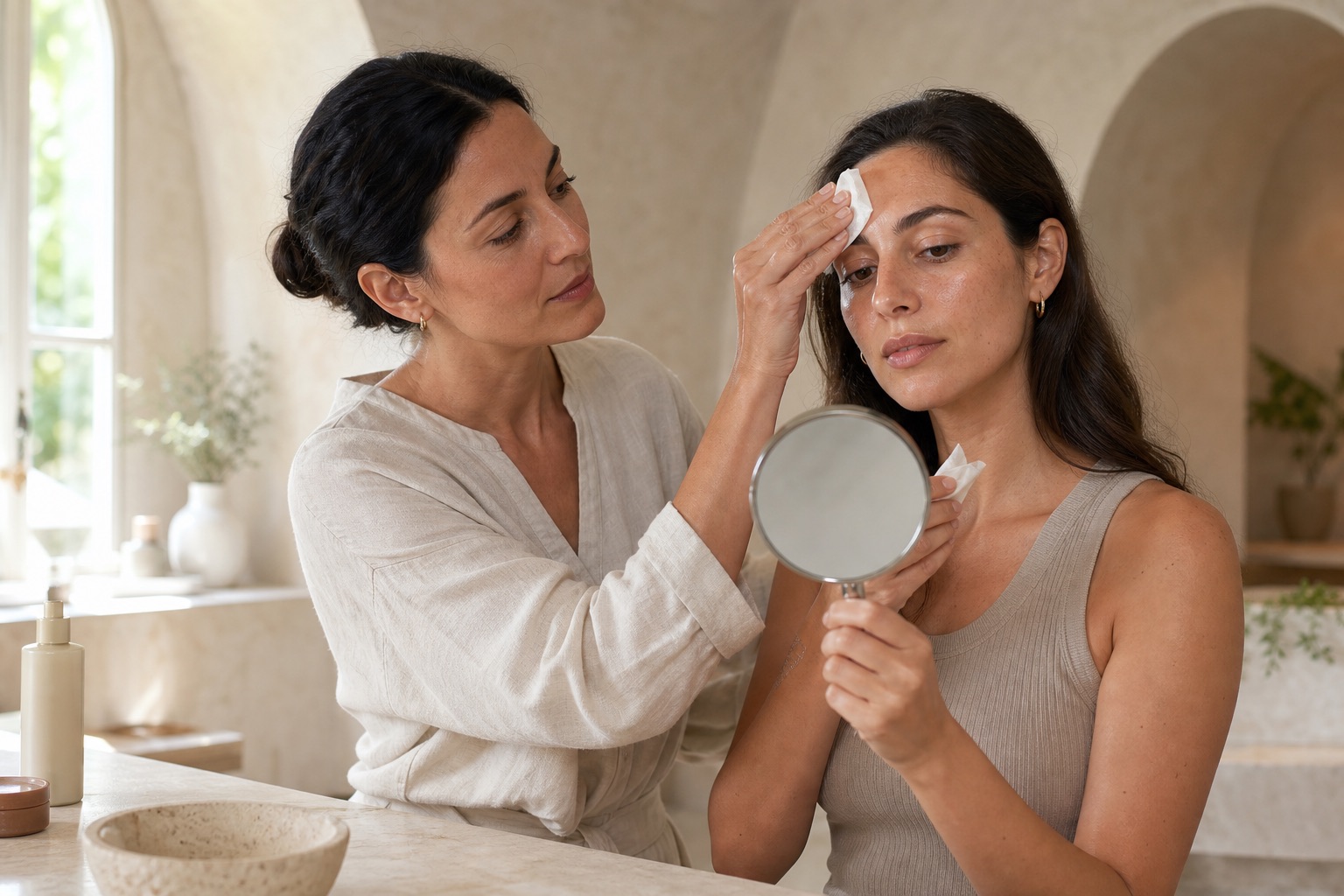

‘Damaged skin barrier’ is an informal phrase used online for a cluster of signs such as burning, tightness, roughness, flaking and unusual reactivity after product overload or irritation. Those signs are not specific: eczema, contact dermatitis, rosacea, allergy, infection and other conditions can look or feel similar. Cosmetic simplification can reduce avoidable exposure, but it cannot diagnose the cause.
Quick answer: stop newly introduced or clearly irritating products, pause non-essential actives and exfoliation, cleanse only as much as needed, use a simple tolerated moisturiser and maintain suitable sun protection. Do not set a universal seven-day repair deadline. Marked swelling, blisters, discharge, severe pain, eye or lip involvement, breathing difficulty or persistent worsening needs prompt professional assessment; breathing difficulty is an emergency.
This guide focuses on cosmetic overload, irritation risk and a minimal routine. It does not diagnose a disease or replace medical treatment. The skin hydration guide explains moisturiser functions, while the skincare routine order guide covers the stable everyday sequence. Here the priority is reducing variables and knowing when to stop.
What people mean by a compromised skin barrier
The outer skin barrier is centred on the stratum corneum: corneocytes embedded in an organised lipid matrix, supported by natural moisturising factors, enzymes and an acidic surface environment. It limits excessive water loss and helps restrict the entry of irritants and microorganisms. Cleansing, climate, friction, inflammation and treatments can temporarily alter its function.
A barrier is not simply ‘good’ or ‘broken’. Function changes along a continuum, and sensations may appear before obvious visual change. Cosmetic language cannot establish transepidermal water loss, lipid organisation or a clinical diagnosis from a selfie. Use the phrase as a prompt to simplify and observe, not as a medical conclusion.
A moisturiser can support hydration, comfort and surface barrier function. It cannot prove why a rash appeared or treat every inflammatory disease. If you have an existing diagnosis or prescription, follow that plan rather than replacing it with a social-media ‘barrier reset’.
Observable signs — without diagnosing the cause
Record what you can actually observe and feel: new tightness, roughness, fine scaling, stinging with previously tolerated products, burning after cleansing, redness, itch, or a sudden change in how makeup sits. Note the area, timing, intensity and what changed beforehand.
Timing: minutes, hours or days after a new product, increased frequency, procedure, weather change or illness.
Distribution: one application area, eye contour, folds, the entire face or exposed areas only.
Sensation: tightness, sting, heat, itch or pain, with a simple severity score and duration.
Visible change: roughness, flakes, redness, swelling, cracks, blisters, crusting or discharge.
The same sign can have several explanations. Tightness can follow harsh cleansing; burning can reflect irritant contact; itch may occur with allergy or eczema; redness can accompany rosacea, friction, heat or inflammation. Documentation narrows the history but does not replace examination and testing.
Why symptoms do not identify the cause
Irritant contact reactions can result from cumulative exposure without a specific allergy. Allergic contact dermatitis involves an immune response and may require professional patch testing. Rosacea, atopic dermatitis, acne treatment irritation and infection can overlap visually. Even a product used for months may become relevant after reformulation, increased frequency or a change in the skin.
Do not diagnose from the location alone and do not identify an ingredient simply because it is fashionable to blame. An INCI list shows what is declared, not the exact exposure, impurity profile, individual allergy or interaction with every other product. Preserve packaging and batch details if a clinician may need the history.
Cosmetic overload: too many products, too many variables
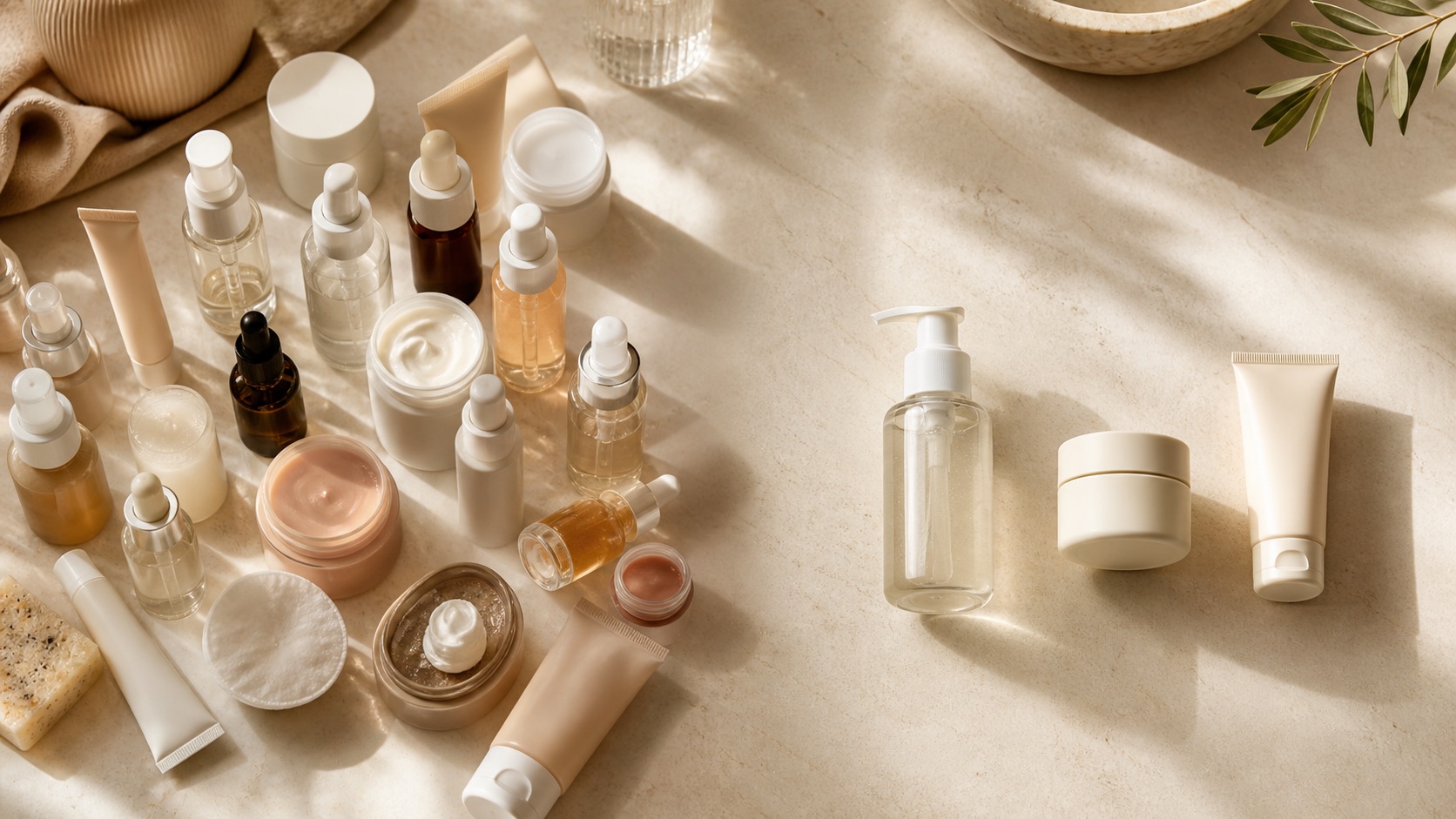
A crowded routine makes both tolerance and troubleshooting harder. Several acids, a retinoid, vitamin C, fragranced masks, cleansing tools and spot treatments may each be usable in isolation, yet the combined frequency and surface exposure can exceed what the skin tolerates. When several new products start together, there is no clean signal about which one mattered.
Simplification does not mean every removed product was harmful. It is an observation strategy: reduce non-essential variables, allow symptoms to settle and rebuild only when the pattern is clear. Keep prescribed treatments unless the prescriber advises otherwise or an urgent reaction requires immediate care.
Skincare mistakes that can increase irritation
Starting several active products at once or increasing frequency before tolerance is established.
Stacking leave-on acids, retinoids, scrubs and cleansing brushes across the same week or evening.
Using very hot water, rough cloths, long massages or repeated cleansing to chase a stripped feeling.
Continuing a product through significant burning because irritation is mistaken for efficacy or ‘purging’.
Covering each new symptom with another serum, balm or essential oil instead of reducing the exposure.
Copying a schedule designed for somebody with different skin, climate, medication and treatment history.
Cleansing, water, friction and frequency
Cleansers remove unwanted material but also increase contact between surfactants and the stratum corneum. A mild formula used briefly with lukewarm water and fingertips is different from the same product used three times, under hot water and with a rough cloth. Total exposure matters.
During a reactive period, cleanse only when and where necessary. One suitable cleanser may remove the day’s load; two stages are not a virtue if the first is enough. The double cleansing guide explains how to match the method to makeup and sunscreen without making two washes automatic.
Do not switch to plain water as a universal solution. Water may not remove resistant films and frequent water exposure can still affect comfort. Choose the minimum effective method for the actual residue and follow medical directions when the skin is inflamed or treated.
Acids, retinoids and exfoliating combinations
AHA, BHA, PHA, retinoids, benzoyl peroxide and other treatments can be useful in the right context but also increase irritation, especially when frequency rises quickly or several are layered. A product’s normal adjustment period is not permission to ignore marked pain, swelling, blistering or persistent inflammation.
If the product is a cosmetic and was self-selected, pausing a non-essential irritant while you simplify is often reasonable. If it is prescribed, contact the prescriber for guidance rather than silently changing dose or schedule. Pregnancy, breastfeeding, medical procedures and active skin disease add reasons for professional advice.
Do not neutralise an acid with household bicarbonate, scrub away retinoid flaking or apply essential oils to ‘heal’ the barrier. Rinse an acute accidental exposure as directed, stop the relevant product and seek help according to severity.
A minimal routine: cleanse, moisturise and protect
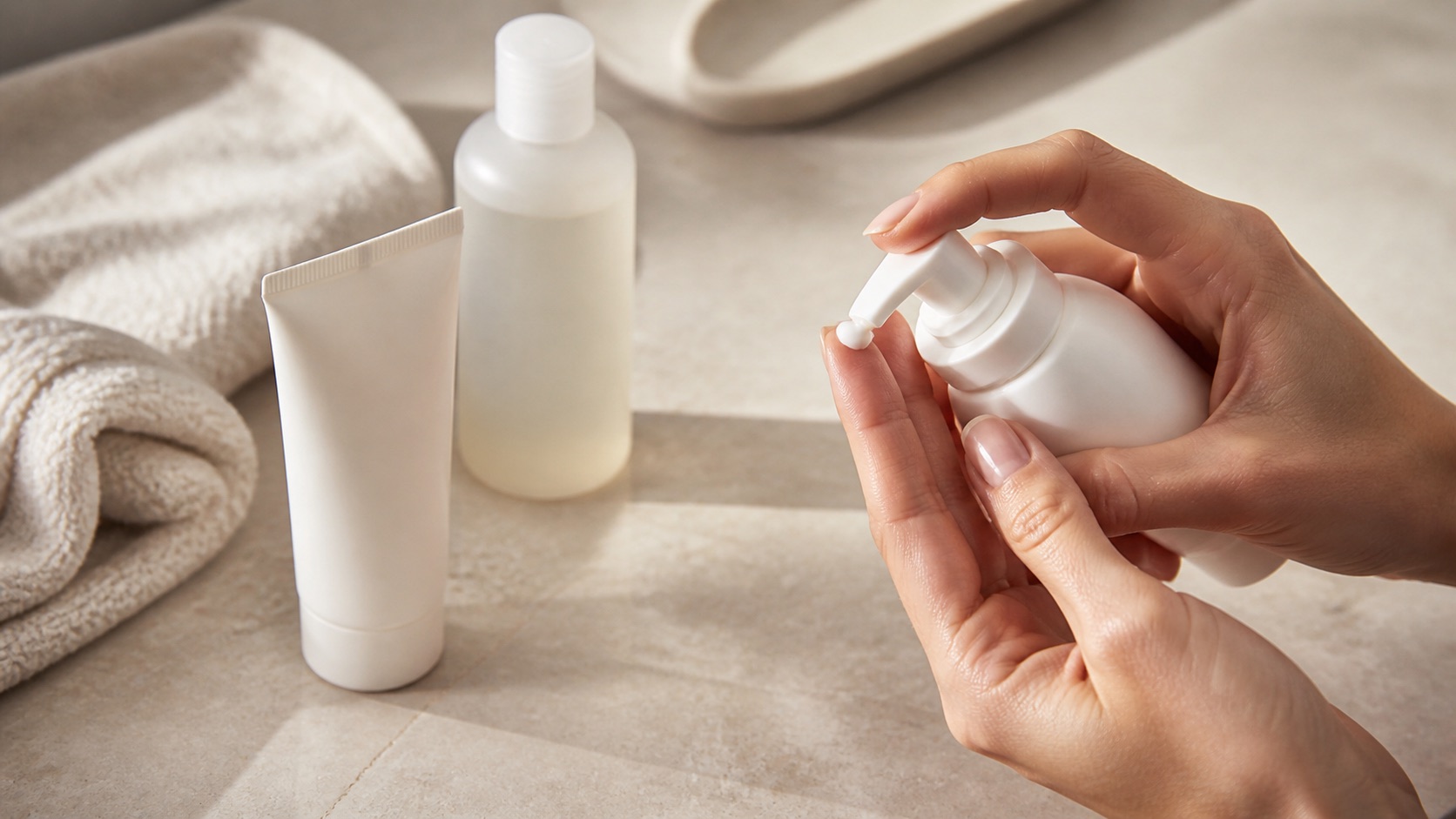
A minimal routine is a temporary, readable baseline, not a branded protocol. It retains only necessary, previously tolerated functions: gentle removal of residue, a simple moisturiser that improves comfort and suitable sun protection for exposed skin. Skip optional toner, masks, scrubs, multiple serums and fragranced experiments while the pattern is unclear.
Morning: rinse or cleanse only as needed, use a tolerated moisturiser if required and finish with an adequate broad-spectrum sunscreen.
Evening: remove makeup and sunscreen with the least irritating effective method, cleanse if needed and apply the tolerated moisturiser.
Avoid: new actives, exfoliation, scrubs, brushes, essential oils and repeated ‘testing’ on already reactive skin.
A moisturiser can combine humectants, emollients and occlusives. Ceramides may be useful but are not mandatory for every person. Petrolatum can reduce water loss on selected areas but is not a universal treatment and should not be used to conceal a suspected infection or severe undiagnosed rash.
How to pause products without confusing the history
Write down everything used during the previous two weeks, including cleanser, makeup remover, sunscreen, hair products near the face, prescribed topicals, masks and professional treatments. Mark what was new, what increased in frequency and what was applied directly to the affected area.
Stop the newest non-essential cosmetics first and remove duplicate actives. Do not throw away packaging or ingredient lists. Keep the stable baseline small. If symptoms are severe or rapidly worsening, skip self-directed troubleshooting and obtain help; a neat spreadsheet is not more important than timely care.
Do not stop prescription medicine without speaking to the prescriber unless emergency guidance requires immediate discontinuation. The same applies to post-procedure care: follow the clinician or qualified practitioner who performed the treatment rather than a generic barrier routine.
A cosmetic diary: timing, zones and exposure
A short diary can reveal whether the pattern follows a specific evening, area or combination. Record the product, batch where relevant, amount, frequency, application zone, preceding cleanser, sensations and visible signs. Photograph only in consistent neutral light without beauty filters.
Use descriptive language: ‘burning around the mouth ten minutes after application, lasting one hour’ is more useful than ‘bad barrier’. A clinician can work with time, distribution and exposure; a self-diagnosis may hide the information that matters.
When and how to reintroduce a product
Reintroduction begins only when the skin has returned to a stable, comfortable baseline and no clinician has advised otherwise. Choose one product with a clear purpose, review its directions and test it cautiously at the labelled or professionally recommended frequency. Keep every other variable stable.
A small-area test can reveal some local reactions but cannot guarantee tolerance over the whole face or after repeated exposure. Wait long enough to observe the expected response before adding another product. Do not re-challenge something that caused a serious reaction merely to prove it was responsible.
Reintroduce foundational, previously tolerated products before optional actives. A sunscreen needed for exposure and a comfortable moisturiser usually have clearer roles than a second serum. Progress is the ability to maintain comfort and function, not returning to the maximum number of steps.
Irritation, allergy, purging and sensitisation
Irritation is a direct response to exposure and can build with amount, frequency and combination. Allergic contact dermatitis is an immune reaction that may occur after sensitisation and often requires professional evaluation and patch testing. The two can overlap in appearance and cannot be reliably separated by an online symptom list.
‘Purging’ is often misused to justify any adverse event. Treatments that change cell turnover may temporarily alter acne lesions in acne-prone areas, but hives, eye swelling, widespread rash, blistering and severe burning are not a normal cleansing phase. Do not continue a painful reaction to prove commitment.
Sensitisation can develop after previous exposure, so ‘I used it before’ does not rule out allergy. Conversely, the presence of fragrance, preservatives or a botanical does not prove which component caused the problem. Professional history and testing are more reliable than ingredient blame by association.
Makeup and sunscreen while simplifying
Sunscreen remains important when skin is exposed, but a stinging or irritating formula needs review rather than forced use. Shade, clothing and timing reduce exposure while a suitable product is found. Do not apply a new sunscreen over broken or actively inflamed skin without appropriate advice.
Makeup is not automatically forbidden, but every layer and removal step adds variables. If applying or removing makeup stings, pause it. When makeup is necessary, use previously tolerated products, avoid friction and remove them with the minimum effective method. Never use coverage to hide a worsening reaction that needs assessment.
Realistic timelines: measure criteria, not a seven-day promise
Recovery time depends on the cause, severity, continued exposure, treatment and individual skin. A mild episode after over-exfoliation may settle as the trigger is removed; dermatitis or another condition may persist without diagnosis and treatment. No responsible guide can promise that every ‘barrier’ repairs in three, seven or fourteen days.
Track practical criteria: reduced burning, improved comfort after cleansing, less flaking, no new areas and tolerance of the minimal routine. If improvement stalls, signs spread or symptoms recur whenever products return, seek professional assessment rather than extending the reset indefinitely.
When to see a dermatologist
Request assessment for persistent or worsening redness, itch, pain, scaling or swelling; fissures, blisters, crusting, discharge or suspected infection; recurrent reactions; eye involvement; or a known condition that changes. Severe swelling, widespread hives, eye or lip involvement or breathing difficulty needs prompt care, and breathing difficulty is an emergency.
Bring a timeline, packaging, ingredient lists, product batch details and unfiltered photographs if available. Do not deliberately reapply the suspected product. Cosmetic education can make the history clearer, but the clinician determines whether diagnosis or testing is required.
Frequently asked questions about a damaged skin barrier
How do I know if my skin barrier is damaged?
New tightness, burning, roughness, flaking and increased reactivity may suggest disruption, especially after product overload, but they do not diagnose the cause. Record timing and distribution and seek assessment when signs persist, worsen or are severe.
What is the best minimal routine?
Use the fewest previously tolerated products needed to cleanse actual residue, moisturise for comfort and protect exposed skin from the sun. Pause optional actives and friction. A prescribed routine remains under the prescriber’s direction.
How long does skin-barrier recovery take?
There is no universal deadline. Cause, severity, continued exposure and treatment change the timeline. Measure decreasing discomfort and stable tolerance. No improvement, recurrence or worsening is a reason to seek assessment.
Are ceramides essential for barrier repair?
Ceramides are important barrier lipids and can be useful in a well-designed moisturiser, but they are not mandatory for every user or the only route to comfort. Complete formula and tolerance matter more than the front-label claim.
Should I stop retinol and acids immediately?
Pause self-selected, non-essential irritants during a significant reactive episode. If the product is prescribed, contact the prescriber for direction. Severe reactions require appropriate help rather than a home reintroduction plan.
Can I wash with water only?
Water may be enough when there is little to remove, but it does not reliably remove resistant makeup or sunscreen. Use the least intensive method that removes the real load comfortably; plain water is not a universal treatment.
Does petrolatum fix a damaged barrier?
Petrolatum can reduce water loss and support selected dry areas, but it does not identify or treat every cause of redness, itch or rash. Do not use occlusion to cover a suspected infection or severe undiagnosed reaction.
How can I tell irritation from allergy?
You often cannot do so reliably at home. Timing and distribution provide clues, but clinical history and patch testing may be needed. Stop the suspected exposure and seek assessment for persistent, recurrent or important reactions.
When can I reintroduce products?
When the skin is stable and comfortable and no clinician has advised otherwise. Add one clearly justified product at a low, directed frequency and keep the rest unchanged long enough to observe tolerance.
Does skin have to sting while adapting?
No. Some products can cause mild expected sensations, but persistent or increasing sting, pain, swelling, blistering or inflammation is not proof that the treatment is working. Follow directions and stop when safety signals appear.
Sources and further reading
American Academy of Dermatology: product order and the irritation risk of using too many anti-ageing products. Read the AAD guidance
American Academy of Dermatology: cautious small-area testing of a new cosmetic. Read the AAD testing guidance
DermNet: irritant and allergic contact reactions to cosmetics and professional patch testing. Read the DermNet overview
Review of skin-barrier and hydration mechanisms. Read the PubMed record
Continue your skincare pathway
Use the skin hydration guide to compare moisturiser functions, the cleansing guide to reduce unnecessary washing and the routine-order guide to rebuild a stable baseline. Browse all English skincare guides or compare the online skincare courses for structured study.
Before adding or combining targeted products, use the skincare actives guide to separate chemical compatibility, cumulative irritation and duplicated function.
For a complete comparison of exfoliant families, frequency and stop criteria, read the AHA, BHA and PHA guide before adding another acid, scrub or exfoliating device.
For form, percentage, gradual introduction and the boundary between cosmetics and medicines, use the retinol, retinal and cosmetic retinoids guide before changing strength, frequency or combinations.
For vitamin C form, stability, oxidation, packaging and routine use, read the complete vitamin C skincare guide before comparing percentages or adding another antioxidant serum.
For SPF, UVA, full application amount and exposure-based reapplication, read the daily face-sunscreen guide before adjusting treatment layers or reducing the sunscreen dose.
For benefits, realistic concentration comparisons and tolerance, read the niacinamide skincare guide before adding another niacinamide product to the routine.
For a complete morning and evening plan based on sebum, shine and comfort, read the oily and combination-skin routine before adding another mattifying or exfoliating step.
To distinguish a stable dry profile from temporary surface water loss and build a practical routine, read dry vs dehydrated skin: differences, textures and review criteria.
For a tolerable base, treatment support and clear referral criteria, read the acne-prone skincare guide without treating oily skin, irritation and acne as the same condition.
To separate a recurring sensitivity pattern from temporary reactivity and build a controlled baseline, read the sensitive versus sensitised skin guide for tolerance testing, a minimal routine and clear referral criteria.
To distinguish an acne lesion from a normal follicular structure and visible texture, read the blackheads, sebaceous filaments and visible pores guide for realistic skincare, strip and extraction limits.
For a cautious distinction between cosmetic discolouration and a mark that needs assessment first, read the facial dark spots and skincare guide for photoprotection, cosmetic options, measurement and dermatology referral criteria.
For a simple base when comfort, hydration and tolerance change over time, read the mature-skin skincare guide for essential care, photoprotection and the gradual introduction of one active at a time.
For a careful comparison of dryness, puffiness, structural bags and different dark-circle components, read the eye-area skincare guide for a simple routine, periocular safety and realistic cosmetic limits.
For a practical routine shaped by skin, shaving and facial hair rather than gendered packaging, read the men’s skincare guide for cleansing, moisturising, razor-bump prevention, beard care and sunscreen.
For a repeatable professional method that separates observation from diagnosis, read the cosmetological skin-analysis guide for type, current conditions, tools, documentation, privacy and referral limits.
To turn cosmetic observations and existing products into a plan a client can understand and follow, use the professional skincare-consultation protocol for intake, product audit, written handover, follow-up and referral boundaries.
For a proportionate record of products, reported reactions, separate permissions, photographs, retention and professional stop decisions, read the skincare client-record guide without turning cosmetic documentation into an improvised medical chart.
For a controlled hands-on protocol covering preparation, pressure, zone sequence, contraindications and realistic claims, read the cosmetic facial-massage guide and keep every movement inside professional scope.
For a verifiable clean-to-used workflow covering hands, textiles, tools, surfaces, cosmetic dispensing and turnover, read the skincare workstation-hygiene guide before designing or auditing a hands-on service.
If you are turning this topic into a structured learning plan, use the online skincare-course selection checklist to compare curriculum, teacher, demonstrations, practice, feedback, access, total cost and certificate wording without confusing private training with professional authorisation.
If you want to turn this knowledge into a defined service, continue with the guide to becoming a skincare consultant: it connects training, demonstrable skills, portfolio, boundaries, work models and a controlled launch without confusing cosmetic consultation, beauty treatment and healthcare.
Turn the protocol into a proportionate inventory with the professional skincare and facial-massage kit guide: it sizes furniture, textiles, tools, consumables, cosmetics, stock and optional equipment to the real service instead of building an unnecessarily complex trolley.