Dark dots on the nose, pale threads that return after a few days and visible follicular openings are often grouped together as ‘clogged pores’. They are not necessarily the same phenomenon. Confusing them can lead to repeated cleansing, squeezing a normal structure or expecting a cosmetic to close a pore permanently.
Quick answer: a blackhead is an open comedone, an acne lesion in which sebum and dead cells form a plug exposed to air; oxidation, not dirt, creates the dark colour. A sebaceous filament is a normal follicular structure, usually fine and evenly distributed, that channels sebum and reforms after removal. An ‘enlarged pore’ describes appearance. Skincare can reduce surface build-up and shine and improve the look of texture, but it cannot erase a follicle or permanently close its opening.
This guide owns the comparison and cosmetic-limits intent. The oily and combination-skin routine owns sebum, shine and zone-based hydration. The acne-prone skincare guide owns cosmetic support, lesion warning signs and referral. This page does not turn a mirror or photograph into an acne diagnosis.
The article is educational, requires independent dermatological review and has not been medically reviewed. It does not diagnose acne, prescribe treatment or replace a clinician. Pain, widespread inflammation, scarring, persistent pigmentary change, discharge or uncertainty about a lesion require competent assessment.
Blackheads, sebaceous filaments and visible pores at a glance
A blackhead tends to be a discrete, darker lesion that is less uniform than neighbouring dots. It may occur alongside closed comedones, papules or pustules. Sebaceous filaments are usually fine, pale, yellow-grey and regularly distributed across the nose, chin or central face. When expressed, they can release a thin column that later reforms. A visible pore is the follicular opening perceived through size, shadow, surface oil, hair, surrounding elasticity and light.
These are descriptive clues, not a diagnosis. One nose can contain normal filaments, several open comedones and follicles that simply look prominent under side lighting. Makeup residue, dust, scaling and image sharpening can change what you see. Stop home classification when the area is painful, itchy, inflamed, bleeding, scarred or rapidly changing.
A practical comparison
Blackhead: a distinct open comedone; often dark, persistent and less uniform than nearby follicular dots.
Sebaceous filament: a normal sebum-containing structure; often narrow, pale and evenly repeated, especially on the nose.
Visible or ‘enlarged’ pore: an appearance influenced by the follicle, oil, surface texture, light and surrounding tissue.
Blackheads: why they are dark and why they are not dirt
The American Academy of Dermatology describes a blackhead as an open comedone. Oil and dead cells accumulate in a follicle and widen its opening. When the exposed material reacts with oxygen, it darkens. Washing harder cannot remove the ‘dirt’ because dirt is not the source of the colour. Repeated scrubbing may instead increase irritation while leaving the process that forms comedones unchanged.
An open comedone may remain non-inflamed or coexist with inflammatory acne. Counting dots on the nose alone does not grade severity. Distribution, duration, papules, pustules, nodules, pain, scars, pigmentation and emotional effect are more important. A cosmetic routine can support cleansing and tolerance, but diagnosis and therapeutic selection belong to a qualified clinician.
Oxidation is not poor hygiene
Calling a blackhead dirty encourages excessive washing and shame. Skin hygiene cannot prevent every comedone and acne is not evidence of neglect. Cleanse according to the film present, not until the skin squeaks. If comedones are numerous or persistent, use an evidence-based plan rather than escalating pressure and detergent strength.
Sebaceous filaments: normal structures that refill
Published dermatological descriptions characterise sebaceous filaments as cylindrical white-to-yellow structures composed of sebum, corneocytes and follicular material. They are especially common on the central face and nose and are considered a normal morphological feature. They are not synonymous with microcomedones and do not demonstrate poor cleansing.
Squeezing may empty some visible material, but the follicle continues its physiological work. A classic histological study observed refilling over roughly thirty days, while real-world visibility may return earlier depending on oil, light and surface condition. Recurrence does not prove that a routine failed; it exposes the limit of trying to eliminate a functioning structure.
Set a management goal, not an eradication goal
A realistic objective is comfortable skin, controlled surface build-up and a texture that looks acceptable at normal viewing distance. Looking for a nose with no dots through a magnifying mirror encourages repeated extraction. A physiological filament without pain or inflammation does not need a cure.
What ‘enlarged pores’ actually describes
A pore is not a door that steam opens and cold water closes. What we call a pore is the visible follicular opening at the surface. Clinical reviews associate visibility with factors including sebum output, the volume of the hair follicle and the elasticity of surrounding tissue. Ageing, ultraviolet exposure, previous acne and individual anatomy may contribute, but the balance differs between people.
Evidence does not support a universal rule that more sebum always means larger pores. Some populations show a relationship and others do not. A clear follicle may still be visible, while powder, blur and front lighting can make it look smaller without changing anatomy. Any ‘pore tightening’ claim should specify what was measured, by which imaging method and for how long.
What skincare may change
Skincare can reduce material that exaggerates an opening, control shine, improve hydration and surface regularity, and support sun protection. It cannot change the number of follicles, erase genetic anatomy or permanently shrink an opening with a cream. Dermatological procedures may pursue different endpoints, but their suitability, risk and expected duration require individual assessment.
Observe texture without diagnosing it from a selfie
Look at normal distance in diffuse light without filters. Side light deepens every shadow, front flash increases reflection, and phones routinely apply sharpening, contrast and noise reduction. A wide-angle lens held close to the face distorts proportion. An extreme macro records a surface at magnification, not how skin appears in social interaction.
For comparisons, keep light, distance, lens, time, products and skin condition consistent. Allow cleanser and leave-on products to settle. Record the area, approximate number of discrete dark lesions, shine and comfort. Do not measure success against a retouched image with no visible follicular texture; that is not a biological reference.
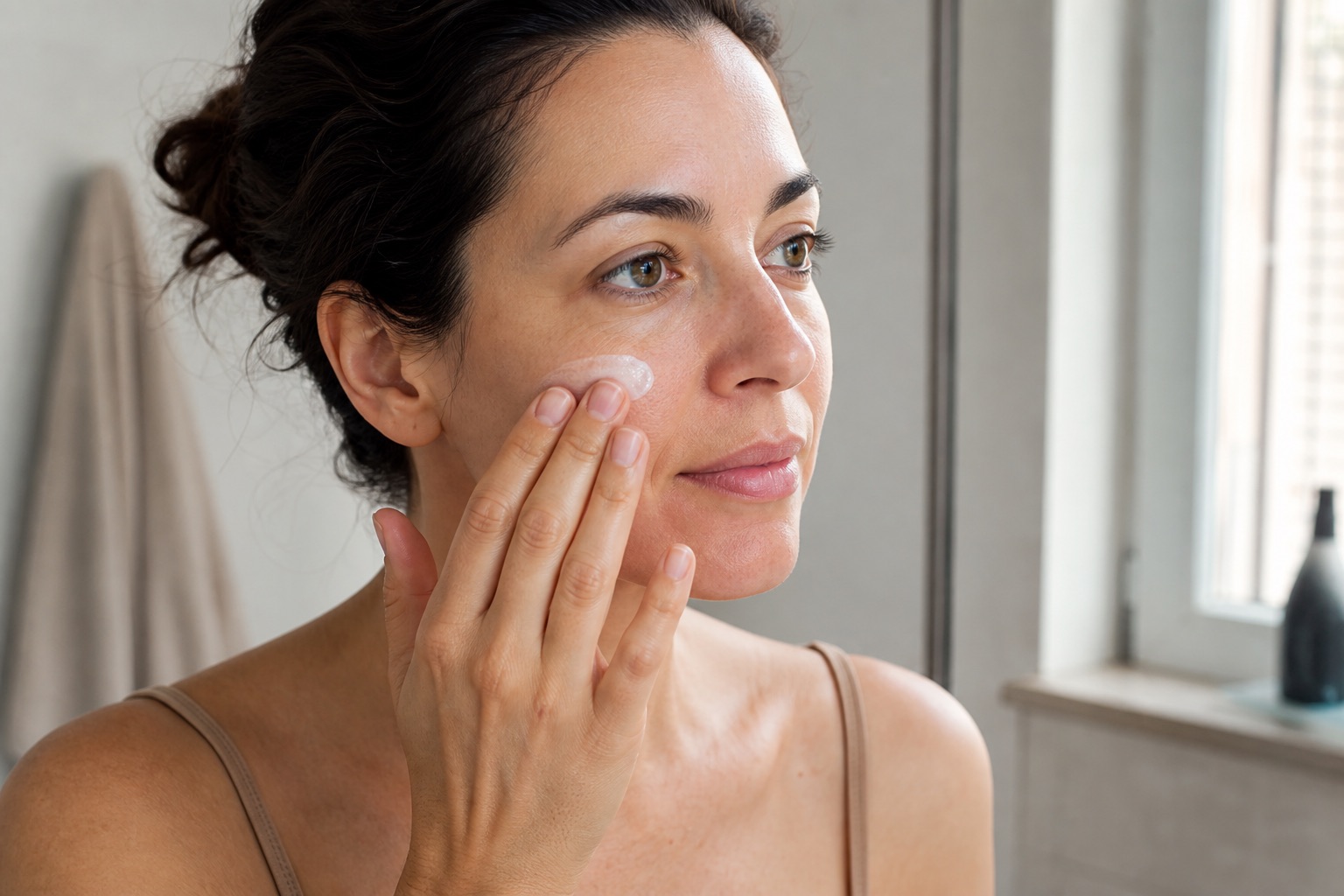
What skincare can and cannot do
Useful cosmetic functions
A coherent routine can remove makeup, sunscreen and surface oil without stripping; maintain hydration; introduce one treatment compatible with the target; protect from ultraviolet exposure; and improve comfort and the optical regularity of texture. Some actives can help keep comedone-prone follicles clearer. For sebaceous filaments, the effect is management and appearance rather than permanent removal.
Promises skincare cannot keep
A cosmetic cannot diagnose every dot, dissolve every deep lesion instantly, stop filaments from reforming, close pores forever or replace acne treatment. Burning, abrasion and intense peeling are not proof of effectiveness. If a result exists only immediately after material is pulled or pressed out, it is temporary removal rather than stable control.
Morning routine: protect without chasing total matte skin
Step 1 — Cleanse only as needed
Very oily skin may prefer a mild cleanser; comfortable skin may use lukewarm water or no morning wash if this suits its treatment plan. The cleansing and double-cleansing guide explains how to match cleansing to the film being removed rather than fear of pores.
Step 2 — Hydrate by zone
Sebum does not guarantee adequate hydration. Aggressive treatment and dehydration can increase roughness, scale and uneven makeup. Apply a tolerated moisturiser in the texture and amount each zone needs. The skin hydration guide explains why one formula can combine several moisturising functions.
Step 3 — Use sunscreen at the proper amount
Choose broad-spectrum sunscreen with a finish you can apply generously. Ultraviolet damage and loss of elasticity may make texture more apparent over time, while underapplying to avoid shine sacrifices protection. The daily face-sunscreen guide covers amount, texture and reapplication. Blot surface shine if needed rather than washing repeatedly.
Evening routine: remove, treat one priority and moisturise
Step 1 — Remove the day's resistant film
Use an oil-based or biphasic first cleanser when resistant makeup or sunscreen needs it, followed by a mild water-based cleanser only if required. Rubbing the nose for longer does not turn cleansing into comedone treatment. Rinse, pat dry and allow the skin to settle.
Step 2 — Choose one defined treatment objective
Decide whether the priority is comedones, shine, tolerance or another clinician-identified concern. Apply one treatment according to its label or clinical instructions, not an improvised cocktail. Keep the rest of the routine stable long enough to interpret. Switching acid, retinoid, mask and cleanser together conceals which change helps and which irritates.
Step 3 — Maintain comfort
Finish with a compatible moisturiser. Adjust amount by area rather than refusing hydration because the nose looks shiny. If burning, persistent scale or tightness appears, use the sensitive-versus-sensitised skin guide to simplify and recognise referral signs.
Salicylic acid and BHA: role and limits
Salicylic acid is a beta-hydroxy acid used in cosmetic formulas and acne treatments under regulatory contexts that vary by country. It can support desquamation and help keep follicles clearer, but outcome and tolerance depend on formula, concentration, pH, vehicle, frequency and the rest of the routine. It cannot promise permanent removal of filaments or a new follicular diameter.
The AHA, BHA and PHA guide owns acid-family differences, introduction, frequency and stop signs. Do not automatically combine an acid cleanser, toner, serum and mask. Irritation risk rises as total exfoliant load increases, particularly when the skin barrier is already struggling.
Do not treat every dot with an acid
A normal filament has no disease to cure, and a dark mark, hair or residue can resemble a blackhead in poor light. Choose a product only after defining the target. Widespread comedones or inflammatory lesions deserve an acne plan rather than stronger and more frequent exfoliation by trial and error.
Retinoids, niacinamide and other actives are not interchangeable
Topical retinoids appear in clinical acne guidance, but prescription medicines and cosmetic retinol or retinal differ in molecule, indication, evidence and supervision. The cosmetic retinoids guide separates these contexts. Do not use a pore guide to start, stop or change medicine.
Niacinamide has been studied in formulas addressing sebum and selected appearance outcomes, but percentages, vehicles, populations and measurements vary. There is no evidence that every high-strength serum permanently tightens follicular openings. The niacinamide guide helps interpret function, concentration and tolerance without using the highest number as a goal.
Azelaic acid, benzoyl peroxide and other treatments may belong in some acne plans but are not equivalent or appropriate for every visible dot. Use the skincare actives pillar to avoid random combinations. When acne is established or treatment is already prescribed, ask the dermatologist or pharmacist how cosmetics fit around it.
Pore strips, peel-off masks and suction devices
Why the immediate result looks convincing
An adhesive strip can lift surface debris, product residue and part of some filaments, producing a visible before-and-after. It does not alter comedone formation, prevent sebum from returning or permanently reduce the opening. Material on the strip proves adhesion and removal, not durable treatment.
Mechanical force has its own tolerance limit
Peel-off masks and suction devices add force. Reactive skin, active dermatitis, rosacea, lesions, visible vessels or recent procedures increase concern. Do not raise adhesion or suction because too little material appeared. Stop for pain, abrasion, swelling, bruising or persistent redness. A device cannot distinguish a normal filament from a lesion that should not be manipulated.
Ask whether the result lasts and whether the skin remains intact. Repeated removal of physiological filaments can become a cycle with no achievable end point. Numerous blackheads need a coherent treatment strategy, not increasingly forceful episodic extraction.
Squeezing and extraction: why DIY increases risk
Pressing with fingernails or unsterile tools can push contents deeper, increase inflammation and introduce bacteria. The AAD lists more visible or painful acne, infection and permanent scarring among possible consequences. Even when material is released, pressure can injure the surface and leave post-inflammatory colour change, especially in skin prone to hyperpigmentation.
Dermatologists may use sterile instruments for selected blackheads and whiteheads, often when other treatment has not cleared them. That does not make every salon or home extraction equivalent. Scope of practice, local law, hygiene, lesion type and contraindications matter. Inflamed, painful, bleeding or uncertain lesions should not be manipulated.
Professional competence includes deciding not to extract
A beauty professional should document consent, avoid claims of permanent pore cleansing and refer when lesions exceed cosmetic observation. Normal sebaceous filaments do not justify an endless extraction package. Training should include recognition of uncertainty, sanitation and referral, not merely instrument technique.
Steam, hot water and cold water do not open and close pores
Heat and humidity can soften surface oil and change comfort temporarily, but they do not anatomically open a follicle. Cold water may feel refreshing or change superficial redness without sealing the opening. Extreme temperatures and prolonged steam can worsen reactivity and vascular flushing.
Use comfortable lukewarm water for cleansing and rinsing. Steam is not required before an active and does not make squeezing safe. If a professional service uses warmth, it needs a defined purpose, limited exposure and clear contraindications. The outcome should be assessed after the transient heat effect has passed.
Routine mistakes that make pores look more obvious
Repeated degreasing can produce tightness, surface scale and more contrast around follicular openings. Heavy occlusion chosen without regard to skin condition can feel uncomfortable, while skipping moisturiser may make a treatment harder to tolerate. The skin types and conditions guide helps separate oil production, hydration and reactivity before a product is selected.
Changing the entire routine after every close-up photograph creates noise rather than evidence. Follow the morning and evening skincare order for a stable functional base, then assess only one pore-focused change. Compare at normal distance after several weeks and stop earlier for pain, rash or marked irritation.
A safe protocol for skincare and beauty professionals
Start with cosmetic history and ordinary light
Record products, frequency, recent procedures, reported medicines, sensitivity, duration, inflammation and the client's expectation. Observe in diffuse light without using a magnifying mirror as a sales device. Describe ‘distinct dark dots’, ‘regular pale filaments’ or ‘visible openings’ without diagnosing. Ask what improvement would be useful and correct the assumption that every pore is dirty.
Build one measurable plan
Establish a simple base, choose one priority, change one variable and schedule follow-up. Record amount, frequency, area and stop signs. Do not offer repeated extraction as a permanent solution to filaments. The damaged skin barrier guide supports de-escalation if overload has already impaired comfort.
Refer outside cosmetic scope
Stop the cosmetic plan for diffuse inflammation, painful nodules, scars, discharge, infection signs or uncertain lesions. Explore online skincare courses for structured learning in observation, formulation, client records and professional boundaries. Education does not expand the legal scope of a non-medical role.
When to see a dermatologist
Arrange assessment when comedones are numerous or persistent; papules, pustules, nodules, pain, itching or discharge appear; scars or persistent dark marks develop; a cautious routine worsens the condition; it is unclear whether the lesions are acne; or treatment is ineffective or difficult to tolerate. Significant distress is also a valid reason for support and referral.
Do not start or modify prescription retinoids from a cosmetic guide. Pregnancy, breastfeeding, childhood and coexisting conditions require individual advice. Rapid swelling, severe pain, spreading redness, fever or infection signs need timely medical help. A suspicious changing pigmented lesion should never be squeezed or treated as a blackhead.
Frequently asked questions about blackheads, filaments and pores
How can I distinguish a blackhead from a sebaceous filament?
A blackhead is usually a discrete dark open comedone; a filament is often fine, pale or grey and repeated evenly across the nose. These are clues, not a diagnosis. They can coexist, and a close photograph can confuse them. Inflammation, persistence or uncertainty warrants assessment.
Are blackheads trapped dirt?
No. The dark colour comes from oxidation of material exposed at the opening. Aggressive washing does not remove the mechanism and can irritate. Cleansing removes surface film; persistent comedones need a consistent plan and sometimes dermatological treatment.
Do sebaceous filaments need to be removed?
Not necessarily. They are normal structures and reform. Appropriate cleansing and a tolerated targeted product may make them less obvious, but repeated squeezing to create a completely dot-free nose is unrealistic and increases injury risk.
Can pores be closed permanently?
No. Skincare and makeup can reduce build-up, shine and shadow and improve the appearance of texture. They cannot erase the follicular opening. Distinguish a temporary optical change from a dermatological procedure with a defined indication and duration.
Do pore strips work?
They can remove surface material and create temporary smoothness, but they do not prevent sebum and filaments from returning or treat comedone formation. They may irritate reactive or injured skin. An immediate result is not permanent pore reduction.
Does salicylic acid eliminate sebaceous filaments?
It may help keep follicles clearer and make filaments less apparent, but it does not remove the structure or its function. Formula and frequency determine effect and tolerance. Avoid stacking exfoliants and accept that physiological material reforms.
Does niacinamide shrink pores?
Some formulas have been studied for sebum and appearance outcomes, but there is no proof that every percentage permanently changes follicular anatomy. Consider the finished formula, population, duration and method of measurement rather than using concentration as a guarantee.
Does steam open pores?
No. Heat and humidity may soften surface material but cannot open the follicle like a door. Steam does not make extraction safe and can increase redness. Comfortable lukewarm water is sufficient for cleansing.
Does cold water close pores?
No. Cold can briefly change sensation or superficial redness, but it does not seal the opening. Alternating extreme temperatures adds irritation without treating comedones. Assess a routine over weeks, not in the minutes after rinsing.
Can dry skin have blackheads and visible pores?
Yes. Oil production, hydration, comedones and follicular visibility are separate variables. Dry skin can have localised comedones, while oily skin does not automatically have very visible pores. Build care around zones, comfort and the complete presentation.
Is double cleansing required every night?
No. It is useful when resistant sunscreen or makeup needs two complementary steps for gentle removal. It is not a blackhead treatment. Choose it according to the film present and comfort after rinsing.
When should I consult a dermatologist?
For widespread, persistent, painful or inflamed lesions; nodules, scars, pigmentary change, discharge or infection; uncertain diagnosis; poor treatment tolerance; or significant distress. Correct classification avoids months of extraction or cosmetics aimed at the wrong phenomenon.
Clinical and scientific sources
American Academy of Dermatology: acne signs and why open comedones look dark. Read the AAD guidance
American Academy of Dermatology: risks of squeezing and the role of dermatological extraction. Read the AAD guidance
Pagnoni et al.: classic histological description of sebaceous filaments as a normal morphological feature. Read the PubMed record
O'Goshi et al.: dermoscopic description of sebaceous filaments. Read the PubMed record
Lee et al.: review of the definition, causes and treatment options for visible facial pores. Read the PubMed record
Roh et al.: study of the relationship between sebum output and facial pore size. Read the PubMed record
Manuskiatti et al.: population study that did not find a universal sebum-to-pore-size correlation. Read the PubMed record
NICE NG198: acne management, referral and follow-up recommendations. Read NICE recommendations
Browse the English skincare guide hub for separate guidance on skin types, cleansing, hydration, acne, sensitivity and actives, or explore online skincare courses for structured professional learning.
For a cautious distinction between cosmetic discolouration and a mark that needs assessment first, read the facial dark spots and skincare guide for photoprotection, cosmetic options, measurement and dermatology referral criteria.
For a practical routine shaped by skin, shaving and facial hair rather than gendered packaging, read the men’s skincare guide for cleansing, moisturising, razor-bump prevention, beard care and sunscreen.
For a repeatable professional method that separates observation from diagnosis, read the cosmetological skin-analysis guide for type, current conditions, tools, documentation, privacy and referral limits.
To turn cosmetic observations and existing products into a plan a client can understand and follow, use the professional skincare-consultation protocol for intake, product audit, written handover, follow-up and referral boundaries.