

A skincare client record is not a medical chart, an endless intake form or a signature collected without explanation. It is a controlled working record of what is genuinely needed: what the client uses and how, what they reported, the cosmetic objective agreed, the decisions made, which permissions are separate from the service, and when the practitioner must pause or stop. A well-designed record reduces errors; collecting everything by habit creates risk without improving care.
Quick answer: design every field around a decision. Separate identity and billing from technical notes; record exact products and timing; distinguish client reports from practitioner observations; ask only relevant sensitive questions; keep service contact, photography, publication and marketing choices separate; define access, retention and deletion; and place stop criteria where staff can use them before and during the service.
This guide owns the client-record, data-governance and stop-criteria intent. The cosmetological skin-analysis guide owns observation and instruments, while the professional skincare-consultation guide owns the service journey from intake to review. Here the question is how to structure, protect, update and close the documentation without turning it into an improvised health record.
This educational guide by Clara Salis is not a ready-to-use legal template. It requires independent dermatological, legal, information-security and privacy review and has not been medically or legally reviewed. Lawful bases, professional duties, record requirements, consumer rights and health-data rules vary by jurisdiction and service. The GDPR discussion applies only where that law applies; obtain advice for the real workflow before collecting live client data.
What a skincare client record is — and what it must not become
The record is the controlled memory of the service. It links a minimum identity, authorised contact, objective, actual routine, products, preferences, observations, instructions, events and next review. It does not replace conversation; it prevents selective memory. ‘Sensitive skin’ is weak documentation. ‘Client reports burning for about ten minutes after Cleanser X, used twice daily and started three days ago’ is specific enough to inform a decision.
It must not become a shadow medical chart. A beauty practitioner should not request complete diagnoses, reports, family history or an exhaustive medication list without necessity, competence and an appropriate legal process. The record does not diagnose disease, establish allergy, prescribe treatment, guarantee outcomes or turn proprietary cosmetic scores into clinical facts. Relevant health information needs greater restraint and protection, not a longer free-text box.
It is not a commercial contract disguised as a safety form. Service terms, privacy information, internal photography, public portfolio use and marketing each serve different purposes. They may sit in one digital journey, but the choices must remain distinguishable. A signature only shows that a version was signed; it cannot repair vague language, unnecessary collection or a service designed so refusal is impossible.
Use five blocks: identity, service, products, safety and traceability
A robust record separates five blocks. Identity contains the minimum client key and service contact. Service documents the appointment, objective and scope. Products captures real use and relevant instructions. Safety records reported reactions, preferences, stop signals and distinct permissions. Traceability stores decisions, document version, practitioner, delivery, follow-up, amendments and closure. The structure also makes role-based access easier.
Mark fields as required, conditional or optional. Client code, date and service may be essential. Photography is conditional only where it adds defined value and has a governed process. Work, lifestyle or social details are optional and should appear only when linked to exposure, routine or preferences. Too many mandatory fields push people to invent answers or overshare simply to continue.
Design the information flow before choosing software. Map who collects, reads, edits, exports, receives and deletes each block. A polished system open to all staff is worse than a simpler protected process with clear access. Privacy and security by design means deciding purpose, minimum data, permissions, retention and deletion before the database fills up.
Identity and contact: keep technical and administrative data separate
A routine consultation may need a name or internal code, one chosen contact, service date and responsible practitioner. Full address, government identification, tax number and date of birth are not automatically necessary. Billing, age verification or a specific legal duty may require some of them, but that belongs in the correct process. Separating administrative identity from technical skincare notes limits needless visibility.
Record which channel is authorised for appointment or follow-up communication and do not silently convert it into promotional consent. Contacting a client about a reaction at an agreed review is not the same purpose as sending offers. If the contact belongs to another person, clarify who can receive information. Minors and represented adults need jurisdiction-specific safeguards rather than a copied generic clause.
Avoid large unrestricted note fields. They encourage copied conversations, judgements and unrelated details. Use targeted options plus a short context box. Do not record irrelevant personal characteristics, assumptions about health or comments you would not say to the client. Access rights and staff changes mean the record must remain factual and professional for its entire life.
Document the agreed cosmetic objective, scope and expected output
Keep the client’s original request and the agreed cosmetic reformulation. ‘Cure my acne’ needs a boundary: the service does not treat acne, although it may organise supportive cosmetics, comfort and photoprotection without altering medical care. ‘Erase my pores’ needs realistic expectations. Recording both statements explains why the plan did not follow an impossible or out-of-scope promise.
List what the appointment includes: consultation, product audit, non-diagnostic observation, any permitted application, written routine and follow-up. List exclusions in plain language: diagnosis, prescription, allergy testing, therapeutic treatment and guaranteed results. Acknowledgement of scope should be readable before the service and leave a genuine opportunity to ask questions.
Record one or two observable endpoints: comfort after cleansing, number of tolerated applications, sunscreen consistency, reduced perceived flaking or confidence with product order. Do not use perfect skin or detox as endpoints. The skincare consultation protocol explains how to agree the objective, while the daily facial sunscreen guide provides a consistent reference when adherence to photoprotection is the endpoint. The record preserves what was agreed and how review will use it.
Build a product-use register with exact identity, timing and sequence
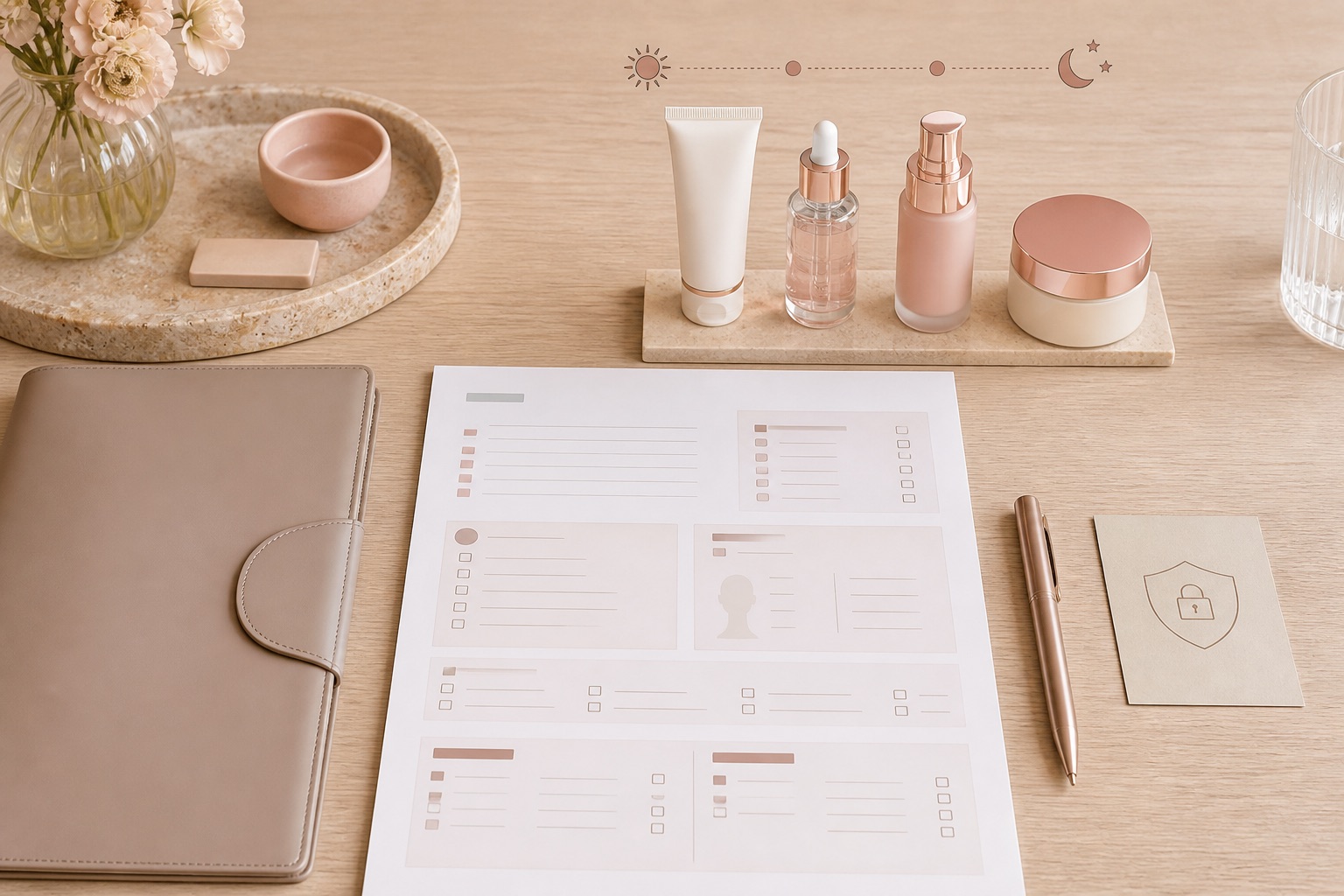
For every cosmetic, record exact product and variant, brand only as identification, format, stated function, area, time of day, actual frequency, approximate amount, order, start date and reported response. Photograph labels only when necessary through the approved process. Batch information may help after an event when available, but it must never be invented or used instead of the applicable adverse-event or product-reporting route.
Distinguish owned, actively used, paused, occasional and prescribed. A product in the bathroom may not be part of the routine; an occasional peel may explain timing; a prescribed topical is not recategorised as a cosmetic recommendation or altered. Record overlapping exfoliants, retinoids, fragranced products or strong cleansers as exposure information without claiming that one ingredient caused the event.
A timeline is more useful than a static list. When did a product enter, what remained constant, when did the sign or sensation appear, and what happened after it stopped? The skincare actives guide explains introduction and combinations, and the morning and evening routine guide supplies the general sequencing reference. The record documents one client’s actual sequence without treating it as scientific proof of causation.
Record sensitivity and reactions descriptively, without diagnosing
Sensitive skin, allergic to everything and intolerant of acids are starting statements, not diagnoses. Ask which product, area, delay, sign or sensation, duration, action and professional help were involved. Preserve the person’s wording and distinguish it from direct observation. Do not translate burning into allergy, redness into rosacea or spots into diagnosed acne.
Use descriptive language: stinging, burning, itching, tightness, reported swelling, observed flaking, reported blisters, pain or eye symptoms. If a scale is used, define it and keep it consistent without presenting it as a clinical measure. The guide to sensitive and sensitised skin owns cosmetic classification and routine; the record owns source, timing and the resulting safety decision.
A confirmed diagnosis or allergy may be noted as client-reported only when relevant, often without copying medical attachments. Do not infer the allergen from an INCI list. A small-area consumer test may reveal some reactions but cannot replace medical patch testing. Important, persistent or recurrent reactions require qualified assessment; the record can preserve a concise product timeline for that conversation.
Use professional language: fact, source, date and degree of certainty
Every note should reveal who says what: client reports itching that began on the evening of application; practitioner observes flaking around the mouth before service; photograph captured under recorded conditions; instruction reported as received from a dermatologist, with no report retained. This grammar separates report, observation and document so an assumption does not become a fact through repetition.
Avoid labels such as non-compliant, definitely allergic, destroyed barrier or toxic skin. Describe behaviour and context: used the treatment on three of seven evenings because the texture felt unpleasant. Neutral language protects dignity and reasoning quality. Corrections need author, date, reason and version history appropriate to the system; silently rewriting an old decision damages traceability.
Do not copy entire chats, emails or image galleries into the record. Summarise the minimum relevant information and preserve its source. Conversations may contain third-party data and unrelated details. An unsolicited image needs a procedure: assess necessity, inform the client, move it into the governed system or delete it rather than leaving it indefinitely on a personal device.
Health information: relevance must come before curiosity
Where the GDPR applies, data concerning health are special-category data with additional restrictions. A beauty form may collect them without calling itself medical: diagnoses, medicines, confirmed allergy, pregnancy, procedures or images revealing a condition can be relevant. Before asking, define necessity, lawful basis, notice, access and retention with competent advice. Consent is not a universal shortcut for excessive collection.
Prefer narrow functional questions. Instead of requesting every illness, ask whether there is relevant professional advice or a circumstance that affects the intended product or service, then refer uncertainty appropriately. Instead of copying a prescription, record the necessary fact that a named topical treatment must not be altered. Collect what changes the decision, not everything that might one day be interesting.
A client must understand whether a field is optional and the real consequence of declining. If information is essential to safety and unavailable, limit or postpone the service rather than coercing disclosure. Beauty practitioners do not interpret reports or advise stopping medication. The record documents the boundary and referral; it does not build a second healthcare file.
Separate service, follow-up, photography, publication and marketing choices
There is no single privacy consent that authorises every operation. Under the GDPR where applicable, contractual processing, legal obligations and consent are distinct legal questions; special-category information needs additional analysis. Marketing and public image use have their own purposes. When consent is relied upon, EDPB guidance explains that it must be freely given, specific, informed and unambiguous, with a real route to withdrawal.
Create granular choices: receive the defined service; receive agreed follow-up contact; permit images for necessary internal documentation; separately permit identifiable public portfolio use; receive marketing. Refusing portfolio or promotion should not prevent a service that can operate without them. Explain purpose, channel, recipients, retention and withdrawal rather than hiding them behind one compulsory checkbox.
Associate each decision with the text version, date and action. Do not change purpose later: an image collected to compare a private follow-up does not automatically become social content. A new use needs a new assessment and any required permission before publication. Withdrawal must be operationally possible for future consent-based use, including copies under the organisation’s control.
Write a privacy notice around the real workflow
Make privacy information available before collection in understandable language. Where relevant, identify the controller and contact, data categories, each purpose and legal basis, recipients and service providers, transfers, retention criteria, rights, complaint route and whether provision is required. A copied website notice is not enough if the salon actually uses personal phones, cloud drives, booking tools and external forms that it never maps.
Name supplier roles and configure them. A booking platform, cloud storage provider, messaging service, analytics tool and practice-management system may process different data. Contracts do not replace access control or deletion. International operations also need a location and transfer assessment where the applicable law requires it. This page explains design principles, not the correct lawful basis for a particular business.
Treat skincare photographs as personal data, not decoration
A face image can identify a person and may reveal sensitive information. Define why it is needed before capture, use a managed device or process, standardise the image only as required and record the permission or other lawful process that applies. Service documentation, remote assessment, training and public marketing are separate uses. Paying for a consultation is not blanket authorisation for photography.
Covering the eyes does not necessarily anonymise an image. Face shape, tattoos, hair, background, metadata, appointment date and accompanying story may still identify the client. Pseudonymisation can reduce exposure but the information remains personal data when it can be reconnected. True anonymisation requires a rigorous assessment, not a sticker placed over the eyes.
Store only necessary images with their purpose, date, conditions and retention rule. Keep public copies governed after posting and avoid exporting them to staff camera rolls. The consultation’s photography and follow-up section explains standardisation; this guide governs the record and permissions.
Set retention, access and deletion across the whole record lifecycle
Do not select one indefinite retention period for every field. Service notes, invoices, incident records, internal photographs, public permissions and marketing choices may have different purposes and duties. Define a period or defensible criterion for each, communicate it and run deletion in practice. Storage capacity is not a lawful or ethical reason to keep information.
Give staff the least access needed for their role. Reception may need booking contact but not detailed reaction notes; a practitioner may need product history but not unrelated billing records. Remove access when roles change. Use individual accounts, strong authentication, appropriate encryption, backups with tested recovery and a procedure for loss, misdirection or unauthorised access.
Deletion must include exports, shared folders, temporary captures and controlled backups according to the documented method. Do not promise instant erasure from systems that cannot deliver it. Where records must be retained for another legitimate reason, restrict use and explain the applicable limits with legal advice.
Paper, spreadsheet or practice software: choose by control, not appearance
Paper avoids some network risks but can be seen, lost, copied or destroyed. Spreadsheets are flexible but often lack field-level permissions, logs and safe concurrent editing. Practice software may offer roles and audit trails but introduces suppliers, remote access, exports and configuration risk. No format is automatically compliant or secure because it is expensive or digital.
Evaluate purpose fit, roles, authentication, logging, encryption, backup, export, correction, deletion, portability, supplier terms, data location, support and incident response. Test with fictional data before live use. Avoid systems that force unnecessary medical fields or bundle marketing permission into service intake.
Generative AI adds another supplier and accuracy problem. Do not paste client records or photographs into a general AI service for convenience. A governed use would still need purpose, lawful process, supplier assessment, security, retention, transparency and human verification. A summary that invents or omits a product can cause a real safety error.
Preserve versions, amendments, delivery and follow-up
Record who created and changed an entry, when and why. Preserve the version of the privacy information, permissions, routine and stop instructions shown to the client. A later correction should not erase the original event where an audit trail is justified. The aim is accountability, not surveillance of staff or clients.
Separate internal notes from the client-facing routine. Record how and when the handover was delivered, whether questions were answered and the planned review endpoint. At follow-up, add what changed rather than duplicating the entire form. A concise timeline should reveal product introduction, response, action and outcome.
Put stop criteria inside the workflow, not in forgotten small print

Do not begin when required information or permission is missing, the skin is broken in the service area, an acute reaction is active, medical aftercare conflicts with the planned step, the product cannot be identified, or the case exceeds competence. Stop during the service for increasing burning, pain, notable swelling, hives, eye symptoms, significant rash or another unexpected response.
Breathing difficulty, swelling of the face, lips or tongue, faintness or rapid systemic deterioration can require urgent emergency help. The record is secondary to immediate safety. Staff need a rehearsed pathway and local emergency information rather than relying on a client signature.
For overload, discomfort and a simplified cosmetic baseline, consult the damaged skin-barrier guide. For persistent inflammatory lesions or scarring concerns, the acne-prone skin guide explains when cosmetic support is no longer enough.
After a stop: support, record the event and refer accurately
Document the time, product and batch if available, quantity, area, observed signs, client-reported sensations, other recent products, action taken and referral. Do not declare causality or diagnose allergy. Preserve packaging or product details where relevant and follow the manufacturer’s and jurisdiction’s appropriate adverse-event route when required.
Give the client a clear summary of what stopped and what information to take to a healthcare professional. Do not recommend retrying a product to prove causation. Protect photographs and messages as part of the incident process, restrict access and set a retention decision with competent legal and insurance advice.
A practical field map: essential, conditional and usually unnecessary
Essential fields commonly include client key, service and date, practitioner, agreed objective and scope, exact active products, relevant reported response, recommendation, stop instructions and review. Conditional fields may include one necessary image, relevant prescribed topical, batch after an event, authorised follow-up channel or accessibility preference. Their necessity depends on the defined service and local law.
Usually unnecessary fields include complete medical history, family history, unrelated employment or relationship status, unrestricted social-media handles, copies of identity documents without a reason, broad lifestyle judgements and consent to all future uses. Do not include a field because a downloaded template had it. Start from the decision map and remove anything without a current purpose.
Ten quality-control questions before the form goes live
Can every field be tied to a defined service, safety, legal or follow-up decision?
Are administrative data separated from technical notes and sensitive information?
Can the record distinguish client report, practitioner observation and external instruction?
Are exact products, dates, sequence and changes reconstructible after an event?
Are service, follow-up, internal images, publication and marketing treated separately?
Does each role see only what it needs, with individual access and a removal process?
Are retention, correction, export and deletion possible across copies and suppliers?
Can staff find and apply stop criteria during the appointment?
Can the client understand the routine, data uses and consequences without legal jargon?
Has the complete real workflow, not only the wording, received qualified review?
Frequently asked questions about skincare client records
Is a skincare client record legally required?
There is no universal answer. Requirements depend on the country, professional activity, service, insurance and other obligations. Proportionate documentation may support continuity and safety even where no single form is prescribed. Obtain advice for the actual workflow rather than copying a medical template.
Which identity details should be requested?
Only those needed to identify the record, contact the client as agreed, deliver the service and meet real obligations. Keep billing and identity-verification data in the appropriate administrative system instead of duplicating them in skincare notes.
Should every medicine and health condition be recorded?
No. Ask only what is relevant to the intended service and safety, and never interpret or alter treatment. Health information is sensitive and needs an appropriate legal process, restricted access and retention. Limit or postpone when genuinely necessary information is unavailable.
How should a client-reported allergy be written?
State that it is client-reported or confirmed according to information shown, only when relevant. Record the product or substance, response, timing and advice received without diagnosing. Do not infer the allergen from an ingredient list; medical patch testing belongs to qualified healthcare professionals.
Do sensitive skin and allergy mean the same thing?
No. Sensitivity may describe a subjective or cosmetic tendency, sensitisation can describe a changing state, and allergy is a medical diagnosis with a specific mechanism. Record words, signs, product and timing rather than converting one label into another.
Is privacy consent always mandatory?
Privacy information and consent are not synonyms. Where the GDPR applies, different purposes may rely on different lawful bases, while special-category data need further analysis. When consent is used it must meet its legal conditions. Have the whole process reviewed, not only one sentence.
Can one signature cover service, photographs and marketing?
A signature may record several choices only when they remain clear and granular. Internal documentation, public portfolio, follow-up and promotion have different purposes. Refusing optional publication or marketing should not block a service that does not depend on them.
Does paying for a consultation authorise face photography?
No automatic permission should be assumed. Define necessity, purpose, information, lawful process, access and retention. If an image is not needed, do not take it. Keep internal documentation separate from training, portfolio and public posting.
Does covering the eyes anonymise a photograph?
Not necessarily. Other facial features, hair, tattoos, setting, metadata and story may identify the person. Treat the image as personal data unless a rigorous assessment demonstrates that re-identification is no longer reasonably possible.
How long should records be retained?
There is no single period for every component. Set defensible periods or criteria for service notes, financial records, incidents, photographs and marketing according to purpose and applicable duties. Communicate and implement them across copies and suppliers.
Can records be stored on a personal phone?
It creates substantial risk through automatic backups, mixed accounts, loss and uncontrolled copies. Prefer managed work systems, strong authentication and a defined transfer-and-deletion process. A personal camera roll should not become the archive.
Can the routine be sent through messaging or email?
Only after assessing the content, recipient, channel and applicable security. A client-facing routine can be separated from internal notes and special-category information. Verify addresses, minimise attachments and do not let messages become an uncontrolled second archive.
Can a client request a copy or correction?
Applicable data-protection law may provide access, rectification and other rights. Establish a channel, verify identity proportionately, find controlled copies and respond within applicable rules. Correct transparently without rewriting history to hide an error.
How should a reaction at home be recorded?
Record what the client reports: exact product, batch if available, amount, area, date, delay, other products, signs or sensations, duration, action and help received. Do not claim causation. Important or persistent symptoms need appropriate medical assessment.
When must a service stop immediately?
For increasing burning, pain, notable swelling, hives, eye symptoms, significant rash, broken skin, possible infection or another unexpected response. Breathing difficulty, facial or lip swelling, faintness or rapid systemic deterioration can require urgent emergency help.
Should clients sign the stop criteria?
Clients should receive and understand instructions, but a signature does not transfer professional responsibility or make an unsafe service safe. Staff training, observation and the actual decision to stop remain essential.
Can a dermatologist’s diagnosis appear in the record?
Only when truly relevant and governed appropriately. Often it is enough to note that professional healthcare instructions must be followed without storing the full report. Beauty practitioners do not interpret diagnoses or change treatment.
How are prescribed products handled?
Identify them as prescribed and do not change dose, frequency, area or discontinuation. The cosmetic plan may organise compatible basics, but therapeutic decisions return to the prescriber. Unclear instructions or reactions are not solved by adding more actives.
Is a digital record safer than paper?
Not automatically. Digital systems can offer roles, logs and encryption but create remote access and supplier risk; paper can be exposed, lost or copied. Security depends on configuration, access, backup, destruction and behaviour.
Can AI summarise a skincare client record?
Do not upload personal data or images to a general service for convenience. Any governed use still needs purpose, legal analysis, supplier controls, security, retention, transparency, accuracy testing and human review. Fabricated or omitted details can affect safety.
How often should the record be updated?
Whenever a fact changes the decision: new product, reaction, relevant instruction, routine revision, photograph, follow-up, withdrawal or new permission. Preserve the date, author, change and reason rather than rewriting the entire history.
Can an online client-form template be copied?
Use it only as a prompt. It may belong to another country, profession or service and collect excessive data. Map your workflow, remove unjustified fields, separate choices and obtain qualified review. A signed template cannot repair open access or nonexistent deletion.
Does a skincare course authorise clinical record keeping?
No. Private training can develop cosmetic and organisational skills but does not turn a beauty record into a clinical chart or authorise diagnosis and treatment. Explore online skincare courses for curriculum, then verify local professional and data duties independently.
Regulatory and dermatological sources
EUR-Lex: GDPR principles, lawful bases, special-category data, transparency, data protection by design, rights and security. Read Regulation (EU) 2016/679
European Data Protection Board: Guidelines 05/2020 on the conditions for valid consent under the GDPR. Read the EDPB guidelines
American Academy of Dermatology: consumer small-area product testing, reactions and dermatologist referral. Read the AAD guidance
EUR-Lex: current consolidated EU Cosmetics Regulation for cosmetic-product scope and safety obligations. Read Regulation (EC) No 1223/2009
Browse the English skincare guide hub for routines, analysis, actives, sunscreen and cosmetic limits. A strong client record does not prove that the practitioner knows everything; it proves that they collect what is necessary, protect the person, explain decisions, stop appropriately and leave a comprehensible trace.
For a controlled hands-on protocol covering preparation, pressure, zone sequence, contraindications and realistic claims, read the cosmetic facial-massage guide and keep every movement inside professional scope.
For a verifiable clean-to-used workflow covering hands, textiles, tools, surfaces, cosmetic dispensing and turnover, read the skincare workstation-hygiene guide before designing or auditing a hands-on service.
If you are turning this topic into a structured learning plan, use the online skincare-course selection checklist to compare curriculum, teacher, demonstrations, practice, feedback, access, total cost and certificate wording without confusing private training with professional authorisation.
If you want to turn this knowledge into a defined service, continue with the guide to becoming a skincare consultant: it connects training, demonstrable skills, portfolio, boundaries, work models and a controlled launch without confusing cosmetic consultation, beauty treatment and healthcare.
Turn the protocol into a proportionate inventory with the professional skincare and facial-massage kit guide: it sizes furniture, textiles, tools, consumables, cosmetics, stock and optional equipment to the real service instead of building an unnecessarily complex trolley.