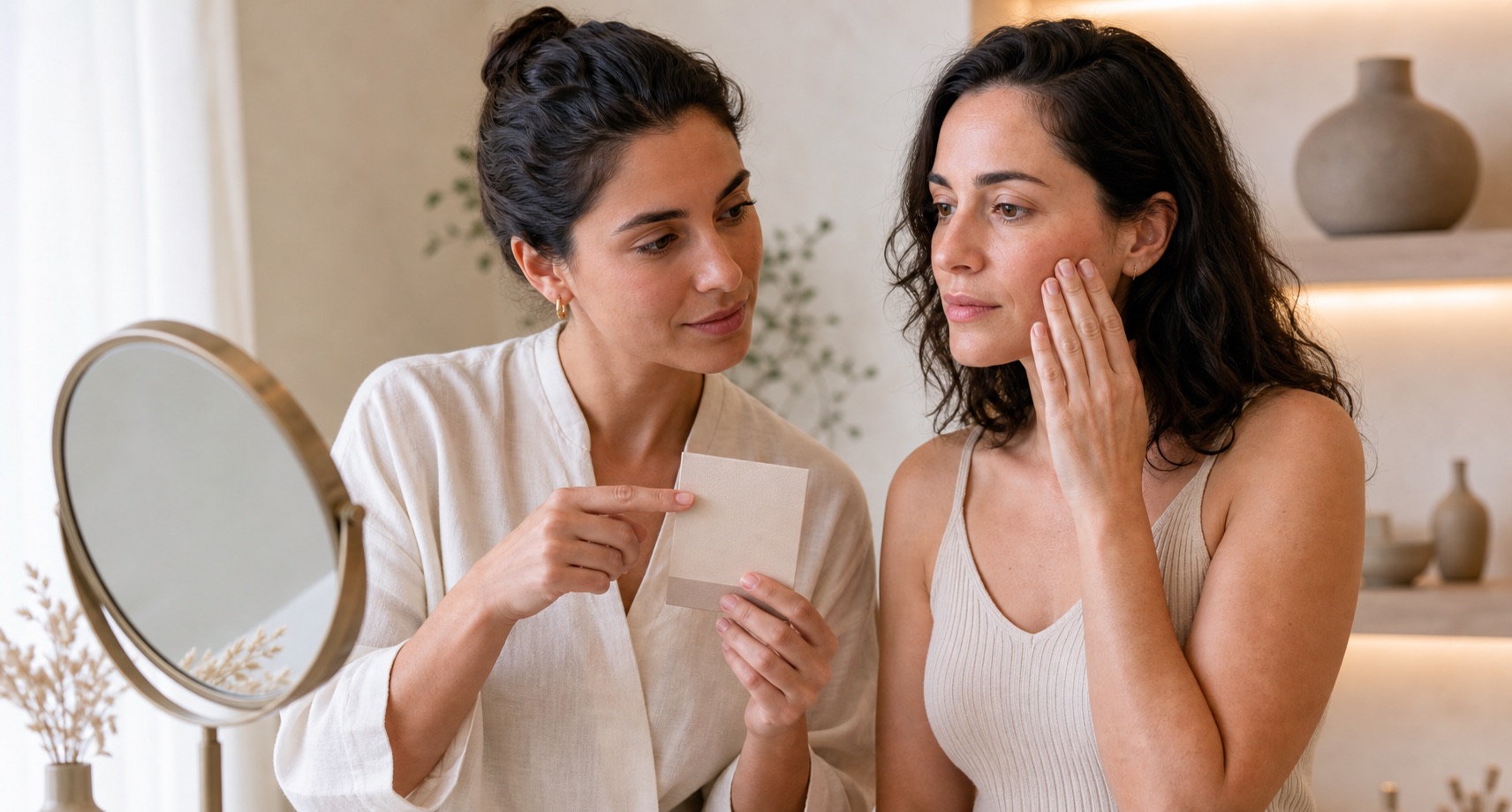
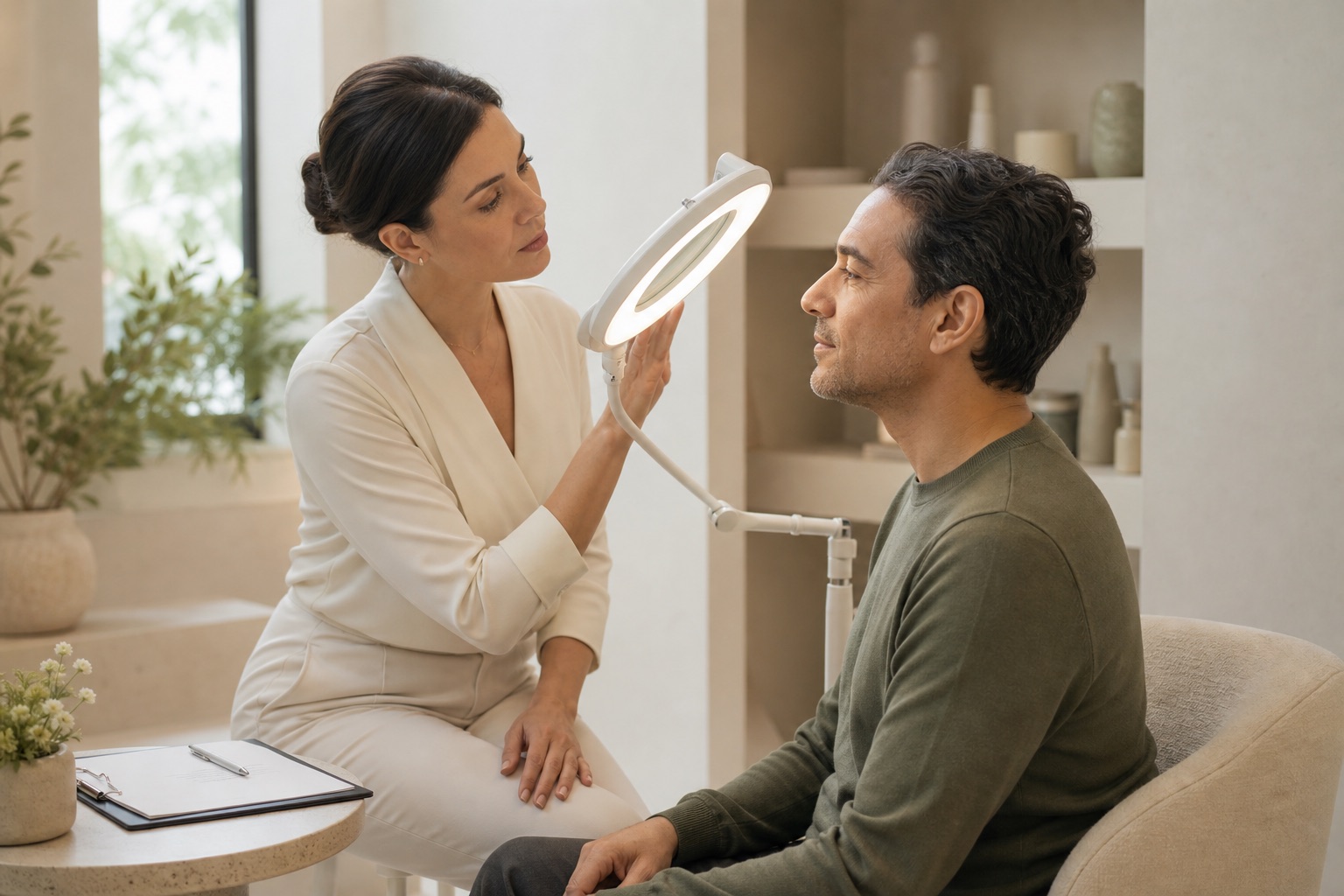
Cosmetological skin analysis is not an instant test that assigns a person to a permanent box. It is a professional process: collect relevant information, observe the face under controlled conditions, describe visible signs and reported sensations without diagnostic language, separate relatively stable characteristics from changing conditions, and build a testable cosmetic working hypothesis. The result is not a medical report.
Quick answer: begin with objective, history and stop criteria; standardise light, timing and products; observe each facial zone; record surface, comfort, oil distribution, visible scale and reactivity; then recommend the smallest cosmetic change with an endpoint and review date. A lens, scanner, moisture reading or AI score adds data only when its method and uncertainty are understood.
This guide owns the professional cosmetological-analysis protocol. The skin types and conditions guide owns classification and self-observation; the morning and evening skincare guide owns product order. A future consultation guide will own service design and follow-up. Here the centre is repeatable observation, documentation and professional boundaries.
This educational content by Clara Salis requires independent dermatological, legal and privacy review and has not been medically or legally reviewed. It does not diagnose acne, rosacea, dermatitis, allergy, infection, pigmented lesions or other disease. Professional permissions, titles, data rules and permitted services vary by country and region and must be checked locally before offering a paid analysis.
What cosmetological skin analysis is — and is not
A useful analysis organises observations so a cosmetic plan can be explained and later checked. It may describe shine by zone, tightness after washing, scale, roughness, tolerance, product residue and exposure. It does not identify a disease, name an allergen, prescribe treatment or prove what occurs in deeper tissue.
The analysis should reduce uncertainty, not manufacture certainty. ‘Combination pattern today, with dehydrated-feeling cheeks after a recent cleanser change’ is a working description. ‘You have dermatitis because the scanner is red’ is a diagnosis and exceeds the method. A professional records what is known, what is reported, what is inferred and what remains uncertain.
Type, condition, sign, symptom and objective are five different layers
Skin type is a broad working pattern
Type usually summarises relatively persistent oil and comfort patterns such as dry, oily or combination. It can vary by zone and does not predict every ingredient response. It should be revisited when climate, hormones, treatment or routine changes.
Condition describes the current state
Dehydration, temporary sensitisation, surface roughness and visible congestion can change faster. A condition can overlay any type. Calling an oily forehead ‘hydrated’ or a dry cheek ‘sensitive’ from appearance alone collapses different observations.
Signs are observed; symptoms are reported
Scale, shine and a visible papule are signs. Burning, itch, tightness and pain are symptoms the client reports. A photograph cannot record sensation, and the professional should not replace the client's description with an image score.
An objective must be cosmetic and measurable
‘Reduce evening tightness while keeping sunscreen comfortable’ can be checked. ‘Cure sensitivity’, ‘detoxify skin’ and ‘erase pores’ cannot be owned by a cosmetic analysis. If the requested outcome is diagnostic, therapeutic or structural, refer rather than rewriting it as a beauty promise.
Before the appointment: information, preparation and consent
Explain the service, its cosmetic scope, duration, touch, images or devices, data use, price and right to stop before collecting information. Ask the client to bring product names and relevant instructions. Do not demand a medical history ‘just in case’; collect only information necessary for safety and the agreed service.
Give clear preparation instructions. Heavy makeup, a recent scrub, exercise, hot shower or freshly applied occlusive product can change surface appearance and instrument readings. Never tell a client to stop prescribed medicine or necessary skincare. Record departures from the protocol instead of cancelling the person’s needs. When removal is required, use the proportionate method described in the double-cleansing guide rather than stripping the surface before observation.
Consent to the service is not automatically consent to photography, marketing, teaching or long-term storage. Where GDPR applies, purpose limitation, data minimisation, transparency and special-category rules may be relevant. Local law determines the correct basis and documentation; this article is not a legal template.
Standardise room, light and acclimatisation
Use stable neutral front light, a consistent chair position, clean background and comfortable room conditions. Direct sun, coloured walls, a bright ring reflected in oil and auto-adjusting exposure can change colour and shine. Record meaningful deviations such as a very hot room or arrival immediately after outdoor cold.
Allow a consistent settling period after arrival and any gentle cleansing before comparing readings. The correct interval depends on the protocol and device. Standardisation does not make a cosmetic measurement diagnostic; it only makes repeated observations less noisy.
Observe the face zone by zone

Divide forehead, nose, chin, cheeks, eye area, jaw and neck. For each zone, record visible oil, scale, texture, colour variation, integrity and product residue. Use the same vocabulary and order every time. Do not turn normal pores, facial movement or pigment variation into defects. The eye-area skincare guide explains why darkness, puffiness and ocular symptoms require separate boundaries.
Observe at conversational distance before magnification. A lens changes scale and can make every follicle look dramatic; it should answer a defined question rather than create dissatisfaction. Compare symmetrical zones without assuming the two sides must be identical.
Do not confuse oil, water, barrier function and texture
Oil is not hydration
Sebum produces shine and contributes to surface lipids; hydration refers to water in the stratum corneum. Oily skin can feel dehydrated or sensitised, and dry skin can carry product shine. The oily and combination skin routine keeps that practical routine intent separate.
Barrier is a function, not a camera colour
Burning, scale and increased water loss may suggest that the cosmetic plan needs simplifying, but a red overlay or one moisture value cannot diagnose barrier disease. The damaged skin-barrier guide owns overload and minimal-routine decisions.
Texture needs a neutral description
Use terms such as visible scale, closed-looking bump, rough patch or prominent follicular opening without assigning cause. The blackheads, sebaceous filaments and pores guide explains why extraction and pore-erasing claims need restraint.
Touch and palpation: use only when justified
Explain touch, gain specific consent, clean hands and use minimal pressure. Palpation may help describe superficial feel and mobility, but it does not identify pathology or measure collagen. Do not pinch, scrape or press inflamed, painful, broken or uncertain skin.
Stop when the client withdraws consent or reports pain, when integrity is compromised, or when local rules place the action outside the professional role. Gloves do not make an unnecessary manoeuvre appropriate. A hands-off observation can still produce a useful cosmetic plan.
Magnifiers, lamps, scanners and AI do not prove a diagnosis
A magnifier improves visibility. Polarised, ultraviolet or multispectral systems may visualise selected surface or subsurface optical features. A scanner may calculate indices from proprietary images. None automatically identifies acne, rosacea, cancer, allergy or the biological age of skin. The output depends on hardware, calibration, lighting, algorithm, reference population and operator.
Ask what the score measures, its units, repeatability, validation population and error. ‘AI detected’ is not a method description. Deeper skin tones must be represented in validation, and a model that performs well on one acquisition system may fail on another. Use a device as an adjunct to a question, not an authority that overrides symptoms or referral.
Hydration, sebum and TEWL readings need context
A number is protocol-dependent
Capacitance and conductance instruments estimate properties related to water in superficial skin; sebum devices sample surface lipids; transepidermal water loss estimates water vapour flux. Different devices, sites and protocols are not interchangeable. A value without unit, site, environment and device is not useful documentation.
TEWL and hydration are not the same measurement
A skin surface may show a particular hydration reading while TEWL reflects a different process. Temperature, humidity, airflow, sweating, cleansing, product film, probe pressure and acclimatisation can alter results. Repeat under comparable conditions and interpret trends cautiously rather than labelling a person from one number.
Standardised photography documents; it does not diagnose

Use fixed camera, focal length, distance, height, background, light, white balance, exposure, crop and facial expression. Disable beauty filters and undocumented automatic enhancement. Include a colour reference when accurate colour is an endpoint. Store the original and identify any processing.
A before-and-after pair can illustrate appearance under matched conditions; it cannot alone prove causation. Skin varies with time, climate, cycle, sleep, exposure and other products. Photographs of identifiable faces are personal data and may reveal health-related information. Define purpose, access, retention and deletion before capture.
Client record: collect enough, not everything
Record contact details required for the service, objective, current products, reported reactions, recent relevant procedures, consent choices, observations by zone, recommendation, batch or product details where useful, stop rules and review date. Distinguish the client's own words from the professional's observations.
Do not copy diagnoses, photographs, identity documents or extensive medicine lists without a necessary purpose and lawful process. Access should follow role, exports should be controlled and retention should be defined. The English client-record guide will own detailed governance when published; until then, obtain local legal advice rather than copying this paragraph into a form.
Turn observations into a cosmetic working hypothesis
Name one priority
Choose one agreed outcome such as reducing post-cleanse tightness, improving sunscreen comfort or simplifying an overloaded routine. Do not create a separate product target for every pore and line. A small priority makes the next observation interpretable.
Stabilise the basic functions
Match cleansing, moisturising and sun protection to current needs. The skin hydration guide separates humectants, emollients, occlusives and ceramides; the daily face-sunscreen guide owns amount, texture and reapplication.
Change one variable with a stop rule
Specify product, zone, amount, frequency, introduction date, expected endpoint and signs to stop. The skincare actives pillar explains why several simultaneous actives destroy attribution and can increase irritation.
Follow-up measures adherence, comfort and useful change
At review, ask what was actually used, how much, how often and what prevented adherence. Recreate baseline conditions when possible. Compare the agreed endpoint, not every visible feature. Comfort may change within days; pigmentation, comedones and tolerance to an active can require longer. The mature-skin routine guide demonstrates how change over time can be discussed without treating age as a diagnosis. A worsening safety signal overrides the timetable.
Record no change and unintended effects honestly. A result of ‘not tolerated’ or ‘too impractical to apply at the intended amount’ is useful. It prevents escalation and helps refine the next choice. Do not keep the original label simply to make the analysis look correct.
Inclusive observation across skin tones
Redness may appear pink, red, violaceous, grey or mainly as a change from the person’s baseline. Scale, warmth, swelling, tenderness and symptom history remain important. Train on a range of skin tones and avoid using white skin as the default reference for colour and contrast.
Post-inflammatory hyperpigmentation may be a prominent outcome of irritation in deeper skin tones. The facial dark-spots guide explains why examination, photoprotection and irritation control precede fading. Device validation must also include the skin tones on which it will be used.
Stop signs and dermatology referral
Stop cosmetic analysis or hands-on work for a new or changing lesion, non-healing wound, uncontrolled bleeding, pus, spreading heat, marked swelling, severe pain, widespread or acute rash, ocular symptoms or a significant allergic reaction. Urgent symptoms require urgent care. Do not photograph and continue as if documentation made the service safe.
Refer persistent inflammatory lesions, recurrent reactions, scarring acne, sudden pigment change, severe itch and problems not improving after simplification. The acne-prone skin guide and sensitive-versus-sensitised guide show how cosmetic support stops before diagnosis and treatment.
Professional language describes without diagnosing or promising
Prefer ‘visible scale on both cheeks’, ‘client reports burning after cleanser’ and ‘temporary combination pattern under these conditions’. Avoid ‘your barrier is destroyed’, ‘toxic buildup’, ‘fungal acne’, ‘hormonal skin’ and ‘this device found inflammation’ unless a qualified healthcare professional has made and communicated the diagnosis within their role.
Replace certainty with a plan: ‘This working hypothesis can be checked after two weeks with one change.’ Do not sell fear of pores, wrinkles or normal variation. Ethical analysis may conclude that no additional product is needed.
A 12-step operating protocol
Define service, local professional scope and stop criteria.
Explain process, data use, photography and separate consent choices.
Collect the minimum relevant routine, exposure and reaction history.
Record preparation and recent factors that may change observation.
Standardise room, light, position and acclimatisation.
Observe the whole face before magnification or devices.
Map signs and reported symptoms by zone using neutral vocabulary.
Use touch or instruments only for a defined question and with consent.
Identify uncertainty, device limits and referral signs.
Agree one cosmetic objective and the simplest viable base.
Write one change, amount, frequency, endpoint and stop rule.
Review adherence and repeat only comparable observations.
Common skin-analysis errors
Assigning one permanent type after one observation.
Treating oil, hydration, barrier function and texture as synonyms.
Using coloured or changing light without documenting conditions.
Presenting a scanner or AI score as a diagnosis or biological age.
Photographing without a separate purpose, consent and retention plan.
Collecting excessive health data in an unprotected customer record.
Turning every observation into a product sale.
Continuing on damaged or suspicious skin instead of stopping and referring.
Frequently asked questions about cosmetological skin analysis
Is cosmetic skin analysis the same as dermatological diagnosis?
No. It describes surface, comfort, routine and cosmetic objectives within professional scope. Diagnosis identifies disease and belongs to a qualified healthcare professional. A scanner or magnifier does not erase that distinction.
What is the difference between skin type and condition?
Type is a broad, relatively persistent working pattern; condition is a more changeable state such as dehydration or temporary sensitisation. Both can vary by zone and time and neither is a medical diagnosis.
How long should a professional analysis take?
There is no universal duration. It must allow explanation, relevant history, standardised observation, documentation and an agreed plan without rushing consent. More device screens do not automatically mean better analysis.
Should I arrive without makeup or skincare?
Follow the provider’s preparation instructions without stopping necessary or prescribed care. Record products already applied. Gentle removal and a consistent settling period may be part of the protocol, but aggressive cleansing changes the surface being observed.
Can a magnifying lamp diagnose acne or rosacea?
No. It makes surface features easier to see. Diagnosis requires appropriate medical training and context. The professional can describe lesions and refer without naming a disease.
Does a Wood’s lamp show how deep every dark spot is?
No universal interpretation applies to every pigment type and skin tone. Optical contrast is affected by device, environment and biology. It cannot independently diagnose or choose treatment.
Are skin hydration meters reliable?
They can be repeatable under a defined protocol, but the number depends on device, site, environment, product film and technique. Use trends under comparable conditions, not a universal good/bad cutoff.
Are TEWL and skin hydration the same?
No. They reflect different physical measurements. Reporting one as the other is incorrect, and neither value alone diagnoses a barrier disorder.
Can a scanner determine my skin age?
It may compare selected image features with a proprietary reference set, but ‘skin age’ is not one biological measurement. Ask which features, population, uncertainty and validation produced the score.
Can AI replace a beauty professional or dermatologist?
No system should exceed its validated purpose. AI can organise or classify selected inputs, but may inherit bias and acquisition error. It does not obtain informed consent, understand every symptom or expand the user’s legal scope.
Do before-and-after photographs prove a product works?
Not alone. Matched photographs improve comparison, but natural variation, other products, behaviour and image processing can affect the result. Define the endpoint and record the full context.
Do I need consent to photograph a face?
Requirements depend on jurisdiction and purpose, but identifiable images are personal data and need a clear lawful process. Service documentation, teaching and marketing are distinct purposes and should not be bundled casually.
What belongs in a skincare client record?
Only information necessary for the defined service: objective, products, relevant reported reactions, observations, consent choices, recommendation, stop rules and review. Data must be protected and retained only as justified under applicable law.
Can a beauty professional tell a client they have acne or dermatitis?
They should not diagnose disease outside their qualification and local scope. They can describe what they see, stop a contraindicated service and recommend appropriate medical assessment.
Should skin be analysed during an acute reaction?
Do not continue a routine sales analysis over acute swelling, severe rash, pain or broken skin. Record the stop reason, avoid provocative testing and direct the person to appropriate care.
How should deeper skin tones be assessed?
Use the person’s baseline, neutral light and more than redness alone. Consider scale, warmth, swelling, symptoms and pigment change. Ensure training and devices include the full range of clients served.
How often should analysis be repeated?
Repeat when the agreed endpoint can reasonably change, the routine or environment changes, or tolerance requires review. Daily rescanning adds noise and can encourage unnecessary product changes.
Must an analysis produce a complete routine?
No. The best result may be keeping a tolerated base, correcting one amount or referring. A ten-product prescription is not evidence of greater professional skill.
How can over-selling be avoided?
Separate assessment from sales pressure, name one objective, explain alternatives and record why each product is needed. Allow no-purchase as a valid outcome and never create fear using magnified images.
When should a dermatologist be recommended?
For suspected disease, persistent inflammatory lesions, severe or recurrent reactions, scarring, pain, infection signs, a new or changing lesion, non-healing wound or any concern outside cosmetic scope.
Does an online course authorise professional skin analysis?
Not automatically. A course documents learning; legal titles, permitted services, insurance, premises and device rules depend on the country and activity. Verify them separately. Explore online skincare courses for curriculum and practical scope, then check local professional requirements.
Regulatory, scientific and professional sources
EUR-Lex: current consolidated EU Cosmetics Regulation, definition, purpose and safety framework. Read Regulation (EC) No 1223/2009
EUR-Lex: GDPR principles, data minimisation and special-category data where applicable. Read Regulation (EU) 2016/679
Berardesca et al.: EEMCO review of in-vivo skin-water measurements and standardisation limits. Read the PubMed record
Rogiers and the EEMCO Group: guidance on transepidermal water-loss measurement and environmental variables. Read the PubMed record
Piérard et al.: EEMCO guidance on skin surface oil assessment and accuracy factors. Read the PubMed record
Finnane et al.: technical guidance for standardised acquisition of skin-related clinical images. Read the PubMed record
American Academy of Dermatology: ABCDE signs and other changes that need medical review. Read the AAD guidance
Browse the English skincare guide hub for classification, routines, barrier, actives and photoprotection. The strongest cosmetological analysis is not the one with the most labels: it collects the minimum necessary, describes precisely, proposes cautiously and recognises when to stop.
To turn cosmetic observations and existing products into a plan a client can understand and follow, use the professional skincare-consultation protocol for intake, product audit, written handover, follow-up and referral boundaries.
For a proportionate record of products, reported reactions, separate permissions, photographs, retention and professional stop decisions, read the skincare client-record guide without turning cosmetic documentation into an improvised medical chart.
For a controlled hands-on protocol covering preparation, pressure, zone sequence, contraindications and realistic claims, read the cosmetic facial-massage guide and keep every movement inside professional scope.
For a verifiable clean-to-used workflow covering hands, textiles, tools, surfaces, cosmetic dispensing and turnover, read the skincare workstation-hygiene guide before designing or auditing a hands-on service.
If you are turning this topic into a structured learning plan, use the online skincare-course selection checklist to compare curriculum, teacher, demonstrations, practice, feedback, access, total cost and certificate wording without confusing private training with professional authorisation.
If you want to turn this knowledge into a defined service, continue with the guide to becoming a skincare consultant: it connects training, demonstrable skills, portfolio, boundaries, work models and a controlled launch without confusing cosmetic consultation, beauty treatment and healthcare.
Turn the protocol into a proportionate inventory with the professional skincare and facial-massage kit guide: it sizes furniture, textiles, tools, consumables, cosmetics, stock and optional equipment to the real service instead of building an unnecessarily complex trolley.