Skincare workstation hygiene is not a quick wipe of the treatment bed or a collection of white objects that look clean. It is a traceable flow designed to prevent hands, textiles, tools, surfaces and cosmetics from carrying residue from one client or zone to another. The process begins before the client arrives, continues through treatment and ends only when clean, used and waste streams have been separated, processed and stored correctly.
Quick answer: map clean and used zones; perform hand hygiene at the right moments; expose only what the service needs; dispense cosmetics without returning to the container; move used textiles and waste directly to dedicated containers; clean before disinfecting unless a validated combined product says otherwise; follow label concentration and wet contact time; inspect, dry, store and record before resetting.
This guide owns hygiene for manual skincare and cosmetic facial-massage workstations. The cosmetic facial-massage guide owns techniques and contraindications; the facial-cleansing guide owns cleansing the client’s skin; and the skincare client-record guide owns personal data and incident documentation. Here the centre is contamination control around the professional service.
This educational guide requires independent infection-control, occupational-safety, regulatory and professional review. It does not replace manufacturer instructions, safety data sheets, a workplace risk assessment or local licensing and public-health rules. WHO and CDC healthcare guidance provides technical definitions and useful principles, but a non-medical beauty setting must select lawful products and processes for its own jurisdiction and service.
What workstation hygiene means in skincare practice
Hygiene means designing people, materials, environment and timing so every item is used as intended and processed when required. A visually tidy trolley is not evidence of decontamination: visual tidiness is the final appearance, not the method. Before that come soil removal, compatible product selection, correct preparation, full contact time, drying, protected storage and traceability. Invisible residue can block disinfection; a processed item stored damp can be contaminated again.
The protocol must match the real service. A cosmetic massage on intact skin differs from an invasive procedure, which this guide does not cover. Do not call something sterile when it was merely cleaned or disinfected. Use technical definitions accurately while verifying which reprocessing level and local rules apply to every tool and contact.
Professional responsibility travels with the full process
The business remains responsible for selecting products, writing procedures, training staff, checking performance and correcting failures. A manufacturer’s claim is necessary information, not an outsourced hygiene programme. Record local registration or authorisation where required, permitted uses, dilution, surface compatibility, hazards, contact time, expiry and storage.
Qualifications and salon rules vary across countries and regions. Verify whether the activity, premises, equipment and waste route require notification, inspection, specific training or occupational controls. Do not import a healthcare protocol blindly or lower standards because a beauty service is non-medical. Proportionate does not mean improvised.
Map five routes: hands, touch points, moisture, residue and movement
Hands move between client, pump, trolley, phone, hair, door and notes. High-touch points include bed controls, lamp handles and stool levers. Moisture supports survival and can damage storage. Product, skin oil and makeup form residue that interferes with later processing. Movement can carry used items across the clean zone. Map these routes during a real service rather than from an empty-room photograph.
For each route define prevention and recovery: clean hands before contact and after contamination; barrier or reprocess touch points; dry equipment completely; remove visible soil before disinfection; and place used items into a receiving container without crossing back. A good layout makes the correct action easier than the wrong one.
Create one-way movement from protected clean stock to used collection
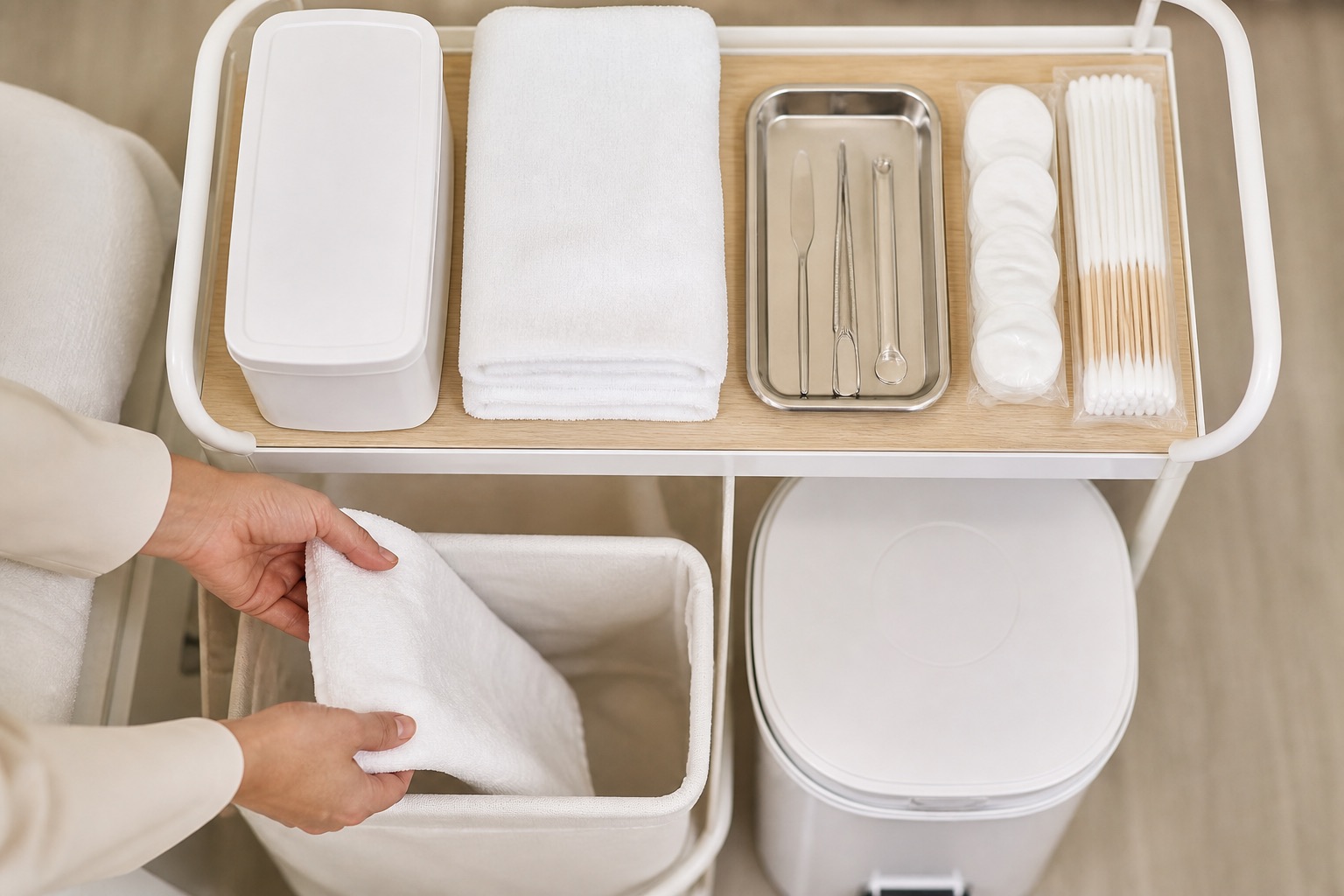
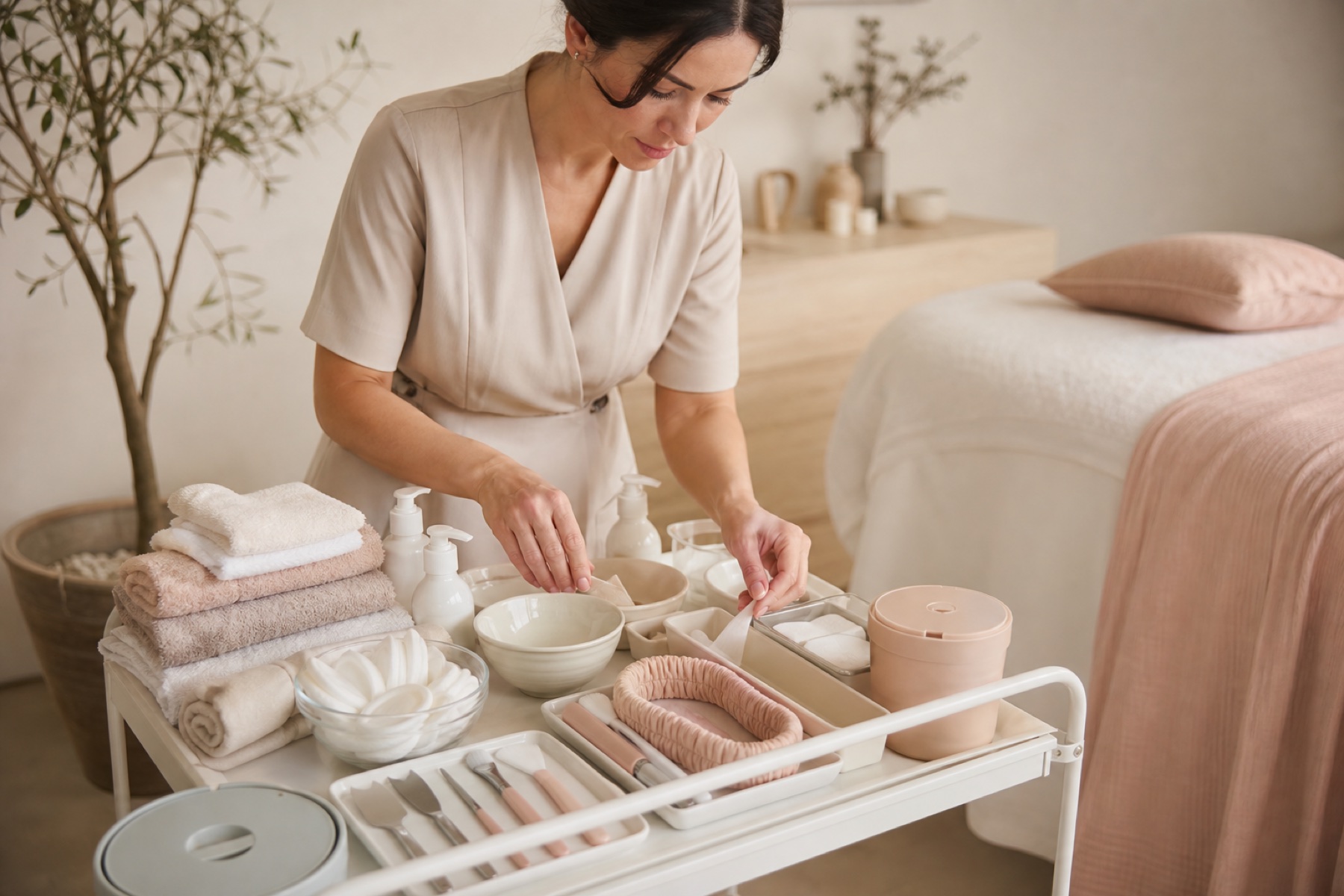
Place protected clean stock away from splash and treatment contact. The active tray contains only what this client needs. Used tools move directly to a rigid or suitable receiving container; linen goes into the designated bag; waste follows its classified route. Nothing placed on the active tray returns to bulk clean storage merely because it looks untouched.
Use physical distance, trays, colour or labels that staff can interpret without stopping treatment. Never place used items on a sink edge or top of a clean container. Replenish from clean stock only with clean hands or a clean retrieval method. One-way flow reduces memory-dependent decisions during busy turnover.
Hand hygiene: repeat it when the task changes
Perform hand hygiene before preparing clean materials, before touching the client, after touching used items or contaminated surfaces, after glove removal, after interruption and before returning to clean work. WHO guidance distinguishes handwashing when visibly soiled from appropriate alcohol-based handrub in other healthcare moments; the business must adapt methods to local guidance and product instructions.
Cover all hand surfaces for the stated time and allow them to dry before client contact. Rings, bracelets, watches and long or damaged nails create missed areas and scratching risk. Maintain skin integrity and cover cuts appropriately. Hand hygiene immediately followed by touching a phone, drawer handle or hair must be repeated before treatment.
Gloves do not replace hand hygiene and are not automatically required for every cosmetic massage. Use them when the task, product label, risk assessment or local rule indicates, select the correct material and change them between dirty and clean tasks. Never wash or disinfect disposable gloves for reuse.
Control nails, clothing, hair and phones
Keep working nails short, smooth and compatible with hand hygiene. Clothing should be clean, changed when contaminated and designed not to brush across the client or tray. Secure hair before preparation. Jewellery and lanyards that contact the treatment area need removal or controlled cleaning.
The phone is a high-touch object, not a clean camera by default. Use a managed device or cleanable barrier and a defined cleaning method compatible with the manufacturer. Perform hand hygiene after handling it before returning to the client. Transfer necessary images into the governed system and avoid leaving client photographs in personal galleries.
Prepare before the client arrives
Confirm that the previous cycle closed: surfaces processed and dry, reusable items released from the correct route, linen protected, waste removed, hand-hygiene supplies stocked and cleaning products within expiry. Inspect the bed, headrest, lamp, trolley and containers for damage. A cracked surface cannot be reliably processed and must be repaired or removed.
Review the service and client-specific exclusions, then place only the expected clean materials. Keep reserve stock closed. Do not pre-dispense cosmetics hours before use unless the product and procedure explicitly support it. Label any authorised prepared solution with identity, concentration, preparation and expiry according to its instructions.
Maintain hygiene while treatment is in progress
Pause when the workflow is interrupted. If hands touch a drawer, pen, phone, floor item, used textile or waste, complete the appropriate hygiene step before resuming. Do not open clean cupboards with contaminated hands. Use foot-operated or accessible containers when practical, but do not assume a lid removes the need for hand hygiene.
Dispense enough product using a pump, clean spatula or single-client portion. Never return leftovers to the original container. A spatula that touched skin, a used glove or the active tray must not re-enter a jar. If more product is needed, use a fresh retrieval tool and clean-hand process.
Turn over the workstation between clients without skipping steps
Close the service, perform hand hygiene as needed and remove the client safely.
Discard single-use items immediately into the correct waste stream.
Move used textiles without shaking them into the designated closed or controlled container.
Place reusable tools in their receiving container without crossing the clean zone.
Remove visible soil from surfaces and equipment with the approved cleaning method.
Apply the compatible disinfectant at label concentration and maintain full wet contact time.
Rinse only when instructed, allow surfaces to dry and inspect for residue or damage.
Perform hand hygiene, reset protected materials and record anomalies before the next client.
A ten-minute booking gap is not itself a validated protocol. Measure the real time needed for the products and layout. If contact time, drying, laundry handling and tool transfer cannot fit, change scheduling or add equipment rather than shortening the disinfectant step.
Close the cycle at the end of the day
Process low-frequency touch points, storage handles, reusable containers and cleaning equipment according to the schedule. Empty, clean and dry waste or linen receivers as appropriate. Inspect stock, expiry, pump function, tool integrity and linen supply. Remove damaged items from service rather than leaving a note for the next person.
Review logs for missed checks or incidents and close corrective actions. Store products at their required temperature, light and humidity conditions. Launder or route all used textiles; do not leave damp items overnight. A clean-looking reset that hides used tools in a container is not a closed cycle.
Handle textiles from collection to protected storage
Treat every textile used with a client as used even when no visible product remains. Remove it without shaking, keep it off clothing and clean surfaces, and move it in a dedicated washable or disposable container. Separate transport and storage routes for clean and used linen. Do not top up clean shelves with hands that handled used laundry.
Follow textile manufacturer instructions, local guidance and a validated laundry process for detergent, load, temperature, drying and storage. One temperature cannot be prescribed for every fabric, machine, detergent and rule. Items must be fully dry before protected storage. Replace textiles that remain stained, damaged, absorbent in the wrong places or cannot tolerate the required process.
Bed, headrest, headband, cushions and blankets
Use intact cleanable surfaces or a controlled barrier that is changed between clients. Process the entire touched zone, not only the centre of the bed. Headrest seams, controls and underside edges can be missed. A paper roll does not disinfect the bed and cannot cover damaged upholstery reliably.
Headbands and face-cradle covers are single-client textiles unless designed and processed otherwise. Cushions and blankets need washable covers or an approved barrier system plus a cleaning schedule. Client comfort items do not sit outside the hygiene map simply because they are decorative.
Cleaning, disinfection and sterilisation are different processes
Cleaning removes visible organic and inorganic soil using an appropriate detergent and mechanical action. CDC guidance emphasises that retained soil can interfere with disinfection and sterilisation. Disinfection reduces or eliminates many pathogenic microorganisms on inanimate objects according to product level and conditions. Sterilisation is a validated process intended to eliminate all forms of microbial life; it is not a UV storage box or a stronger-smelling spray.
Select the required process from intended use, material, manufacturer reprocessing instructions and local law. This guide addresses non-invasive manual skincare. It must not be used to design reprocessing for needles, lancets, invasive extraction tools or devices entering sterile tissue. Those require a separate regulated pathway and qualified expertise.
Select and use detergents and disinfectants by label
Choose a locally authorised product for the intended surface and required spectrum. Confirm dilution, water quality if specified, application method, temperature, ventilation, personal protection, wet contact time, rinsing, compatibility, storage and disposal. More concentrated is not automatically more effective and can damage surfaces or expose staff and clients.
Alcohol at a familiar percentage is not universal. It may evaporate before the required contact time, damage finishes, fail against the needed organisms or be inappropriate for a device. Never mix products unless the manufacturer explicitly instructs it. Keep safety data sheets and spill instructions accessible and train staff on the exact products in use.
Choose smooth, intact and reachable surfaces
Work surfaces should tolerate the selected cleaning and disinfection cycle without cracking, swelling or losing coating. Reduce decorative grooves, absorbent organisers and clutter around the active field. Cables, lamp joints, touch screens and bottle bases need accessible methods. If a surface cannot be reached, it cannot be claimed as processed.
Inspect integrity routinely. Tape over a crack does not restore a cleanable finish. Porous stone, unfinished wood and damaged plastics may be unsuitable for repeated professional use. Select furnishings based on reprocessing, ergonomics and service flow rather than an image alone.
Classify reusable tools before writing the reprocessing step
Record material, intended contact, joints, pores, adhesives, electronics and manufacturer instructions. A reusable label does not explain how many cycles the item tolerates or which chemicals are compatible. Reject tools that cannot be fully cleaned, dried and inspected. Keep used tools contained until the validated process begins.
Do not improvise sterilisation or high-level disinfection for a tool whose materials and use do not support it. Conversely, do not downgrade a process required by intended use or local regulation. When instructions are absent or conflict with workplace requirements, remove the item and seek manufacturer or competent advice.
Bowls, spatulas, brushes, pads and applicators
Use a clean individual bowl and enough fresh applicators for the full service. A single-use spatula is discarded after one retrieval or contact according to the defined process; it is not disinfected for another client. Do not double-dip after skin contact, even for the same client, because the container then becomes a future multi-client source.
Reusable brushes need a validated cleaning, disinfection, drying, inspection and protected-storage route compatible with bristles, ferrule and adhesive. Cotton pads and similar disposables stay protected until use. Anything dropped on the floor is treated as used, not recovered by selecting the side that looks clean.
Rollers, gua sha and facial-massage devices
Stone, metal and composite tools may contain pores, cracks, glue, moving parts or decorative coatings. Natural stone is not naturally antibacterial in a way that replaces processing. Inspect under good light and follow the manufacturer’s professional reprocessing instructions. Chips and inaccessible joints are removal criteria.
Electronic devices need a method that protects controls and does not drive liquid into openings. UV cabinets do not automatically sterilise tools: shadowing, dose, distance, time and device validation matter, and storage is not a substitute for cleaning. The cosmetic facial-massage guide covers tool technique and claims.
Single-use means one use, not simply cheap or fragile
A single-use item is discarded after its intended use and must not be cleaned, disinfected or passed to another client. Keep packaging protected and open at the point of use. Do not relabel a household disposable as professional reusable equipment or use visible cleanliness as permission for reuse.
Plan stock and waste so staff are never pressured to reuse an item during a busy day. If an item is accidentally contaminated before contact, discard or reprocess only if it is genuinely reusable under its instructions. Record recurring waste incidents and correct the layout rather than blaming individual carelessness.
Prevent cosmetic contamination during the service
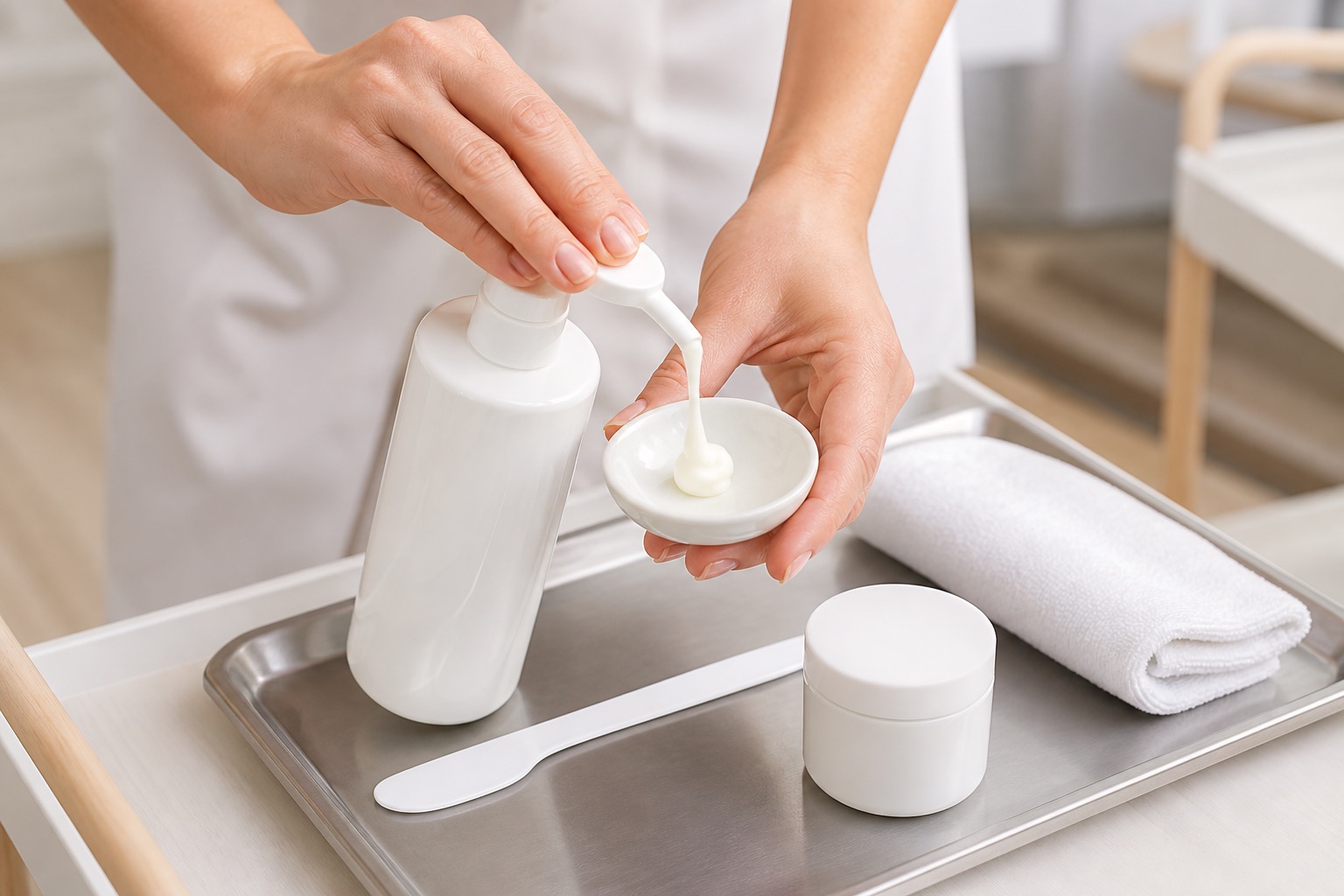
Prefer packaging that supports controlled dispensing. Clean the outer pump or cap when it becomes a touch point, but do not spray disinfectant into a cosmetic. Decant only when the manufacturer, applicable law and your controlled labelling process allow it. An elegant unlabelled bottle loses identity, batch, warnings, traceability and storage instructions.
Never add water, alcohol, fragrance or another product to change texture or extend stock. Do not combine leftovers from separate packages. If the dispenser touches skin or a used tool enters the container, isolate it and follow the contamination procedure; removing the top layer is not a validated recovery.
Track period after opening, minimum durability, batch and storage
Keep the original label and record opening where operationally useful. Period-after-opening and minimum-durability information are different. A date does not override visible alteration, packaging damage, recall or improper storage. Check batch details after an incident or recall but do not invent a batch from another unit.
Store cosmetics within manufacturer temperature, light, humidity and closure instructions, separated from cleaning chemicals and used materials. Rotate stock without overfilling treatment trays. The general skincare routine guide explains product use at home; professional stock also needs controlled traceability between clients.
Manage dropped items, contamination, spills and reactions
Define responses before incidents happen. A dropped textile enters the used-linen route. A dropped reusable tool enters its receiving container. A contaminated cosmetic is isolated. A spill is controlled using its safety data sheet and PPE. A client reaction stops the service, prioritises safety and follows the documented referral and incident process described in the skincare consultation guide.
Record date, item, product and batch when relevant, people involved, immediate control, client impact, disposal or reprocessing decision and corrective action. Do not hide an event by resetting quickly. The skincare client-record guide covers proportionate client documentation and privacy.
Exclude broken skin, eyes and uncertain areas
This protocol is for non-invasive cosmetic work on appropriate intact skin. Do not proceed over wounds, weeping areas, painful inflammation, possible infection or active eye symptoms. The professional skin-analysis guide explains observation boundaries without diagnosis. Do not use a surface disinfectant or tool-processing chemical on skin. Antiseptics and disinfectants have different intended uses and safety profiles.
Pause when the product migrates towards the eye, a client reports burning or an excluded area becomes exposed. The eye-area skincare guide covers cosmetic limits, while the sensitive and sensitised skin guide explains tolerance and routine simplification. Significant reactions need appropriate medical care.
Turn hygiene into a verifiable SOP and log
A standard operating procedure should identify responsibility, area, sequence, product, dilution, contact time, PPE, frequency, acceptance check, storage, incident action and record. Use photographs or diagrams for layout, not as substitutes for words. Train with demonstration and observation, then reassess when products, furniture, devices or services change.
Log what supports verification and action: date or cycle, responsible role, unusual condition, selected response and closure. Record prepared solutions or equipment maintenance where relevant. Avoid meaningless pre-ticked forms. Audit by watching a real turnover and checking whether the procedure matches reality.
Common mistakes and hygiene myths
Treating a disposable bed cover as cleaning and disinfection.
Using disinfectant on visible soil without an approved combined process.
Assuming 70% alcohol is correct for every surface, tool and organism.
Wearing the same gloves across phone, client, drawers and clean stock.
Double-dipping a spatula because it is still the same client.
Calling a UV storage cabinet a steriliser without validated evidence.
Storing clean textiles uncovered beside used-linen or splash zones.
Shortening wet contact time to fit the appointment schedule.
Decanting cosmetics into attractive unlabelled containers.
Using disinfectant smell or visible foam as proof of effectiveness.
Frequently asked questions about skincare workstation hygiene
Is wiping the treatment bed enough between clients?
No. Turnover includes used textiles and tools, waste, visible-soil removal, compatible disinfection with full contact time, drying, inspection, hand hygiene and a protected reset. Process all touched surfaces, not only the centre of the bed.
Are cleaning and disinfection the same?
No. Cleaning removes soil; disinfection uses a suitable process to eliminate many or all pathogenic microorganisms except those outside its validated level. Soil can interfere with disinfection. Follow a combined product only when its label supports both steps.
Can 70% alcohol be used everywhere?
No. Suitability depends on authorisation, organism spectrum, surface, device, wet contact time and manufacturer compatibility. It may evaporate too quickly or damage material. Select products by the defined task, not familiarity.
Are gloves required for facial massage?
Not universally. The task, skin integrity, product, risk assessment and local rules determine glove use. Gloves never replace hand hygiene and must be changed when moving between contaminated and clean tasks.
Can single-use spatulas be disinfected and reused?
No. Single-use items are discarded after their intended use. Reprocessing them creates an unvalidated product with uncertain material integrity. Keep enough stock so reuse never becomes the emergency plan.
Can one spatula enter the same jar twice for one client?
Not after it has touched skin, a glove or the active field. The jar will be used later for other clients. Use a fresh spatula for each retrieval or pre-dispense a controlled single-client amount.
Can leftover product return to the bottle?
No. Discard the client portion according to the process. Returning it can introduce contamination and breaks batch integrity. Improve future portioning rather than recovering leftovers.
How long must a surface remain wet?
For the full contact time stated by the authorised product label under its conditions. If it dries early, follow manufacturer guidance; do not assume an incomplete interval is enough. Scheduling must accommodate the process.
At what temperature should skincare towels be washed?
There is no universal number for every fabric, machine, detergent and local rule. Use a validated laundry cycle consistent with textile instructions and guidance, avoid overloading and dry completely before protected storage.
Can headbands be reused during the same day?
A headband used with one client enters the used-textile route. Use a fresh processed headband or genuine single-use item for the next client. Looking dry does not return it to clean status.
Are stone rollers and gua sha naturally antibacterial?
Do not rely on that claim. Material may be porous, cracked, glued or coated. Follow professional reprocessing instructions, inspect every surface and remove tools that cannot be reliably cleaned, dried and disinfected.
Does a UV cabinet sterilise tools?
Not automatically. Sterilisation requires a validated process; UV effectiveness depends on dose, time, distance, wavelength, cleanliness and direct exposure. A storage cabinet is not evidence that all surfaces are sterile.
Can cream be decanted into a prettier dispenser?
Only if the manufacturer, applicable law and a controlled labelling and hygiene process allow it. Otherwise identity, batch, warnings, compatibility and traceability are lost. Keep original professional packaging whenever possible.
How should a phone used for photographs be handled?
Use a managed device or cleanable barrier and a manufacturer-compatible cleaning process. Treat it as a contaminated touch point, perform hand hygiene before resuming and transfer necessary images out of personal galleries securely.
Does disinfectant smell prove the station is safe?
No. Odour does not prove cleaning, concentration, spectrum or contact time and may signal unnecessary exposure. Safety depends on the correct authorised process, ventilation and label-led use.
What if a used spatula re-enters the jar?
Isolate the product and follow the defined contamination procedure, recording package and batch when relevant. Do not remove only the top layer or use it on someone else. Correct the layout and retrieval process that allowed the event.
When should a reusable tool be discarded?
When cracked, porous, rusted, deformed, inaccessible to cleaning, incompatible with the required process or missing adequate professional instructions. Disinfection cannot repair damage. Inspect after every cycle.
What happens when a towel falls on the floor?
Treat it as used, place it in the designated container without shaking and replace it. Do not use the side that appears clean or rest it on the trolley. Stock must allow safe recovery from small incidents.
Can the trolley be prepared hours in advance?
Expose as little as possible shortly before the service. If preparation is earlier, protect clean textiles, tools and disposables from dust, splash and handling. Dispense cosmetics only at the appropriate time.
What should a workstation log contain?
Record what enables verification and action: date or cycle, responsible role, relevant product or equipment, anomaly, decision and closure. Maintenance, excluded tools, prepared solutions and incidents deserve traceability. Avoid automatic ticks nobody reviews.
Does workstation hygiene prevent every infection and reaction?
No. It reduces controllable risks but cannot make a service risk-free or prevent individual intolerance and pre-existing conditions. Client selection, compliant cosmetics, prudent technique, stop decisions and referral remain necessary.
Authoritative references
World Health Organization: hand-hygiene indications and technique. Read Hand Hygiene: Why, How & When
World Health Organization: illustrated handwashing method. Read How to handwash
CDC: technical definitions of cleaning, disinfection and sterilisation and factors affecting efficacy. Read the CDC definitions
CDC: selection, preparation, storage and compatibility of cleaning supplies and equipment. Read the CDC guidance
EUR-Lex: current consolidated EU Cosmetics Regulation for product safety, labelling and traceability where applicable. Read Regulation (EC) No 1223/2009
Continue through the English skincare guide hub or explore online skincare courses for curriculum details. A trustworthy workstation is not the one that smells strongest: it is the one whose clean-to-used flow, product use, contact time, storage and corrective actions can be explained and verified.
If you are turning this topic into a structured learning plan, use the online skincare-course selection checklist to compare curriculum, teacher, demonstrations, practice, feedback, access, total cost and certificate wording without confusing private training with professional authorisation.
If you want to turn this knowledge into a defined service, continue with the guide to becoming a skincare consultant: it connects training, demonstrable skills, portfolio, boundaries, work models and a controlled launch without confusing cosmetic consultation, beauty treatment and healthcare.
Turn the protocol into a proportionate inventory with the professional skincare and facial-massage kit guide: it sizes furniture, textiles, tools, consumables, cosmetics, stock and optional equipment to the real service instead of building an unnecessarily complex trolley.