
Mature skin does not begin on a particular birthday and it is not a skin type. The phrase is useful for describing gradual changes shaped by time, hormones, ultraviolet exposure, environment and individual history. Mature skin can be dry, oily, combination, sensitive or resilient. It may have visible lines without discomfort or look smooth while losing comfort easily. An effective routine therefore starts with what the skin does today, not the age printed on a jar.
Quick answer: begin with a small, dependable base — non-stripping cleansing when needed, a moisturiser suited to comfort and water loss, daily broad-spectrum photoprotection, and one optional active for a measurable priority. Starting retinol, vitamin C, acids, peptides and several serums together does not accelerate results. It raises the chance of irritation and makes it difficult to identify what is useful.
This guide owns the essential-routine and gradual-active intent. The dry versus dehydrated skin guide owns that distinction; the cosmetic retinoids guide owns forms and precautions; the facial dark-spots guide owns pigment evaluation and referral.
This educational page requires independent dermatological review and has not been medically reviewed. It does not diagnose xerosis, dermatitis, rosacea, skin cancer or hormonal conditions, and it cannot change a prescription. A new or changing lesion, a wound that does not heal, persistent bleeding, pain or severe itch needs assessment rather than an anti-age product.
Mature skin is a useful description, not a diagnosis or skin type
Chronological ageing describes the passage of time; photoageing describes part of the change associated with cumulative ultraviolet exposure. They overlap but are not identical. Genetics, smoking, climate, outdoor work, medicines, health conditions, menopause and daily habits can alter dryness, elasticity, pigmentation and vulnerability differently in people of the same age.
Skin may become thinner, produce less oil and sweat, retain less water and recover more slowly after stress. Collagen and elastin change, lines become more visible and vessels may be more fragile. These are tendencies, not a required checklist. They do not appear together in every person, and a wrinkle is not a disease that must be corrected.
‘Anti-ageing’ is marketing language rather than one measurable endpoint. A cosmetic may improve hydration, temporary smoothness, visible evenness or tolerance. It cannot stop time or provide the structural result of surgery. Immediate plumping often comes from hydration and is temporary. A permanent face-lift claim from a cream exceeds the realistic reach of a cosmetic.
Observe current skin before buying age-labelled products
Record four dimensions for two weeks: comfort after washing, shine by zone, scale or roughness, and reactivity to products or climate. Add the main objective, current routine, medicines, recent procedures and exposure. ‘Look younger’ cannot be measured; ‘reduce evening tightness without causing comedones’ or ‘introduce one retinoid while maintaining comfort’ can.
Use the skin types and conditions guide to separate oil production, hydration and sensitivity. Do not assume mature skin is dry. A shiny T-zone can coexist with dehydrated cheeks, and a very rich cream can remain uncomfortable after sixty.
Photograph only visual endpoints in diffuse, repeatable light. Tightness, itch and burning belong in notes, not photographs. A new, different or non-healing lesion, or one that changes, crusts or bleeds, must not be filed in an anti-age diary. The dark-spots guide explains why examination comes before fading or procedures.
An essential routine has four functions, not ten compulsory products
A readable routine removes dirt, makeup and resistant film when necessary; supports water and lipid retention; protects from exposure; and optionally treats one defined priority. Toner, essence, mist, booster, oil and mask are not mandatory categories. They may be enjoyable, but each should justify its function without duplicating ingredients, film or irritation.
The morning and evening skincare pillar owns universal order, waiting and exceptions. Here the decision is simpler: establish a stable base for several weeks, then change one variable. Texture order is useful only when it supports function and compatible films.
Morning routine for mature skin
Step 1 — Cleanse only when the skin needs it
Use lukewarm water or a mild cleanser when oil, sweat or night-time residue needs removal. Alkaline soap, hot water and brushes do not make skin more receptive. If it feels tight immediately after washing, reduce duration, temperature, friction and surfactant load before buying another serum.
Step 2 — Add one optional morning active
Vitamin C or niacinamide can be considered for a defined objective, but neither is compulsory and they do not have to be paired. Introduce one finished product and assess tolerance. An antioxidant cannot replace sunscreen, and a high percentage does not compensate for instability or poor usability.
Step 3 — Moisturise and protect
Apply moisturiser where needed and finish with broad-spectrum SPF 30 or higher on exposed skin. Find a sunscreen that can be used at the labelled amount without excessive dryness or pilling. The daily face-sunscreen guide covers quantity, texture, water resistance and reapplication.
Evening routine for mature skin
Step 1 — Remove sunscreen and makeup with minimum force
Double cleansing can be useful for resistant film, but it is not a universal ritual. Use an oil-based first cleanser and a water-based second cleanser only when residue and comfort justify both. The double-cleansing guide explains how to choose without repeated rubbing.
Step 2 — Use the planned active or choose a recovery night
On dry, intact, comfortable skin, apply the one active planned for that evening and then moisturiser, unless the label or clinician states a different order. On recovery nights, moisturiser alone can be the complete treatment step. Peeling is not a target; growing burning, persistent redness, cracks or itch show that the plan is not being tolerated.
Step 3 — Treat neck, chest and hands as separate tolerance zones
Gentle cleansing, moisturiser and sunscreen can often extend to the neck, upper chest and hands, but these areas do not automatically tolerate the face dose of a retinoid or acid. Introduce separately. Eyelids, nose folds and mouth corners are particularly vulnerable and should not receive a product unless its directions permit that area.
Hydration: water, lipids and texture chosen by function
Humectants such as glycerin and hyaluronic acid help bind water in the stratum corneum. Emollients smooth gaps between surface cells; occlusives reduce water loss; ceramides and other lipids can support barrier organisation. No family is ‘for old people’. Its value depends on the complete formula, climate, amount and how the skin feels.
A systematic review of basic care for older skin found supportive signals for mild cleansers and moisturisers containing humectant or occlusive components, while highlighting methodological limitations and insufficient evidence to name one winning ingredient. The skin hydration guide owns the detailed comparison and formula logic.
Apply moisturiser to slightly damp skin when compatible with the formula and any treatment. A richer cream can help during cold weather or heating, while a lotion may suit combination skin or summer. First adjust the amount or frequency of one tolerated formula; do not automatically layer three moisturisers.
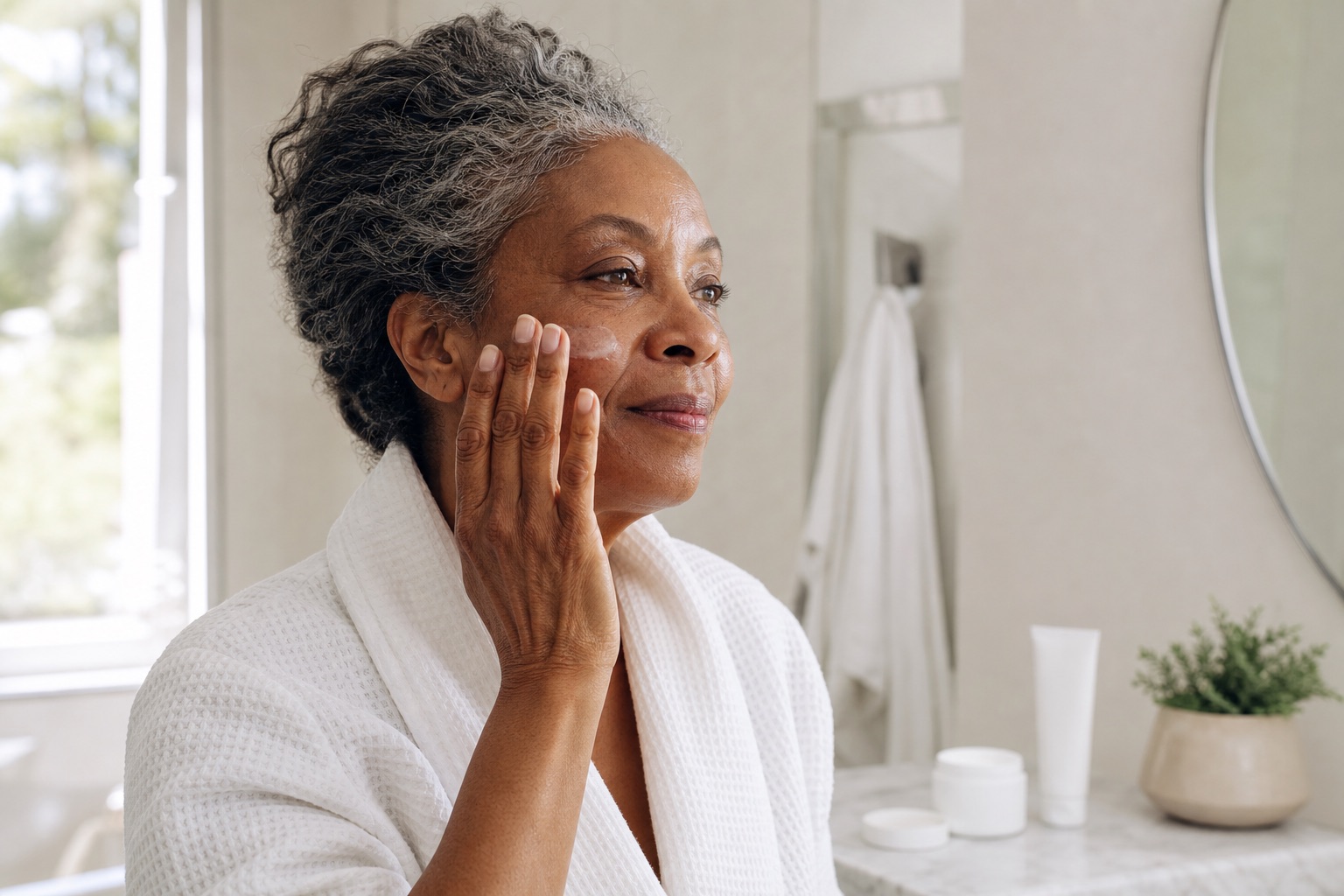
When dryness is not only a cosmetic issue
Severe dryness, widespread itch, cracks, bleeding, pain or rash can reflect dermatitis, medicines, systemic illness or another condition. Older skin may be thinner, lose water more easily, bruise more readily and heal more slowly, while health conditions and treatment can also contribute. Do not attribute every symptom to age or conceal it with fragranced oils.
The damaged skin barrier guide helps simplify after cosmetic overload, while the sensitive-versus-sensitised guide separates recurring sensitivity from temporary reactivity. If symptoms do not improve with gentle basic care or affect sleep, seek assessment.
Medication and health history matter
Do not stop a medicine because skin changed after it was introduced. Record timing and discuss it with the prescriber or pharmacist. Sudden widespread dryness, severe itch, yellowing, bruising, swelling or systemic symptoms should not be managed by a new moisturiser alone.
Photoprotection remains valuable at every age
Ultraviolet radiation contributes to wrinkles, discolouration, loss of elasticity and skin cancer. Protection remains useful after signs are already present because it reduces additional exposure and supports other treatment. No sunscreen blocks all radiation, and sunscreen is only one part of a photoprotection system.
Use shade, protective clothing, a broad-brimmed hat and sunglasses alongside the product. Reapply during prolonged exposure and after water, sweat or rubbing according to its label. If a formula is too drying or emphasises lines, change texture or layering instead of reducing the amount. Foundation protects only when it carries an appropriate claim and is applied at the tested dose, which is rarely the amount used for makeup.
Introduce actives with a five-step method
1. Stabilise the base
Keep cleanser, moisturiser and sunscreen consistent for at least two weeks when the skin is comfortable and intact. If the base burns, the next active will not produce readable information. Prescription schedules take priority over this generic timing.
2. Choose one measurable priority
Select texture, a clinically assessed pigment concern, fine lines or another defined endpoint. No product treats every feature of ageing. One target allows a realistic formula choice and reduces duplicate ingredients.
3. Read the complete product directions
Check the active, concentration when disclosed, area, amount, frequency, warnings, pregnancy advice, storage and period after opening. Do not infer dose from a social-media routine. Compare the finished formula, not only the headline ingredient.
4. Introduce it without parallel experiments
Start at the cautious labelled frequency on an appropriate intact area. Do not add a new acid, scrub or device at the same time. A home tolerance test may reveal a local reaction but cannot guarantee whole-face tolerance or diagnose allergy.
5. Review tolerance before increasing
Record amount, frequency, comfort and the chosen visual endpoint. Two well-tolerated applications per week can be a stable schedule rather than a failure to reach daily use. The skincare actives pillar owns combinations, total load and stop criteria.
Retinol and retinoids: real potential, non-negotiable tolerance
Retinoids are among the most studied topical options for photoageing and fine lines, but cosmetics and medicines are not interchangeable. Tretinoin is a medicine; retinol and retinal appear in cosmetics with different conversion, stability and vehicles. Systematic reviews support tretinoin for photoaged skin while noting variation in dose, tolerability and study quality.
Retinoids remain optional in a mature-skin routine. If use causes persistent inflammation, it is not simply ‘speeding renewal’. Follow the product or prescriber for reduction or discontinuation and seek support. Pregnancy, trying to conceive and breastfeeding require professional review; do not use an anti-age article to override contraindications.
More irritation does not mean more collagen
Peeling and burning are adverse tolerance signals, not a measure of dermal change. Reduce the total routine load instead of buffering severe irritation with several soothing products. If a prescription retinoid is involved, ask the prescriber before changing schedule or layer order.
Vitamin C, niacinamide, exfoliants and peptides have different roles
Vitamin C
Vitamin C may support antioxidant protection and visible evenness, but form, pH, concentration, packaging and oxidation change the product. The dedicated vitamin C guide owns those decisions. Morning use is not compulsory if the formula irritates or disrupts sunscreen.
Niacinamide
Niacinamide can support barrier, sebum and selected evenness outcomes, but higher concentration does not guarantee better results. Count the same ingredient across serum, moisturiser and sunscreen. The niacinamide guide explains why a complete, tolerated formula is more useful than a headline percentage.
AHA, BHA and PHA
Hydroxy acids alter exfoliation in different ways. They are not required to ‘thin’ mature skin and should not be layered on retinoid-related peeling. The AHA, BHA and PHA guide owns family differences and frequency. A granular scrub is not automatically gentler because it is acid-free.
Peptides and topical collagen
Some peptide formulas and moisturisers can improve surface feel and selected appearance outcomes, but ‘contains collagen’ does not mean rebuilding dermal collagen. Evaluate studies on the finished formula, conflicts of interest, endpoint and duration. A comfortable moisturiser used daily can provide more practical value than an expensive serum abandoned after a week.
Menopause and hormonal change: adapt without self-diagnosis
During and after menopause, reduced oestrogen can contribute to dryness, thinning, lower elasticity, slower healing and more visible lines. The degree varies. First adjust cleansing, moisturiser texture, body care and photoprotection, then introduce one active. Do not assume every sudden rash, flushing episode or hair change is a normal cosmetic part of menopause.
Record symptoms and timing and discuss significant changes with a dermatologist, general practitioner or gynaecological clinician. Do not begin hormones, topical phytoestrogens or supplements on the basis of a cosmetic claim. Medicines, health conditions and vulvovaginal symptoms require the appropriate healthcare professional.
Common mistakes in mature-skin routines
Buying a complete ‘50+’ range without identifying functions, duplicate actives or the current skin type.
Starting several actives to make up for lost time and treating stinging as evidence of efficacy.
Using hot water, stripping cleansers or scrubs on skin already peeling from a retinoid.
Reducing sunscreen amount to avoid pilling instead of correcting incompatible layers.
Changing products every week and comparing with filtered photographs rather than a stable personal baseline.
Do not assign a different cosmetic to every line. A valid result can be more comfortable, resilient and protected skin even when expression lines remain visible. The correct comparison is with a consistent baseline and defined endpoint, not a face altered by lighting or software.
How to review the routine without chasing daily fluctuations
Use a stable baseline and one measurable question
Keep cleanser, moisturiser and sunscreen stable while assessing one treatment. Note comfort after cleansing, evening tightness, visible scale, redness and the exact frequency used. Review tolerance after several uses and appearance outcomes over an appropriate longer interval; a single morning, menstrual phase, flight or weather change is not a reliable verdict.
Separate hydration, oil and sensitivity observations
Photograph only when lighting, distance and camera settings can be repeated, and pair images with written symptoms. The skin types and current conditions guide provides a neutral observation framework so temporary dehydration, shine or sensitisation is not automatically attributed to age. Stop and reassess when discomfort increases rather than waiting for a cosmetic calendar deadline.
A responsible protocol for skincare and beauty professionals
Record objective, tolerance and referral signs
Collect the goal, comfort, products, reported medicines, allergies, procedures, exposure and recent change without diagnosing. Observe integrity, scaling, oil distribution and irritation. Do not describe normal ageing as damage or exploit a magnifying mirror to create dissatisfaction.
Provide one written cosmetic change
Establish an essential base, specify order, amount, frequency and stop signs, then schedule review. Do not promise rejuvenation, lifting, collagen reconstruction or wrinkle erasure. Explore online skincare courses for structured education in observation, formulation, hygiene and professional limits.
Do not treat uncertain lesions
Refer a new, changing, symptomatic or non-healing lesion before peels, devices or massage. A beauty professional cannot diagnose, prescribe or advise stopping medicines. Clear boundaries protect the client and make cosmetic follow-up more credible.
When to see a dermatologist
Seek assessment for a new or changing lesion; a wound that does not heal; repeated bleeding or crusting; persistent pain or itch; severe dryness with cracks or rash; marked redness; a reaction that does not improve after stopping new products; or interest in prescription treatment and procedures. Do not wait for a lesion to meet every ABCDE criterion.
A dermatologist can distinguish photoageing from disease, examine lesions, review medicines and decide whether a procedure is appropriate. Before a peel, laser, microneedling or other intervention, ask about indication, provider qualification, risk for your skin tone, management of complications and photoprotection.
Frequently asked questions about mature-skin skincare
At what age does skin become mature?
There is no universal biological threshold. Barrier, sebum, elasticity and pigment change according to genetics, exposure, hormones and health. Choose products for current comfort and goals rather than an age number on the package.
Is mature skin always dry?
No. Oil production may decrease, but mature skin can remain oily, combination or acne-prone. Dryness and dehydration can coexist with shine. Observe zones and symptoms rather than automatically using a very occlusive cream.
What is the minimum mature-skin routine?
Morning: cleanse if needed, moisturise where useful and apply sunscreen. Evening: remove the day's film, cleanse gently and moisturise. Add one treatment only for a defined priority. Consistency matters more than the number of steps.
Is a richer cream always better after fifty?
No. Rich texture may help in cold weather or marked dryness and feel heavy on combination skin or in summer. Adjust by zone, climate and comfort. A formula does not become appropriate because its label targets an age bracket.
Are ceramides essential?
They can support a barrier-focused formula, but their presence alone does not measure performance. Humectants, emollients, occlusives, vehicle and consistent use work together. Do not replace a well-tolerated moisturiser solely because it does not advertise ceramides.
Is sunscreen useful in winter and after sixty?
Yes, when skin is exposed. UVA contributes to photoageing and skin risk and does not disappear with season or age. Adapt product and reapplication to actual exposure and combine it with shade, clothing, hat and sunglasses.
What is the best anti-ageing active?
There is no winner for every person and endpoint. Retinoids, vitamin C, niacinamide and acids address different outcomes and have different tolerance. Sunscreen and moisturiser come first; then choose one priority with relevant evidence.
How should retinol be started on mature skin?
Stabilise the base, choose an appropriate formula, follow its directions and begin cautiously without other new actives. Moisturise and protect from the sun. Pregnancy, trying to conceive, breastfeeding, disease or strong sensitivity requires professional advice.
Does mature skin need more frequent exfoliation?
No. Roughness does not justify aggressive exfoliation. Combining acids, scrubs and retinoids can impair comfort and worsen discolouration. Use one strategy at a tolerated frequency and pause on irritated skin.
Can collagen creams erase wrinkles?
No cosmetic permanently erases every wrinkle or rebuilds deep tissue simply because it contains collagen. Hydration can temporarily soften the appearance of lines. Evaluate evidence on the complete product rather than transferring a claim from one ingredient.
What should I do if an active burns and peels?
Stop new irritants, return to gentle cleansing, moisturiser and sunscreen, and do not cover the reaction with another acid. Significant or persistent pain, swelling, blisters, cracks or rash needs medical advice. Do not call it a necessary purge.
When does dryness require a dermatologist?
When it is severe or sudden, very itchy, cracked, bleeding, associated with rash, disrupting sleep, not improving with simple care, or beginning with a medicine or systemic symptom. Xerosis and dermatitis cannot always be distinguished from a photograph.
What can a beauty professional do for mature skin?
They can record goals, observe integrity and comfort, explain cosmetic functions, propose a simple base, document tolerance and refer appropriately. They cannot diagnose, prescribe, alter medicine or promise permanent lifting and rejuvenation.
Clinical and scientific sources
National Institute on Aging: skin changes with age, protection and signs that need attention. Read the NIA guidance
American Academy of Dermatology: selecting focused anti-ageing skincare with realistic expectations. Read the AAD guidance
American Academy of Dermatology: skin care in the sixties and seventies, sun protection and lesion checks. Read the AAD guidance
American Academy of Dermatology: retinol and retinoid differences and cautious introduction. Read the AAD guidance
Yao et al.: systematic review and meta-analysis of xerosis in older adults. Read the PubMed record
Kottner et al.: systematic review of basic care and older-skin integrity, including evidence limitations. Read the PubMed record
Siddiqui et al.: systematic review of tretinoin and other topical photoageing therapies. Read the PubMed record
Sitohang et al.: systematic review of randomised trials of topical tretinoin for photoageing. Read the PubMed record
Browse the English skincare guide hub for separate guidance on barrier, actives, hydration, pigmentation and sunscreen. The best routine does not fight age; it makes skin more comfortable, protected and understandable over time.
For a careful comparison of dryness, puffiness, structural bags and different dark-circle components, read the eye-area skincare guide for a simple routine, periocular safety and realistic cosmetic limits.
To turn cosmetic observations and existing products into a plan a client can understand and follow, use the professional skincare-consultation protocol for intake, product audit, written handover, follow-up and referral boundaries.
For a proportionate record of products, reported reactions, separate permissions, photographs, retention and professional stop decisions, read the skincare client-record guide without turning cosmetic documentation into an improvised medical chart.
For a controlled hands-on protocol covering preparation, pressure, zone sequence, contraindications and realistic claims, read the cosmetic facial-massage guide and keep every movement inside professional scope.
For a verifiable clean-to-used workflow covering hands, textiles, tools, surfaces, cosmetic dispensing and turnover, read the skincare workstation-hygiene guide before designing or auditing a hands-on service.