Vitamin C in skincare does not describe one formula. L-ascorbic acid, ascorbyl glucoside, sodium ascorbyl phosphate, magnesium ascorbyl phosphate, 3-O-ethyl ascorbic acid and oil-soluble derivatives differ in chemistry, stability and evidence. To understand a product, identify the INCI name, what its percentage actually refers to, pH where relevant, vehicle, packaging, directions and tolerance. ‘Vitamin C’ on the front label is not enough.
Quick answer: L-ascorbic acid has the most recognisable topical evidence but is difficult to stabilise and commonly requires an acidic formula. Derivatives may be easier to formulate, yet they differ in penetration, conversion and clinical evidence. Choose the finished product rather than an abstract ranking. Introduce it alone, follow storage and period-after-opening instructions, and never treat vitamin C as a substitute for sunscreen.
This is BeautyLearn’s single guide to topical vitamin C. It includes ascorbic acid, derivatives, concentration, pH, oxidation, morning versus evening use and combinations instead of creating thin pages for each derivative. The general method for combining ingredients remains in the skincare actives pillar, while the full product sequence remains in the morning and evening routine guide. Here the independent intent is how to read, store and use a vitamin C formula.
What vitamin C means in a cosmetic
Vitamin C is ascorbic acid, a water-soluble molecule involved in antioxidant systems and collagen biosynthesis. Its physiological role does not prove that every topical product reaches the same site or produces the same result. The stratum corneum is an effective barrier, while ascorbic acid is polar and ionisable; delivery depends heavily on formulation.
In cosmetics, vitamin C can mean free ascorbic acid, a salt, an ester, a phosphate- or glucose-containing derivative, or an encapsulated system. Some vitamin C ingredients mainly help protect the formula from oxidation rather than being present in the form or amount studied for a visible skin effect. The ingredient list identifies a declared name but does not reveal exact concentration, purity at the end of shelf life, release rate or conversion in skin.
Realistic cosmetic goals include antioxidant support and gradual improvement in the appearance of brightness, uneven tone and signs of photoageing when a suitable formula is used consistently. Small clinical studies have reported improvements with specific preparations, but samples, vehicles, concentrations and durations vary. A mechanism is not a promise to erase pigmentation, cure acne, measure collagen at home or provide independent UV protection.
L-ascorbic acid: the best studied and most demanding form
Ascorbic Acid in an INCI list normally means ascorbic acid; L-ascorbic acid specifies the biologically relevant stereoisomer. It has the clearest topical research history but is unstable in water and vulnerable to oxygen, light, heat and unfavourable formulation conditions. At physiological pH it is largely ionised and crosses the stratum corneum poorly. The challenge is not placing a percentage in a bottle; it is preserving and delivering a useful amount throughout use.
A frequently cited 2001 porcine-skin study found measurable L-ascorbic-acid penetration below pH 3.5 and saturation around 20% under its experimental conditions. That finding became the popular ‘10–20% below pH 3.5’ rule. It is a meaningful formulation reference, not a universal consumer prescription. It does not prove that everyone needs 20%, that lower concentrations cannot work or that the same scale applies to derivatives and unrelated products.
Acidity can increase sting and irritation, especially when the barrier is disrupted or the routine already includes exfoliants, retinoids, scrubs or recent procedures. A higher percentage does not rescue a degraded product or guarantee greater benefit. Anhydrous vehicles, emulsions, solvents, complementary antioxidants, chelators, viscosity and dispensing systems all influence stability and release. Two 15% ascorbic-acid serums are not automatically equivalent.
Vitamin C derivatives: a map, not a ranking
Derivatives are developed to alter stability, solubility or formulation compatibility. To produce effects attributed to ascorbic acid, they must reach a relevant site and, for many forms, be converted. Better bottle stability does not automatically prove better delivery; greater oil solubility does not prove efficient conversion; promising laboratory activity does not establish clinical effectiveness of every finished product. Evidence must be interpreted form by form and formula by formula.
Ascorbyl glucoside
Ascorbyl Glucoside links ascorbic acid to glucose and is designed for improved stability in aqueous formulas. It requires enzymatic conversion and may be formulated at a less acidic pH than L-ascorbic acid. Its front-label percentage cannot be converted one to one to an Ascorbic Acid percentage. Compare finished-product evidence, vehicle, directions and tolerance rather than labelling it weak or strong from its INCI position.
Sodium and magnesium ascorbyl phosphate
Sodium Ascorbyl Phosphate (SAP) and Magnesium Ascorbyl Phosphate (MAP) are water-soluble phosphate derivatives that are generally more stable near neutral pH than free ascorbic acid. They need dephosphorylation to release ascorbate. Evidence for penetration, conversion and clinical outcomes is more limited and product-dependent. A potentially more comfortable pH does not guarantee suitability for sensitive skin when the rest of the formula contains fragrance, solvents or other actives.
3-O-ethyl ascorbic acid
3-O-Ethyl Ascorbic Acid is an ethylated derivative with both water and partial lipid solubility, developed to improve stability and availability. It appears in many modern serums, but independent clinical evidence is not as extensive as for L-ascorbic acid. Do not use social-media conversion tables to turn its percentage into an ascorbic-acid equivalent. Purity, vehicle, pH, degradation and the tested finished product remain decisive.
Tetrahexyldecyl ascorbate and ascorbyl tetraisopalmitate
Tetrahexyldecyl Ascorbate and Ascorbyl Tetraisopalmitate are names used for oil-soluble derivatives and are sometimes treated as synonyms or superior forms in marketing. Verify the exact nomenclature and commercial ingredient in the actual product. Lipid solubility supports use in oils and anhydrous formulas but does not independently prove penetration, conversion or clinical superiority.
Ascorbyl palmitate and other forms
Ascorbyl Palmitate is a lipophilic ester also used to protect formulations from oxidation. Early research does not show that every derivative increases skin levels of L-ascorbic acid. Sodium Ascorbate, Calcium Ascorbate and other salts have specific formulation roles, but ‘stabilised vitamin C’ is too vague for technical comparison. If a brand does not identify the form, a responsible assessment stops there.
Separate concentration, pH, vehicle and finished formula
A percentage only has meaning alongside the substance name. Ten per cent Ascorbic Acid, ten per cent of a commercial derivative solution and ten per cent of a ‘vitamin complex’ describe different exposure. Check whether the number refers to the pure molecule, a supplier solution or an entire blend. When a brand does not clarify, the active level cannot be reconstructed from INCI order.
pH is important for some aqueous L-ascorbic-acid formulas because it changes ionisation, penetration and degradation. It is not a universal product score. Derivatives may use different pH ranges, and anhydrous products cannot be interpreted in the same way. Home pH strips are unreliable in viscous creams. Never acidify a cosmetic with powder, lemon juice or another acid; that changes preservation, distribution and safety.
The vehicle determines where the ingredient sits, how it is protected and how it spreads and releases. Water, glycols, silicones, oils, emulsions and encapsulation systems behave differently. Vitamin E and ferulic acid may support stability and antioxidant performance in specific formulations, but mixing three separate products in the palm does not recreate the studied formula.
The finished product is therefore the unit to judge. A lower-concentration formula that remains stable, is well packaged and can be tolerated consistently may be more useful than an aggressive product used sporadically. Look for finished-product stability data and clear storage directions when available. ‘Pharmaceutical grade’ on a cosmetic is not proof of clinical performance.
What challenges vitamin C stability
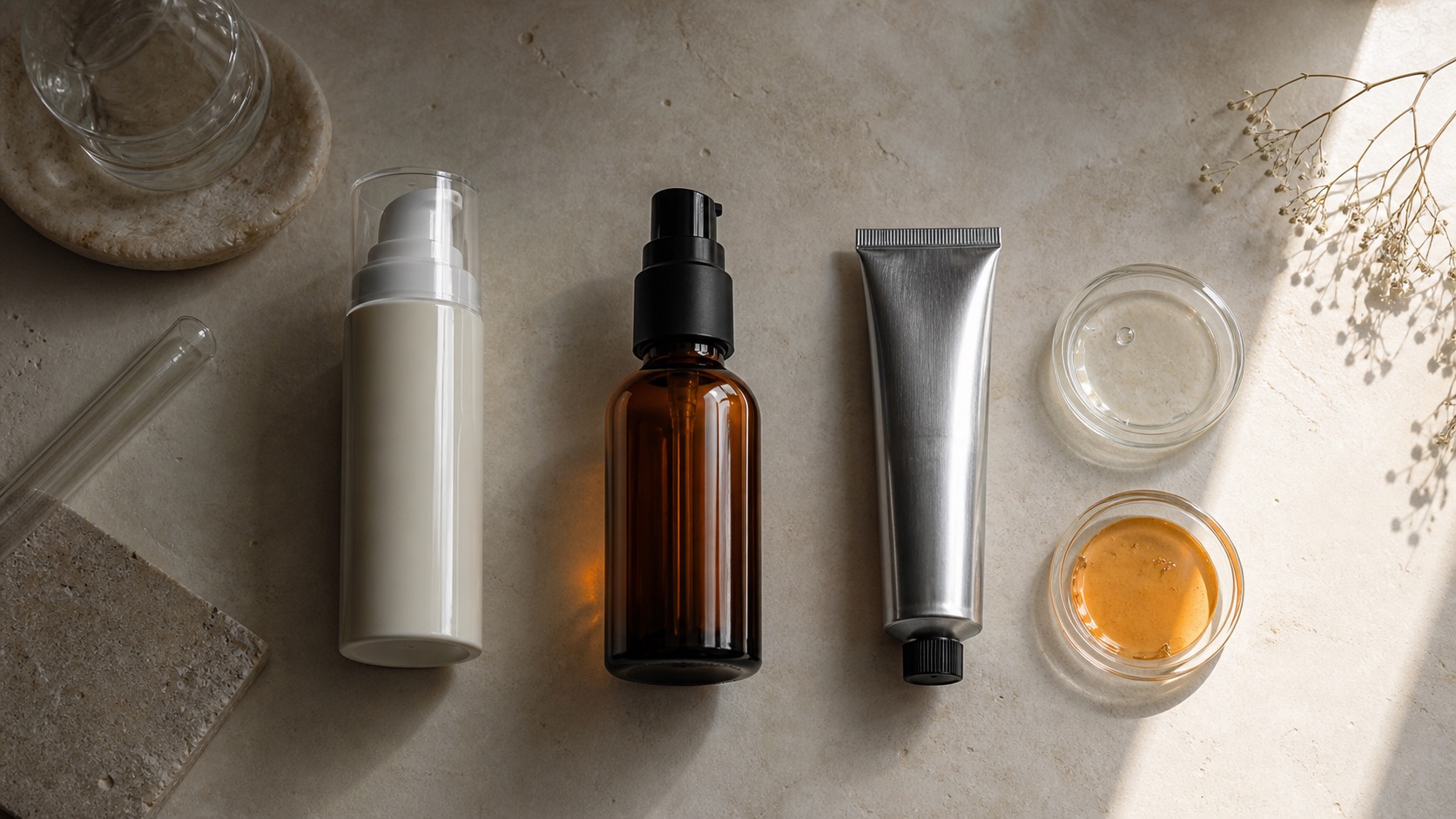
Ascorbic acid can lose electrons to become dehydroascorbic acid, followed by further degradation reactions. In aqueous formulas, dissolved oxygen, light, temperature, pH and trace metals can accelerate change. Studies of creams show that viscosity, emulsion structure, acidity and excipients alter the rate. There is no universal lifespan derived from the molecule alone, and oxidation can continue in the dark even though light may accelerate it.
Light: keep the product away from direct sunlight and strong lamps.
Oxygen: close it promptly; air-restricting packaging may help but cannot eliminate all exchange.
Heat: avoid cars, radiators, hot bathrooms and heated surfaces; follow the stated temperature.
Water and pH: these belong to formulation design, not DIY powder-and-water experiments.
Contamination: do not touch the nozzle, add water or decant into a decorative container.
Amber glass reduces some wavelengths but a dropper opens the bottle at each use. An opaque airless package may reduce light and air exchange, although pump quality and formula compatibility matter. Single-dose containers and barrier tubes can help. A heavy bottle or dark colour alone does not establish stability.
Refrigeration is not a universal rule. Lower temperatures may slow some reactions, but condensation, temperature cycling, crystallisation or packaging incompatibility may introduce new problems. Store as directed. If the label says room temperature, use a cool, dry, dark place. Do not freeze or refrigerate solely because an online video recommends it.
Oxidation: interpreting colour, smell and texture
Many fresh L-ascorbic-acid serums are clear or pale yellow, but extracts, oils, ferulic acid or colourants can make a formula naturally amber. A progressive shift towards deep yellow, orange or brown together with changes in odour or texture may be consistent with degradation. There is no universal colour chart because lighting, background, formula and batch change perception. Compare with official information for the same product, not a different brand.
Colour does not measure how much intact vitamin C remains, and clarity cannot guarantee concentration or performance. Only a validated analytical method such as chromatography can quantify content. pH strips do not measure oxidation; smell does not measure antioxidant activity; applying serum to cut fruit does not reproduce skin. If a change is substantial or outside the manufacturer’s description, stop and contact the brand with batch, opening date, photographs and storage conditions.
Period after opening, minimum durability date and batch number answer different questions. The open-jar symbol estimates intended use after opening under stated conditions; it cannot guarantee a badly stored product. Record the opening date, keep the dispenser clean without adding water and avoid stockpiling multiple open bottles.
How to choose a vitamin C product
Define one observable cosmetic goal such as brightness or more even-looking tone, not treatment of disease.
Identify the INCI form and what the percentage refers to; do not invent an equivalence when disclosure is vague.
Assess pH where relevant, vehicle, fragrance, alcohol and other actives in the complete formula.
Check packaging, amount, period after opening and realistic consumption; a large bottle is poor value if it degrades.
Prefer finished-product evidence or at least coherent stability information and directions over percentage-only claims.
Assess the skin now. Burning, fissures or an overloaded routine require simplification before a new active.
Use the guide to skin types and conditions to separate stable characteristics from temporary dehydration or sensitivity. If water, cleanser or moisturiser already causes persistent burning, follow the damaged barrier guide before introducing vitamin C.
How to introduce vitamin C into a routine
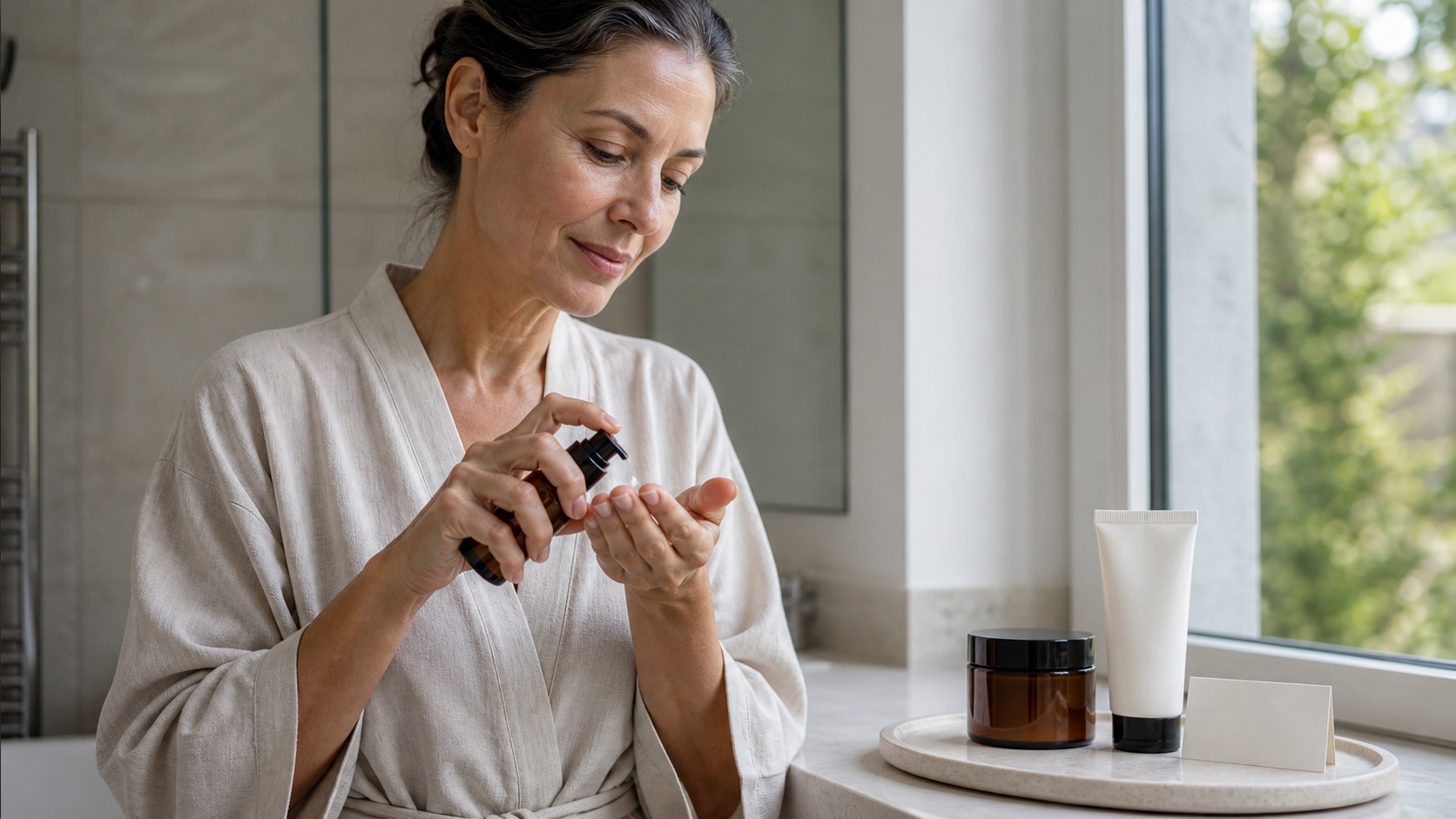
Keep cleanser, moisturiser and sunscreen unchanged. Test the new formula on a small area according to reputable guidance, then begin at the lowest labelled frequency on the intended area. A small-area test can reveal some reactions but cannot guarantee repeated full-face tolerance or diagnose allergy. Record date, amount, area, comfort and any other product change.
Follow the product’s placement and amount. A thin serum is commonly applied after cleansing and before moisturiser, with sunscreen as the final morning skincare layer, but format can change the sequence. A cream containing a derivative may replace the moisturiser step. Do not force a toner-serum-oil hierarchy when the manufacturer specifies otherwise.
If makeup or resistant sunscreen needs removal, use the double-cleansing guide to choose an appropriate cleansing step rather than adding friction or an exfoliating cleanser. Pair the new serum with a familiar moisturiser selected through the skin hydration guide so both variables are not changed at once.
Increase frequency only after multiple comfortable uses and when the product permits it. Daily application is not a badge of success. If the product pills under sunscreen, first reduce quantity and unnecessary layers rather than skipping protection. Consistency with a tolerable product is more valuable than an ambitious routine repeatedly interrupted by irritation.
Vitamin C in the morning or at night
Morning use is common because antioxidant support can complement a sun-protection strategy. Complement is the key word: vitamin C does not create a labelled, uniform UVA/UVB protective film and cannot replace sunscreen, shade or clothing. Apply sunscreen separately in the labelled amount and reapply according to exposure.
Evening use is also valid when it suits the directions, simplifies layering or improves comfort. There is no universal rule that night use wastes antioxidant value or that morning use makes every formula unstable on skin. Choose the time that supports correct storage, regular use and a sunscreen layer that remains comfortable and even.
Vitamin C with niacinamide, acids and retinoids
The claim that vitamin C and niacinamide can never be combined is based on oversimplified or outdated interpretations. Tested products may contain both. With separate products, the practical questions are whether both address a distinct goal, whether the vitamin C form and pH are understood and whether the combined film remains comfortable. Pilling is not proof of a dangerous chemical reaction.
L-ascorbic-acid formulas and AHA/BHA exfoliants can add acidity and irritation. Do not introduce them together. A cleanser containing an acid, exfoliating toner and vitamin C serum may create more exposure than the product names suggest. Use the AHA, BHA and PHA guide to map the whole week.
Vitamin C and retinoids can appear in one routine, but theoretical compatibility does not guarantee tolerance. Introduce one first and separate morning and evening or different days if the labels and response support that plan. The guide to retinol, retinal and cosmetic retinoids maintains the boundary with medicines; a prescription schedule belongs to the prescriber, not a layering chart.
Benzoyl peroxide, hydroquinone, topical medicines, peels, laser and microneedling need product- and procedure-specific advice. Bring names, strengths and photographs of packaging to the dermatologist or practitioner. Do not attempt to solve possible oxidation interactions by alternating products at random.
Signs of excess and when to seek help
Brief tingling may occur with an acidic formula, but it does not measure efficacy and should not intensify over time. Increasing tightness, persistent redness, scaling, burning with water or moisturiser and sensitivity spreading to new areas indicate that the routine needs reducing. Stop the new product and return to a simple tolerated baseline instead of adding several ‘soothing’ actives together.
Significant pain, swelling, hives, blisters, fissures, weeping, eye or lip involvement, breathing difficulty or rapid worsening requires appropriate care; breathing difficulty is an emergency. Vitamin C does not have a compulsory purging phase. Allergic and irritant contact dermatitis cannot be reliably separated from a photograph, and diagnostic patch testing belongs with a dermatologist.
New or changing pigmentation, persistent melasma, inflammatory acne, rosacea or eczema should not be managed by increasing vitamin C. A cosmetic can support appearance but cannot diagnose or treat the cause. Supplements and oral megadoses are outside this guide and should not be used for skin without considering diet, medicines and health advice.
Common mistakes with vitamin C skincare
Choosing only by percentage without identifying the INCI form or what the number represents.
Assuming a more stable derivative is automatically stronger, gentler or clinically superior.
Making DIY vitamin C with powder, water or lemon juice without pH, purity or preservation control.
Using a changed product because it smells normal, or rejecting a naturally amber formula from colour alone.
Opening several bottles, decanting or buying a size that exceeds realistic use within its PAO.
Stacking acidic vitamin C, exfoliants, retinoids and scrubs while ignoring weekly exposure.
Treating vitamin C as sunscreen, a pigment cure or acne therapy.
A professional product-reading protocol
In a consultation, record brand and product name for identification, then transcribe the vitamin C INCI form, declared percentage and exact wording of the claim. Add vehicle type, packaging, period after opening, batch, opening date, manufacturer’s description of initial colour, storage and frequency. Document the full routine, including exfoliating cleansers, scrubs, shaving, medicines and procedures. This creates a traceable cosmetic assessment without diagnosis.
Monitoring photographs need the same light, distance, angle, camera, exposure and absence of filters. They do not measure skin vitamin C or collagen. Set a review interval consistent with product directions and avoid universal deadlines. Poor tolerance is not corrected by forcing frequency. Refer to a dermatologist when the goal is medical or the presentation is inflammatory.
Frequently asked questions about vitamin C skincare
What is the best form of vitamin C?
There is no universally best form. L-ascorbic acid is the most studied but more unstable and commonly acidic. Derivatives differ in stability, solubility, conversion and evidence. Choose the finished product for the goal, packaging and tolerance.
Is 20% vitamin C always more effective?
No. The 20% reference comes from specific L-ascorbic-acid absorption research and cannot be transferred to every derivative or vehicle. Higher concentration may increase irritation without overcoming instability or inconsistent use.
What pH should a vitamin C serum have?
Below pH 3.5 is a research reference for some aqueous L-ascorbic-acid formulas, not all vitamin C products. Derivatives and anhydrous systems follow different formulation logic. Do not test and adjust a cream’s pH at home.
How can I tell if vitamin C has oxidised?
A progressive shift to deep yellow, orange or brown with odour or texture change may be suspicious for some formulas. Others begin amber. No universal colour threshold measures remaining active, so compare official product information and contact the manufacturer with the batch and storage history.
Should vitamin C be refrigerated?
Only when the manufacturer requires or permits it. Cooling may slow some reactions but can introduce condensation, crystallisation and temperature cycles. Otherwise store it closed in a cool, dry, dark place.
Is an airless pump better than a dropper?
An opaque airless package may reduce light and incoming air, while a dropper opens the bottle at every use. Pump quality, headspace, formula and packaging compatibility still matter; the format cannot prove stability to the end of PAO by itself.
Should vitamin C be used in the morning or at night?
Either may work according to directions and tolerance. Morning use can complement sunscreen but never replace it; evening use can simplify layering. Choose the time that preserves comfort and correct sunscreen application.
Can vitamin C and niacinamide be used together?
There is no universal ban, and one tested formula may contain both. With separate products, consider the exact vitamin C form, goals, film and tolerance. Separate them if irritation or pilling makes the routine impractical.
Can vitamin C be used with retinol?
It may be possible, but there is no need to begin both together. Introduce one variable and separate morning and evening if useful. A prescribed retinoid follows its clinician’s plan.
Can vitamin C be used with AHA or BHA?
Chemical compatibility does not guarantee comfort. Acidic vitamin C and exfoliating acids can add irritation. Do not introduce them together; consider the entire weekly schedule and simplify if tolerance declines.
Does vitamin C replace sunscreen?
No. It may complement an antioxidant strategy in tested formulas but does not provide the uniform UVA/UVB protection of a labelled sunscreen. Apply sunscreen separately in its stated amount.
Does vitamin C lighten dark spots?
Specific formulas may gradually improve uneven-looking tone, but pigmentation has many causes. New, irregular or persistent marks need assessment. A cosmetic cannot replace diagnosis, treatment and sun protection.
Does vitamin C cause purging?
Vitamin C has no compulsory purging phase. New lesions, burning, redness or scaling may reflect irritation, vehicle, another product or an independent condition. Do not increase frequency to push through deterioration.
Can I make a serum from vitamin C powder?
DIY mixing is not recommended. Without control of purity, concentration, pH, solvent, preservation and uniformity, the result is unstable and potentially irritating. Adding powder to moisturiser also changes the formulated system.
How long does vitamin C take to work?
There is no universal deadline because goals, formulas, studies and skin differ. Compare standardised photographs over an appropriate period with a stable routine. Increasing the amount does not create a reliable shortcut.
Scientific sources and reading criteria
This guide separates biochemical mechanism, penetration research, formulation stability and clinical outcomes rather than turning them into a product ranking. Evidence for derivatives remains less uniform than for L-ascorbic acid and frequently concerns specific formulas.
Pinnell et al.: percutaneous absorption of topical L-ascorbic acid. Read the PubMed record
Humbert et al.: randomised double-blind study of a 5% vitamin C cream in photoageing. Read the PubMed record
Pullar, Carr and Vissers: review of vitamin C in skin health. Read the open-access review
Enescu et al.: review of topical vitamin C derivatives and available efficacy evidence. Read the PubMed record
Sheraz et al.: formulation factors and ascorbic-acid stability in emulsions. Read the PubMed record
Continue your skincare pathway
Return to the skincare actives overview, place vitamin C inside a stable morning and evening routine and use the hydration guide to build a comfortable base. Browse the English skincare guide hub or explore online skincare courses for structured cosmetic-science learning.
For SPF, UVA, full application amount and exposure-based reapplication, read the daily face-sunscreen guide before adjusting treatment layers or reducing the sunscreen dose.
For benefits, realistic concentration comparisons and tolerance, read the niacinamide skincare guide before adding another niacinamide product to the routine.
To separate a recurring sensitivity pattern from temporary reactivity and build a controlled baseline, read the sensitive versus sensitised skin guide for tolerance testing, a minimal routine and clear referral criteria.
For a cautious distinction between cosmetic discolouration and a mark that needs assessment first, read the facial dark spots and skincare guide for photoprotection, cosmetic options, measurement and dermatology referral criteria.
For a simple base when comfort, hydration and tolerance change over time, read the mature-skin skincare guide for essential care, photoprotection and the gradual introduction of one active at a time.
For a careful comparison of dryness, puffiness, structural bags and different dark-circle components, read the eye-area skincare guide for a simple routine, periocular safety and realistic cosmetic limits.
To turn cosmetic observations and existing products into a plan a client can understand and follow, use the professional skincare-consultation protocol for intake, product audit, written handover, follow-up and referral boundaries.