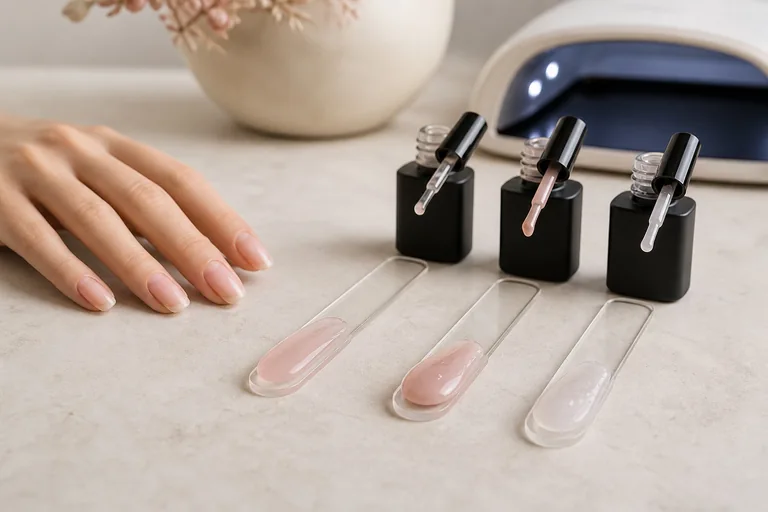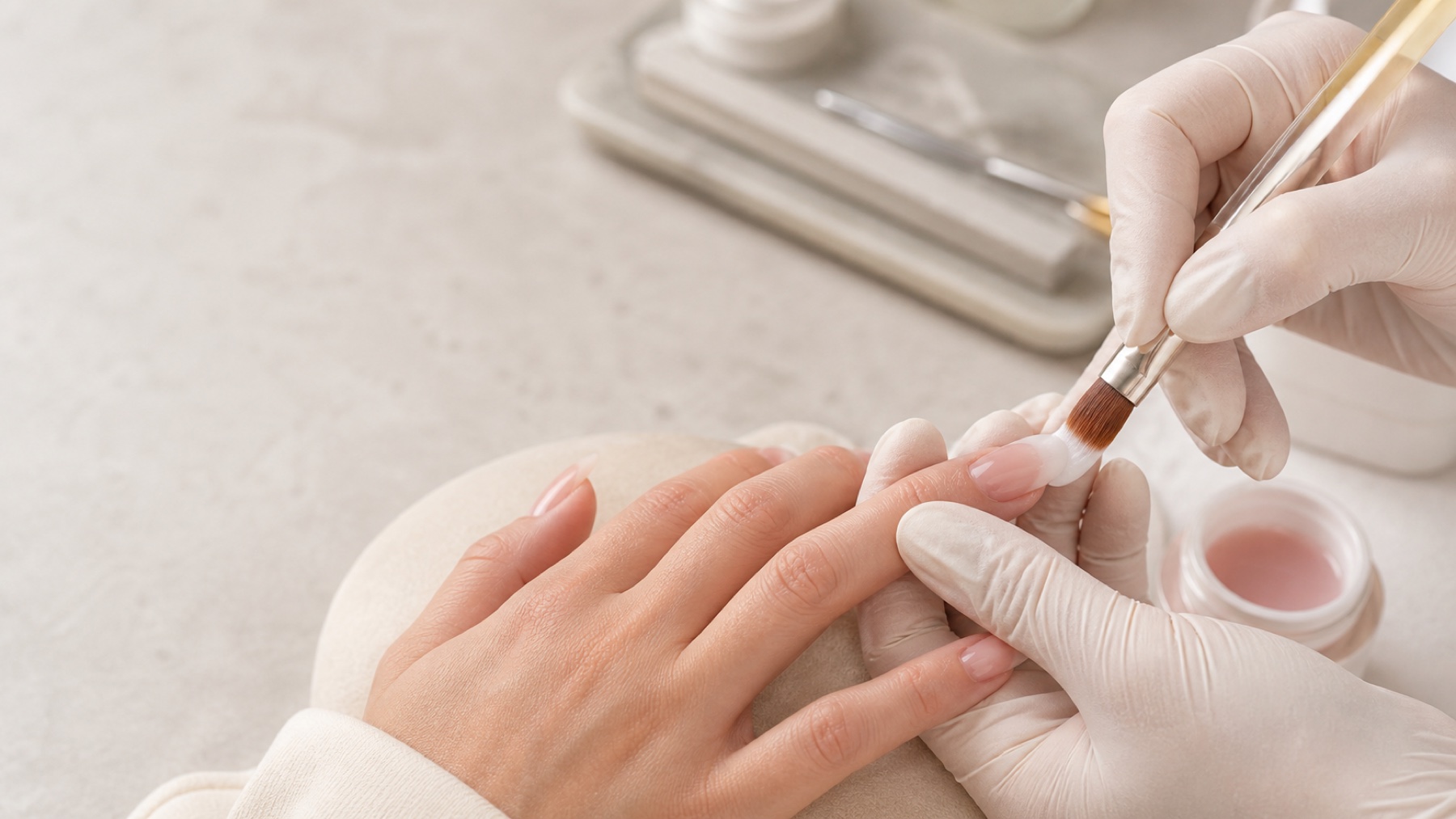
Builder gel is not one material with a simple strength scale. Hard and soak-off mainly describe the documented removal route; self-levelling and thixotropic describe aspects of how uncured material moves; fibre describes a formulation family rather than a universal performance level. These properties overlap. A hard gel may self-level, a soak-off builder may be thixotropic and a fibre gel may be flexible or rigid, clear or pigmented, bottled or potted.
Choose a builder on four independent axes: how it is removed, how it moves before cure, how it behaves after cure and which services the current manufacturer documentation supports. Viscosity, the word ‘builder’ and a dramatic product video cannot answer all four.
The professional decision also includes natural-nail condition, length, architecture, client activity, base, top, lamp, layer limit, maintenance interval and removal skill. A product that is easy for one overlay can be unsuitable for a long extension; a highly controlled gel may help precision but demand more refinement. This guide was substantively reviewed on 5 September 2026. Formulas and protocols can change while the front label stays familiar, so verify the exact market version, batch, instructions and lamp before use.
If product roles are still unclear, begin with one-, two- and three-phase gel systems. That guide separates adhesion, structure and finish. This page owns a different intent: comparing builder categories without turning removal, rheology and cured mechanics into synonyms.
Four coordinates for comparing builder gels
Read four properties independently
One marketing name cannot describe the complete builder
Removal
File-off, soak-off or combined
Rheology
Flow, levelling and recovery
Mechanics
Cured rigidity and flexibility
Service
Overlay, extension and maintenance
Commercial labels such as builder, structure, sculpting, control, rubber, fibre and builder-in-a-bottle are not one standard technical taxonomy. Start by recording what the manufacturer actually states. Then place the product on four coordinates. A single gel can occupy several positions at once, and none of the coordinates proves safe use without the intended lamp and complete system.
Coordinate | Question to verify | It does not prove |
|---|---|---|
Removal | File-off, soak-off or a documented combined route? | Strength or flexibility in wear |
Rheology | How does the uncured gel flow and recover? | Cured rigidity or adhesion |
Mechanics | How does the cured structure respond at the permitted thickness? | Suitability for every nail or length |
Form and formulation | Clear, cover, fibre, bottle or pot—and for which service? | Cure, compatibility or performance by itself |
Examples make the overlap clear: hard + self-levelling + camouflage + one-phase can describe one product; soak-off + thixotropic + fibre can describe another. Viscosity seen in the jar is only one observation under one temperature and shear history. It does not automatically measure the mechanical performance of the cured coating.
Hard gel: file-off structure and planned maintenance
Hard and soak-off describe different removal routes
They do not mean strong and weak
Hard gel
Normally file-off and rebalanced
Soak-off builder
Softens through the named process
Unknown stack
Do not scrape or guess
Hard gel usually means a structural gel that is not designed to dissolve through the soak-off process. It is reduced with a hand file or e-file according to the system and maintained through infill or rebalancing. ‘Hard’ does not necessarily mean very thick in the pot or the most rigid material available. It describes a cured network that resists the solvent route used for soluble gel systems.
Hard gels may be low, medium or high viscosity; clear, cover or coloured; self-levelling or controlled. They are often selected for extensions and services that need stable architecture, but the label does not authorise any length. The permitted extension, apex, sidewalls, C-curve, lower arch and thickness remain product- and technique-specific. Use the guide to nail architecture and apex placement to connect material choice with load distribution.
The maintenance advantage depends on controlled reduction. Do not soak a file-off gel for longer in the hope that it changes category, and do not remove every trace from an intact plate simply to start again. Remove lifting and unreliable material, preserve an appropriate stable layer and rebuild the balance. The detailed nail infill and refill protocol explains the structural decision.
Soak-off builder: solvent removal without a weak-gel assumption
A soak-off builder is formulated to soften through the named remover process after the seal is opened as instructed. It may support short overlays, structured gel manicures, repairs or limited extensions when its documentation allows them. It is not simply thick gel polish: it performs a building role, yet its safe length and thickness come from the exact technical protocol rather than the generic word builder.
Soak-off does not mean weak, just as hard does not mean indestructible. Cured behaviour depends on formulation, geometry, thickness and natural-nail movement. Some soluble builders flex with short natural nails; others support moderate length. A flexible product used beyond its limit can distort or crack, while an excessively rigid choice on a very flexible plate may concentrate stress. Compare the service requirement, not an imagined strength ladder.
Removal time is not universal. Top coat, pigment, bulk, wrap contact and previous layers all affect the route. If material does not release, resistance is information: verify identity and instructions instead of scraping the plate. Follow the complete guide to removing gel, acrylic, acrygel and gel polish safely.
Self-levelling builder gel: speed, surface and migration risk
A self-levelling gel tends to smooth brush marks and redistribute towards a more even surface during its working window. It can accelerate overlays and infills and reduce finishing work. Self-levelling is not the same as runny. A dense gel may level slowly, while a medium-viscosity gel may travel quickly. Temperature, quantity, hand warmth and time alter what the technician experiences.
The main control issue is migration. While one nail is being shaped, uncured gel may approach the lateral folds or proximal skin. Work one nail or a small manufacturer-approved group at a time. Turn the hand or use a flash step only when the system teaches it, and always complete the full cure. A flash cure is not a remedy for material that has already touched skin: remove uncured contamination completely before any lamp exposure.
A fast self-leveller rewards confident placement but can overwhelm a learner who needs more time. A slower product may make edge control easier while adding refinement. Neither profile is inherently beginner or advanced. Match movement to service pace, room conditions and ability to keep a clean perimeter.
Thixotropic gel: movement under the brush and recovery at rest
Viscosity, levelling and thixotropy are not synonyms
Observe the whole working window
Place
Observe initial viscosity
Guide
Apply controlled brush shear
Wait
Watch levelling and recovery
Stop
Remove any skin contamination
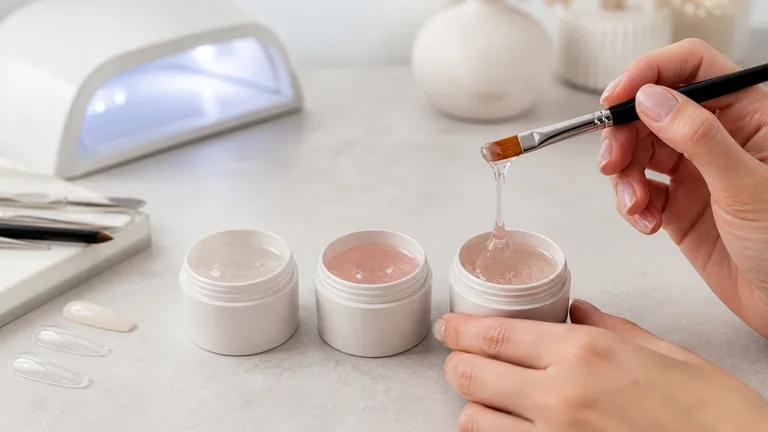
Thixotropy is a time-dependent rheological behaviour. Under shear—such as deliberate brush movement—the apparent viscosity decreases; after the stress ends, the material recovers towards its resting structure. In practice, a thixotropic builder may look stable in the pot, become easier to guide under the brush and regain control after placement. The IUPAC definition concerns behaviour under specified conditions, not a promise that a salon product never moves.
Thixotropic does not mean immobile or necessarily extra-thick. Too much material, a warm room, prolonged working or repeated agitation can still produce migration. The degree and speed of recovery vary by formula. Product demonstrations should therefore include temperature, amount and elapsed time; a short clip of a stationary bead is not a complete rheology test.
Controlled movement can help form fitting, sidewall correction, reverse-French walls and work where the placed shape needs to remain readable. The trade-off may be more brush guidance or surface refinement. Choose it because its working window fits the method—not because ‘no filing’ or ‘never floods’ sounds attractive.
Fibre gel: reinforcement wording without universal performance
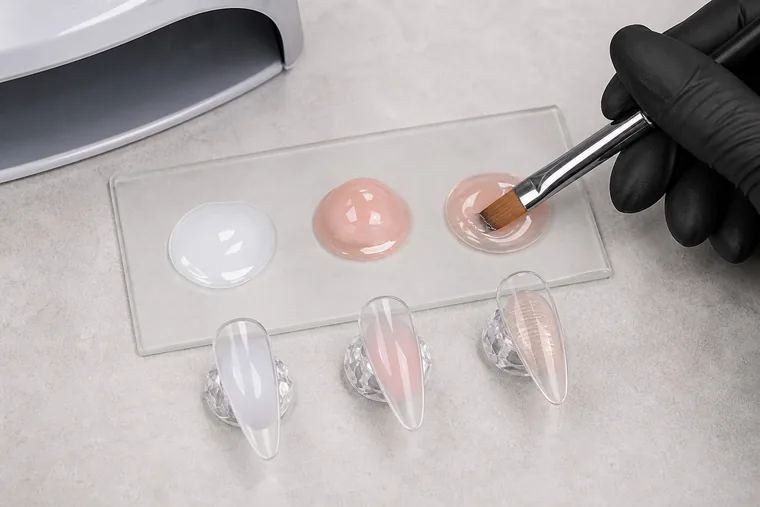
Fibre gel identifies products that declare fibres or reinforcing components in the formulation. The fibres may be subtly visible or not obvious to the eye. Their material, dispersion and function depend on the formula. There is no single fibre-gel standard: one may be soak-off and flexible, another file-off and rigid; one may self-level, another remain highly controlled.
Fibre does not prove that a gel is stronger than every non-fibre builder, suitable for all repairs or able to restore the natural nail. It creates a cosmetic coating when appropriate; it does not biologically repair thinning, separation or disease. Compare manufacturer service limits, cure, thickness, removal and mechanical evidence. Do not allow visible fibres or marketing language to replace a balanced structure.
For bottle systems, also separate format from chemistry. Builder in a bottle describes packaging and brush application. BIAB is widely used commercially but does not by itself state removal, rigidity, fibre content or maximum extension. Read the exact product label and instructions rather than treating the initials as a regulated class.
Practical comparison: properties can overlap
Label or property | Useful information | Still verify |
|---|---|---|
Hard gel | Normally file-off structural maintenance | Flow, rigidity, service length and lamp |
Soak-off builder | Documented solvent-softening route | Mechanical limits, layers and removal time |
Self-levelling | Surface tends to smooth during working time | Migration speed, cured behaviour and cure |
Thixotropic | Flow changes under shear and recovers at rest | Recovery window, temperature and quantity |
Fibre | Reinforcing component is declared | Removal, mechanics, lamp and service scope |
Rigidity, flexibility and the client’s natural nail
The goal is a coherent service, not maximum hardness. Observe plate flexibility, free-edge behaviour, length, shape, previous lifting, occupation, sport, impact and maintenance habits. A product must support the planned geometry while its interfaces remain compatible. Excessive flexibility can allow distortion; excessive rigidity on a very mobile base can shift stress to the interface. Neither observation diagnoses a nail condition.
Do not use a builder to hide pain, green or dark colour, unexplained separation, inflamed skin or a markedly altered plate. Cosmetic product selection comes after the decision that a service is appropriate. The guide to fragile nails after gel distinguishes gentle recovery from signs that need healthcare assessment.
Service matrix: choosing without a universal winner
Choose the service before the jar
Material, architecture and maintenance must form one plan
Assess
Plate, flexibility and client activity
Design
Overlay, length and architecture
Verify
System, lamp, layer and removal
Review
Wear, infill and stop criteria
For a short natural-nail overlay, start with the product’s approved overlay range, suitable flexibility and the maintenance or removal route the client can follow. For moderate extensions, verify explicit length, shape and architecture limits. For long or corrective structures, use a structural system validated for the load and ensure the technician can build and rebalance it. For rapid infills, working time and self-levelling may matter, but never more than perimeter control and full cure.
A product can serve several scenarios, but document which one is being performed. The natural nail overlay comparison helps separate short overlays from extensions. Do not convert a bottle builder’s successful short wear into permission for lengths it does not claim.
Lamp, thickness, pigment and heat
Builder gel cures as a volume, not just a shiny surface. Photoinitiator system, wavelength distribution, irradiance, pigment, layer thickness, apex volume, lamp geometry, mode, time and hand position all matter. Wattage alone cannot establish compatibility. Use the lamp named or technically validated for the exact product, keep it maintained and respect maximum amounts and complete cycles.
Clear and heavily pigmented builders may have different instructions. Never assume a nude or white version can be placed as thickly as clear. A hard surface does not prove adequate cure below. Review UV/LED nail-lamp compatibility and the professional gel-curing protocol before interpreting surface hardness.
Polymerisation is exothermic. Heat can increase with material volume, formula, lamp output and plate condition. Do not ask a client to endure pain. Use the system’s authorised heat-management method and complete the required cure; do not invent shorter exposure. Strong or repeated heat is a signal to stop and reassess amount, plate, lamp and protocol.
Compatibility with primer, base, colour and top
Some builders are approved directly on a prepared natural nail; others require a named base or primer. Some perform several phases; others need a separate finish. Do not add adhesion products automatically. Verify the exact sequence, layer amount, inhibition-layer handling, lamp and removal route. A successful-looking stack is not evidence of complete cure or long-term interface compatibility.
If you combine brands, the evidence burden increases. Use the dedicated guide to mixing nail brands and system compatibility. Keep every product in its original labelled container and never blend gels in a pot to alter viscosity, colour or strength unless the manufacturer supplies that exact instruction.
A controlled trial before changing builder
Capture exact product, market version, batch, label, role, service scope, lamp, layer, cure and removal instructions.
Observe movement on labelled training samples without skin contact at the actual room temperature and intended amount.
Compare placement, levelling, recovery, bubbles, heat-management protocol, refinement and surface without changing several variables together.
Remember that a tip can reveal obvious failure but cannot prove natural-nail adhesion, complete conversion, client wear or individual safety.
Introduce one controlled variable at a time and document anatomy, length, structure, product stack, lamp, maintenance and removal.
Quarantine incomplete, altered or unidentified stock; stop when uncured material touches skin or a client reports concerning symptoms.
Build the comparison sheet before interpreting wear. Record bead size or layer amount, room temperature, time before cure, movement at each perimeter, lamp model and mode, complete exposure, refinement needed and removal response. During later services, separate proximal lifting, free-edge wear, cracks, impact and client aftercare instead of reducing every observation to ‘retention’. Photographs must use consistent light and angle, and they supplement rather than replace written product and batch records. If the new builder requires a different base, lamp and removal method, it is a new system evaluation—not a one-product swap.
Common builder-gel selection errors
Choosing the thickest gel because it is assumed to be strongest.
Treating hard and soak-off as technician levels instead of removal and maintenance routes.
Using self-levelling as a synonym for liquid or thixotropic as a promise of no movement.
Calling fibre gel a biological repair or universal strengthening treatment.
Applying the same thickness and cure to clear, cover, white and highly pigmented products.
Changing base, builder, top and lamp together, making the result impossible to interpret.
Covering unknown, lifted or altered material instead of identifying and controlling the service.
When cracks, breaks or lifting appear, do not blame the jar first. Review preparation, skin contact, architecture, thickness, length, cure, impact and maintenance. The guide to nail lifting causes by area helps locate the first failure rather than hiding it under a stronger product.
Training: connect material behaviour with structure
Gel Nails Level 1 builds preparation, clean application, architecture, apex and curing fundamentals. Gel Nails Level 2 develops controlled forms, corrections, refinement and defect analysis. Stable technique makes product comparisons meaningful: without a repeatable amount and structure, a change of builder can disguise rather than solve the error.
Compare Gel Nails Level 1 and Gel Nails Level 2 or browse all online nail courses. English course records are separate from the Italian catalogue and remain unavailable for enrolment until their English teaching content is ready.
Frequently asked questions about builder gel types
What is the difference between hard gel and soak-off builder gel?
Hard gel is normally file-off and maintained through reduction and rebalancing. Soak-off builder is designed to soften through a named solvent process after the seal is opened. These labels do not mean strong and weak. Rigidity, flexibility, thickness, length, lamp and maintenance must be verified for the exact product.
Does hard gel dissolve in acetone?
A classic hard gel is not designed for soak-off removal. Reduce it mechanically through the instructed hand-file or e-file method and preserve a stable layer when appropriate. Do not extend solvent exposure or scrape the natural plate. If the product is unknown, proceed conservatively rather than guessing from appearance.
Can soak-off builder support an extension?
Only within the exact product’s declared service and length limits. Some soluble builders support short reinforcement or limited extensions; others are intended for overlays only. Soak-off describes removal, not a universal measure of strength. Verify architecture, thickness, lamp, maintenance and client activity before choosing it.
Does self-levelling mean very runny?
No. Self-levelling describes the tendency to smooth the surface during the working window. A gel can feel dense and still level slowly. Room temperature, hand warmth, amount and time change movement. Test the exact product without skin contact and control each perimeter before curing.
What is the difference between viscosity and self-levelling?
Viscosity describes resistance to flow under specified conditions. Self-levelling describes how a placed surface tends to smooth over time. They are related but not identical. Two products that form a similar string from the brush can level, recover and migrate at different rates.
What does thixotropic builder gel mean?
It describes time-dependent flow behaviour in which apparent viscosity decreases under shear and recovers after the stress ends. Under a brush, the gel may become easier to move and then regain control. The strength and speed of this behaviour depend on formulation, amount and temperature.
Can thixotropic gel still flood the cuticle?
Yes. Thixotropic never means immobile. Excess material, a warm room, long working time or poor placement can move any uncured gel. Inspect every nail before curing and remove all skin contamination completely. Do not use the lamp to freeze a flood already touching tissue.
Is fibre gel always stronger than ordinary builder gel?
No. Fibre identifies a reinforcing feature in a formulation, not a common strength grade. Fibre gels can be flexible or rigid, soluble or file-off and suited to different service limits. Compare the manufacturer’s mechanical claims, thickness, cure, removal and intended use.
Can fibre gel repair a thin or damaged natural nail?
It may provide a cosmetic coating when the plate is intact and the service appropriate, but it cannot biologically repair thinning or treat separation, infection, pain or inflammation. Pause cosmetic work for unexplained or concerning changes and recommend assessment by a suitable healthcare professional.
Which builder gel is best for short nails?
There is no universal winner. For a short overlay, choose an approved product whose flexibility, structure, cure and removal suit the apparent nail condition, client activity and maintenance plan. Even short nails need balanced thickness and a clean, skin-free application.
Which builder gel should I use for long nails?
Use a structural system explicitly validated for the intended extension length and shape. Hard gel may often be considered, but the word alone is insufficient. Apex, sidewalls, lower arch, C-curve, thickness, lamp and refill timing determine whether the service is mechanically coherent.
Can I use another brand's base or top with builder gel?
Only when the exact interface, lamp, layers and removal route are documented or supported. Wear does not prove complete cure or chemical compatibility. Begin with the complete named system, preserve product identity and never mix formulas inside a jar to change consistency.
Can one UV LED lamp cure every builder gel?
Do not assume so. Photoinitiators, wavelength response, pigmentation, thickness and lamp geometry vary. Use the model named or technically validated by the builder manufacturer, with its complete mode and time. A hard or glossy surface cannot prove adequate cure below the apex.
Why does builder gel feel hot in the lamp?
Polymerisation releases heat, and sensation can rise with formula, bulk, lamp output and plate condition. Never require a client to tolerate pain. Stop, reassess amount and protocol, and use a low-heat mode only when authorised for the exact system before completing the required cure.
How do I infill builder gel when the existing product is unknown?
Ask for product and service history, inspect adhesion and identify the removal route. Remove every lifted or unstable zone. If the remaining material cannot be identified or the new system does not support the interface, a controlled removal and documented restart may be the safer professional choice.
Are builder in a bottle and BIAB standard technical categories?
Builder in a bottle mainly describes format and brush application. BIAB is used commercially and does not by itself define rigidity, solubility, fibre content or permitted length. Read the exact label and technical instructions: two bottled builders may require different bases, lamps, removal and service limits.
Scientific and regulatory references
IUPAC Gold Book — thixotropy and rheology: technical definitions for flow behaviour.
European Commission SCCS — opinion on HEMA and Di-HEMA TMHDC: nail-plate application, avoidance of adjacent skin and appropriate UV cure within the artificial-nail system.
US Food and Drug Administration — Nail Care Products: labelled directions, warnings, ventilation and avoiding skin contact in the US context.
Substantively reviewed on 5 September 2026. Product names do not create a universal taxonomy and this guide does not certify a formula, lamp or combination. Verify current manufacturer documentation for the exact product and market. Independent formulation-specific chemical, cure and dermatological review has not been performed.