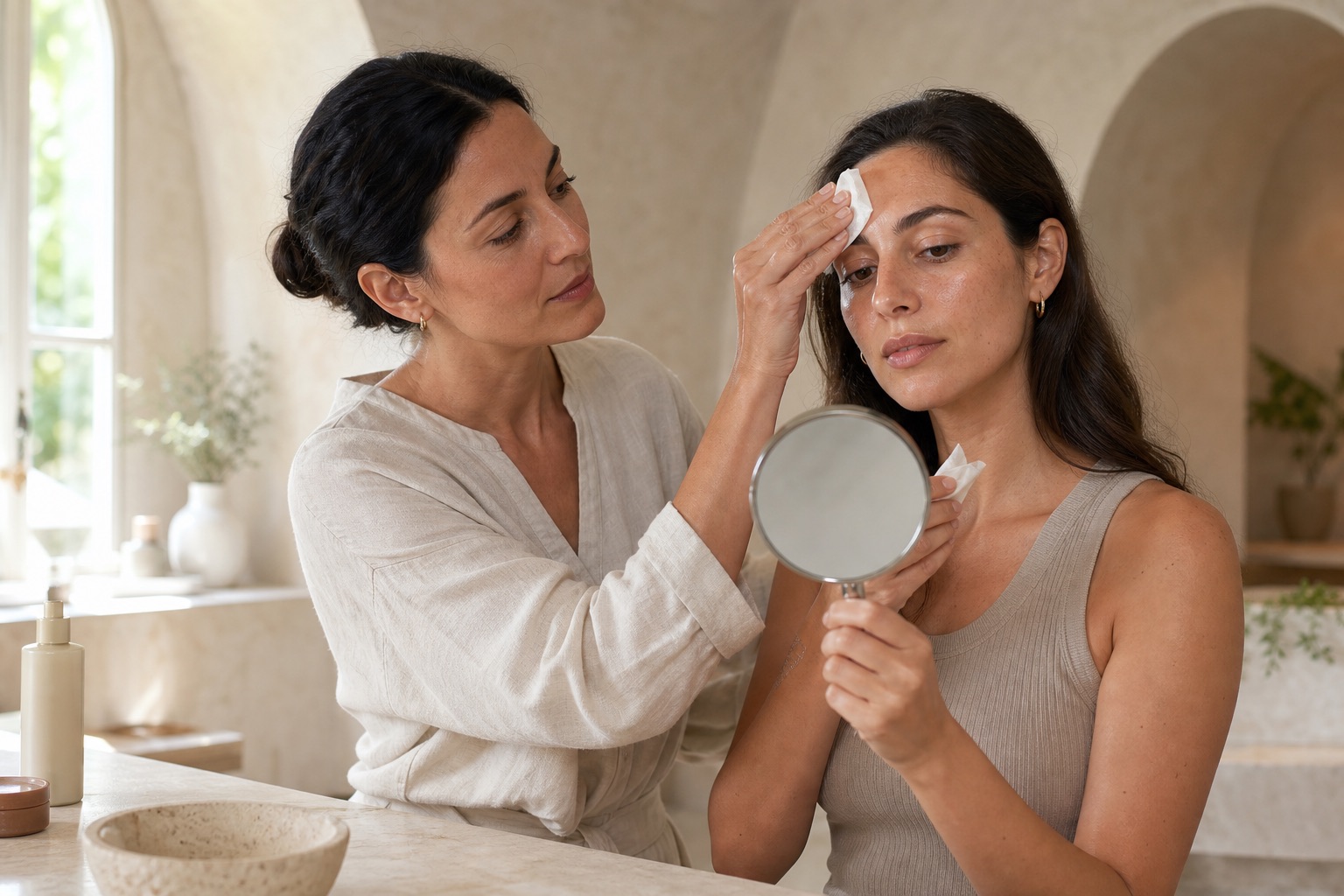

Dry, oily and combination skin mainly describe recurring patterns at the surface and the way sebum is distributed across the face. Sensitive and dehydrated skin describe different dimensions that can overlap with any of those patterns. Skin can be oily and sensitive, combination and dehydrated, or dry without reacting easily. Classification is a tool for organised observation, not a diagnosis.
Quick answer: assess oil and shine, comfort and flaking, stinging or itching, differences between facial zones and whether the pattern repeats over time. Do not classify skin from one sign, visible pores, a photograph or a tissue test. Persistent redness, pain, cracks, lesions or rapid change call for appropriate clinical assessment rather than a new cosmetic label.
This guide is deliberately about classification and observation. It does not prescribe a complete routine. Once you have a useful description, continue with the morning and evening skincare routine guide. For structured study, compare the online skincare courses. Cosmetic education, diagnosis and medical treatment remain separate areas.
Skin type and skin condition are not the same thing
In cosmetic language, skin type is a useful shorthand for tendencies that recur: lower comfort and a rougher surface, more visible oil and shine, or a marked difference between the T-zone and cheeks. It is not a permanent identity. Age, climate, hormones, stress, medication, cleansing, sun exposure, work and season can all change what you observe.
A skin condition is a state that may appear, improve or coexist with several oil-distribution profiles. Sensitivity and low surface hydration are not competing alternatives to dry, oily and combination skin; they are separate axes. Even ‘normal’ or ‘balanced’ only describes the absence of obvious extremes at that moment. It is not an ideal that every complexion should match.
Cosmetic categories do not replace clinical terminology. Xerosis, eczema, rosacea, acne and seborrhoeic dermatitis have diagnostic criteria that cannot be established through a quiz. A beauty professional can document visible signs and the client’s reported sensations, but must not turn those observations into a diagnosis or promise a cure.
Four separate dimensions to observe
A useful assessment postpones the single label and asks four questions. Where and when does shine appear? Does the surface feel comfortable, rough, tight or flaky? Do normally tolerated stimuli cause stinging, burning, itching or heat? Are there persistent signs or lesions that fall outside cosmetic assessment?
Sebum and distribution: record the forehead, nose, chin, cheeks and facial perimeter separately rather than using pore size as proof.
Hydration and barrier comfort: note tightness, flexibility, roughness, fine flakes and changes after water, weather or cleansing.
Reactivity: separate reported sensations from visible redness and document the trigger, intensity and duration.
Possible clinical signs: pain, fissures, crusting, discharge, swelling, widespread papules, persistent itch or rapid deterioration require a different level of assessment.
Professional or research instruments can estimate sebum, hydration or transepidermal water loss, but their readings still depend on the site, room conditions, acclimatisation and method. One number does not define the entire face and never grants permission to diagnose.
How to make observations comparable
Reduce noise before classifying. Observe in indirect daylight or neutral, even light without photographic filters. Record the date, time, weather, products currently on the skin, recent exercise and sensations. If you have just washed, note the cleanser, water temperature and elapsed time because an aggressive cleanse can create temporary tightness and distort the picture.
Checking approximately an hour after gentle cleansing, without applying new products, may offer a clue about where shine returns. It is not a diagnostic test and it is never a reason to stop prescribed treatment, remove necessary sun protection or leave the skin uncomfortable simply to complete an experiment.
Repeat the observation on several comparable days. A photograph documents one moment, but white balance, exposure, camera processing and compression alter colour and shine. Recurrence is more useful: the same area, at a similar time, with a similar sensation and no single product or event that explains the whole change.
Dry skin: observable features and limits of the label
Skin described as dry often shows recurring tightness, reduced comfort, a dull or rough surface and fine flaking. Xerosis involves reduced water in the stratum corneum and impaired barrier function and can progress to itching and fissures. That is why ‘dry skin just lacks oil’ is too simple to be reliable.
Note whether roughness is widespread or local and whether cold, wind, hot water or frequent washing makes it worse. Record itching, burning and cracks. Persistent scaling, painful fissures, suspected eczema or a sudden change is not merely a skin type and deserves appropriate assessment.
Do not equate a matte appearance with dryness. Powder, product residue, irritation-related scaling and several skin conditions can look similar. Skin colour does not predict the profile: dryness occurs across all skin tones and may appear visually different on each.
Oily skin: sebum, shine and distribution
Oily skin shows a more evident presence of sebum, often with shine that returns after cleansing and affects several facial zones. DermNet uses ‘seborrhoea’ to describe excessively oily skin, commonly involving the central face and scalp. Shine alone is not enough: sweat, product film, lighting and warm weather can produce a similar appearance.
Record how far the shine extends and when it appears. A recurring pattern across forehead, nose, chin and cheeks is different from a mildly shiny T-zone late in the day. Visible pores may accompany higher sebum in some people, but pore size is not a universal measurement and does not classify hydration or sensitivity.
Oily does not mean dirty, unusually resilient or immune to irritation. Repeated washing and highly degreasing products can increase discomfort without changing the driver of sebum production. Blackheads, papules and pustules are not required for an oily profile, and persistent or painful lesions belong to acne assessment rather than a cosmetic skin-type test.
Combination skin: a map of zones, not a separate material
Combination skin means that the face does not behave uniformly. The familiar pattern is a shinier T-zone — forehead, nose and chin — with cheeks that feel balanced, tight or dry. There is no compulsory geometric border. Temples, jawline, cheeks and central face can form different combinations.
This regional variation is physiologically plausible: hydration, barrier behaviour, pH and sebum differ across the face. Draw a simple zone map instead of averaging everything into one word. If the T-zone shines only after a rich product, exercise or a hot day, you may be recording a temporary condition rather than a stable pattern.
The term does not automatically require two complete routines. Classification simply tells you that later product decisions may need to be localised. Product order and routine building remain in the separate routine guide so the two search intents stay clear.
Sensitive skin: sensations, triggers and visible signs
The international expert definition of sensitive skin centres on unpleasant sensations — stinging, burning, pain, itching or tingling — in response to stimuli that would not normally provoke them. The skin can look normal or show redness. A photograph therefore cannot confirm or exclude sensitivity.
Document the suspected trigger: cleanser, wind, heat, cold, fragrance, shaving, friction or another exposure. Record how quickly the sensation starts, how long it lasts and how intense it is without deliberately repeating a reaction. Sensitive skin is not automatically allergic skin, and burning alone cannot identify a responsible ingredient.
Sensitivity can coexist with dry, combination or oily skin, so it should not replace the sebum map. Contact dermatitis, eczema, rosacea and other conditions may be experienced as sensitivity and require clinical differentiation. Marked swelling, hives, blisters, eye or lip involvement or breathing difficulty require prompt help; breathing difficulty is an emergency.
Dehydrated skin: what the term can and cannot tell you
‘Dehydrated skin’ is a cosmetic expression for reduced surface hydration and comfort. It is neither a stable skin type nor a diagnosis of dehydration throughout the body. Sebum and water in the stratum corneum are different parameters, so a shiny face can also feel tight, rough or less flexible.
The popular formula ‘dry skin lacks oil, dehydrated skin lacks water’ is too rigid. Dry or xerotic skin also has reduced water in the stratum corneum. The useful distinction is whether dryness appears as a persistent, widespread tendency or whether reduced comfort and hydration seem to be a temporary state layered over an oily or combination profile. Without measurement and context, do not turn that distinction into clinical certainty.
The skin-pinch test on the hand or cheek does not classify facial skincare dehydration. Skin turgor is used in different clinical contexts. Drinking excessive amounts of water is not a proven cure for every skin sign either; maintain normal hydration and assess barrier, environment and product use separately.
Useful combinations: why one label is rarely enough
A strong description produces a sentence rather than a badge. ‘The T-zone becomes shiny by midday, the cheeks remain comfortable and wind causes stinging’ is more informative than ‘combination skin’. ‘Diffuse shine with tightness after cleansing’ records two dimensions, not a contradiction. ‘Rough surface with persistent itch’ calls for caution because the issue may extend beyond cosmetic variation.
Oily and sensitive: evident sebum with recurrent stinging or burning; do not automatically intensify degreasing.
Combination and dehydrated: a shiny T-zone with tightness or roughness elsewhere; record climate, cleanser and current products.
Dry and sensitive: roughness or flaking with reactive sensations; do not diagnose eczema or dermatitis yourself.
Balanced and temporarily sensitised: no stable oil or dryness extreme, but a time-limited response to a documented trigger.
Shortcuts and false tests to avoid
A blotting sheet can show oily residue at that moment, but it cannot reliably separate sebum, sweat and cosmetic film or measure hydration and sensitivity. Pore size does not assign a type. A pinch test does not classify cosmetic dehydration. A flash photograph does not measure sebum, and an uncalibrated image cannot evaluate redness accurately.
Do not classify the discomfort created immediately by a harsh cleanser as the starting profile: you are observing the product’s effect. Never apply lemon juice, bicarbonate of soda or another irritating home experiment to ‘confirm’ sensitivity. Apps and quizzes can organise questions, but a responsible output should offer descriptive possibilities and referral signals, never a diagnosis.
What can change the pattern you observe
Cold dry weather, indoor heating, wind, humidity, UV exposure, sweating, hormonal changes, pregnancy, menopause, age, medicines and health conditions can affect sebum, comfort and reactivity. Cleansers, exfoliation, retinoids and professional treatments also change the surface temporarily. Record these factors without automatically claiming that one caused the change.
Facial regions are not interchangeable and individual differences cannot be reduced to ethnicity, sex or age. Group averages in research do not predict the individual in front of you. Inclusive observation begins with the person’s actual facial zones and reported experience rather than stereotypes about how a skin tone ‘should’ behave.
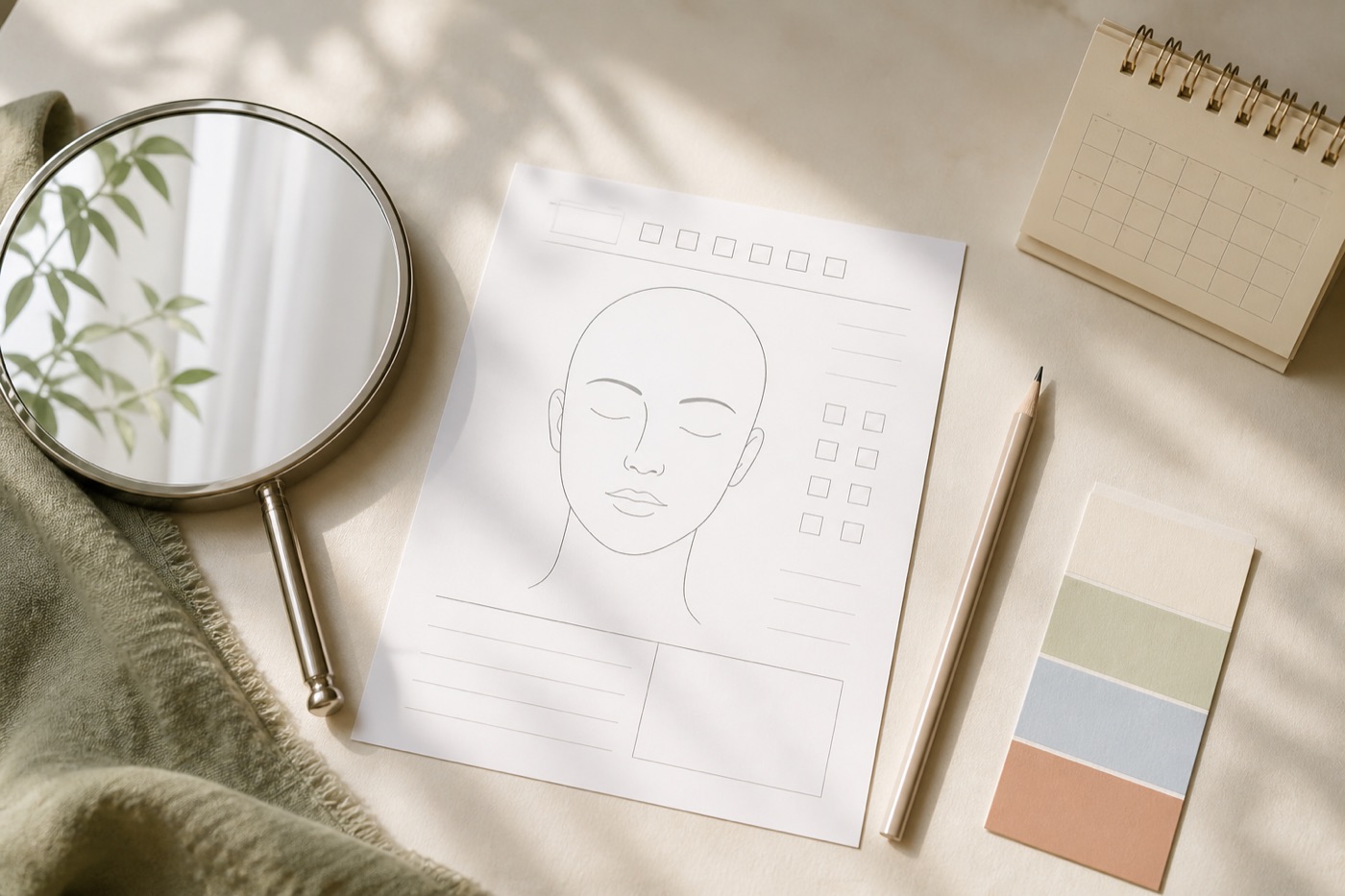
A seven-day observation record
Keep prescribed and well-tolerated products stable while you record. The purpose is to find recurrence, not to create a result in one week. If a product causes a reaction, stop as appropriate and do not continue merely to complete the record.
Date, time, approximate weather and recent activity such as exercise, showering or outdoor exposure.
Products present and elapsed time: cleanser, sunscreen, makeup, treatment or no product.
Zone map: forehead, nose, chin, cheeks, eye contour and jawline.
Appearance: shine, roughness, flakes or redness, described without turning the sign into a diagnosis.
Sensations scored from zero to three: tightness, itch, sting, heat or pain.
Duration and possible preceding stimulus, without deliberate re-exposure.
Decision: continue observing, avoid a suspected trigger or request professional assessment.
When cosmetic observation must stop
Seek dermatological assessment when dryness, itch, scaling, redness, papules or pain is persistent, significant or worsening; when fissures, crusting, discharge, a possible infection, a new mark or a changing lesion appears; or when an existing diagnosed condition changes. A sudden marked increase in oiliness may also have a medical context and should not be solved by assigning a new skin-type label.
For an acute reaction with major swelling, widespread hives, eye or lip involvement or breathing difficulty, seek appropriate help quickly; breathing difficulty is an emergency. Keep the packaging, ingredient list, date and an unfiltered photograph if these may help a clinician. Do not deliberately reapply the suspected product to prove the cause.
Frequently asked questions about skin types
How can I work out my skin type?
Observe several times and record oil distribution, comfort, surface hydration and reactivity separately. Note the facial zones, lighting, time since cleansing and products present. A recurring pattern is more useful than one day. Persistent lesions or symptoms need dermatological assessment rather than a quiz result.
What is the difference between dry and dehydrated skin?
Dry skin usually describes a recurring tendency towards tightness, roughness, flaking and reduced comfort. ‘Dehydrated’ is a cosmetic term for reduced surface hydration that can overlay oily or combination skin. The difference cannot be reduced to oil versus water because dry skin also involves water in the stratum corneum.
Can oily skin be dehydrated?
Yes. Sebum and stratum-corneum hydration are separate parameters, so recurring shine can coexist with tightness, roughness or lower comfort. First separate the effects of harsh cleansing, climate, treatments and products. More degreasing is not the automatic answer.
Does sensitive skin mean allergic skin?
No. Sensitive skin is chiefly described by unpleasant sensations in response to normally harmless stimuli. Allergy involves a specific mechanism and assessment; stinging or redness cannot identify the ingredient by itself. Significant reactions require help, not repeated exposure as a test.
Is combination skin oily or dry?
It describes a non-uniform distribution, often with a shinier T-zone and cheeks that are balanced, tight or dry. You do not need to choose one half. Map the areas and confirm whether the difference repeats on comparable days.
Can blotting paper identify my skin type?
It can show oily residue at one moment, but it does not reliably separate sebum, sweat and product or measure hydration and sensitivity. Use it, at most, as one observation with a known time and context rather than a verdict.
Do large pores always mean oily skin?
No. Genetics, age, sun damage, facial area, sebum and the way the skin is viewed all influence pore appearance. Record recurring shine and distribution rather than classifying from a close-up photograph of the nose.
Can skin type change with age and the seasons?
The observable pattern can change with cold, heat, humidity, hormones, age, medication and products. Categories are not permanent identities. A sudden, marked change or one accompanied by other symptoms should not automatically be blamed on the season.
When do I need a dermatologist rather than a cosmetic analysis?
When redness, itching, pain, scaling, papules, pustules, cracks or lesions persist, worsen or affect daily life; when a sudden change occurs; or when eczema, rosacea, acne or allergy is suspected. Cosmetic analysis describes surface signs and sensations. It cannot diagnose them.
Sources and further reading
American Academy of Dermatology: practical context for dry and oily skin and selecting a moisturiser. Read the AAD guidance
DermNet: clinical background on dry skin and seborrhoea. Read about dry skin and seborrhoea
International Forum for the Study of Itch: expert definition and position paper on sensitive skin. Read the PubMed record
Systematic review of dietary water intake and skin hydration, noting the weakness of the available evidence. Read the PubMed record
From observation to a usable routine
Keep your zone map as a description, not a permanent identity. Use it with the skincare routine order guide to build a small, tolerable sequence. Browse the growing English skincare guide library or review the skincare and facial massage course for structured learning. Programme, level and current availability remain on the course page.
For makeup, water-resistant sunscreen and residue removal, read the double cleansing guide before making two washes an automatic part of every evening.
For a functional comparison of moisturising ingredients and textures, continue with humectants, emollients, occlusives and ceramides without judging a finished moisturiser from one hero ingredient.
If new burning, tightness or reactivity follows product overload, use the damaged skin barrier guide to simplify the routine and recognise when cosmetic troubleshooting must stop.
Before adding or combining targeted products, use the skincare actives guide to separate chemical compatibility, cumulative irritation and duplicated function.
For a complete comparison of exfoliant families, frequency and stop criteria, read the AHA, BHA and PHA guide before adding another acid, scrub or exfoliating device.
For form, percentage, gradual introduction and the boundary between cosmetics and medicines, use the retinol, retinal and cosmetic retinoids guide before changing strength, frequency or combinations.
For vitamin C form, stability, oxidation, packaging and routine use, read the complete vitamin C skincare guide before comparing percentages or adding another antioxidant serum.
For SPF, UVA, full application amount and exposure-based reapplication, read the daily face-sunscreen guide before adjusting treatment layers or reducing the sunscreen dose.
For benefits, realistic concentration comparisons and tolerance, read the niacinamide skincare guide before adding another niacinamide product to the routine.
For a complete morning and evening plan based on sebum, shine and comfort, read the oily and combination-skin routine before adding another mattifying or exfoliating step.
To distinguish a stable dry profile from temporary surface water loss and build a practical routine, read dry vs dehydrated skin: differences, textures and review criteria.
For a tolerable base, treatment support and clear referral criteria, read the acne-prone skincare guide without treating oily skin, irritation and acne as the same condition.
To separate a recurring sensitivity pattern from temporary reactivity and build a controlled baseline, read the sensitive versus sensitised skin guide for tolerance testing, a minimal routine and clear referral criteria.
To distinguish an acne lesion from a normal follicular structure and visible texture, read the blackheads, sebaceous filaments and visible pores guide for realistic skincare, strip and extraction limits.
For a cautious distinction between cosmetic discolouration and a mark that needs assessment first, read the facial dark spots and skincare guide for photoprotection, cosmetic options, measurement and dermatology referral criteria.
For a simple base when comfort, hydration and tolerance change over time, read the mature-skin skincare guide for essential care, photoprotection and the gradual introduction of one active at a time.
For a careful comparison of dryness, puffiness, structural bags and different dark-circle components, read the eye-area skincare guide for a simple routine, periocular safety and realistic cosmetic limits.
For a practical routine shaped by skin, shaving and facial hair rather than gendered packaging, read the men’s skincare guide for cleansing, moisturising, razor-bump prevention, beard care and sunscreen.
For a repeatable professional method that separates observation from diagnosis, read the cosmetological skin-analysis guide for type, current conditions, tools, documentation, privacy and referral limits.
To turn cosmetic observations and existing products into a plan a client can understand and follow, use the professional skincare-consultation protocol for intake, product audit, written handover, follow-up and referral boundaries.
For a proportionate record of products, reported reactions, separate permissions, photographs, retention and professional stop decisions, read the skincare client-record guide without turning cosmetic documentation into an improvised medical chart.
For a controlled hands-on protocol covering preparation, pressure, zone sequence, contraindications and realistic claims, read the cosmetic facial-massage guide and keep every movement inside professional scope.
If you are turning this topic into a structured learning plan, use the online skincare-course selection checklist to compare curriculum, teacher, demonstrations, practice, feedback, access, total cost and certificate wording without confusing private training with professional authorisation.
If you want to turn this knowledge into a defined service, continue with the guide to becoming a skincare consultant: it connects training, demonstrable skills, portfolio, boundaries, work models and a controlled launch without confusing cosmetic consultation, beauty treatment and healthcare.
Turn the protocol into a proportionate inventory with the professional skincare and facial-massage kit guide: it sizes furniture, textiles, tools, consumables, cosmetics, stock and optional equipment to the real service instead of building an unnecessarily complex trolley.