
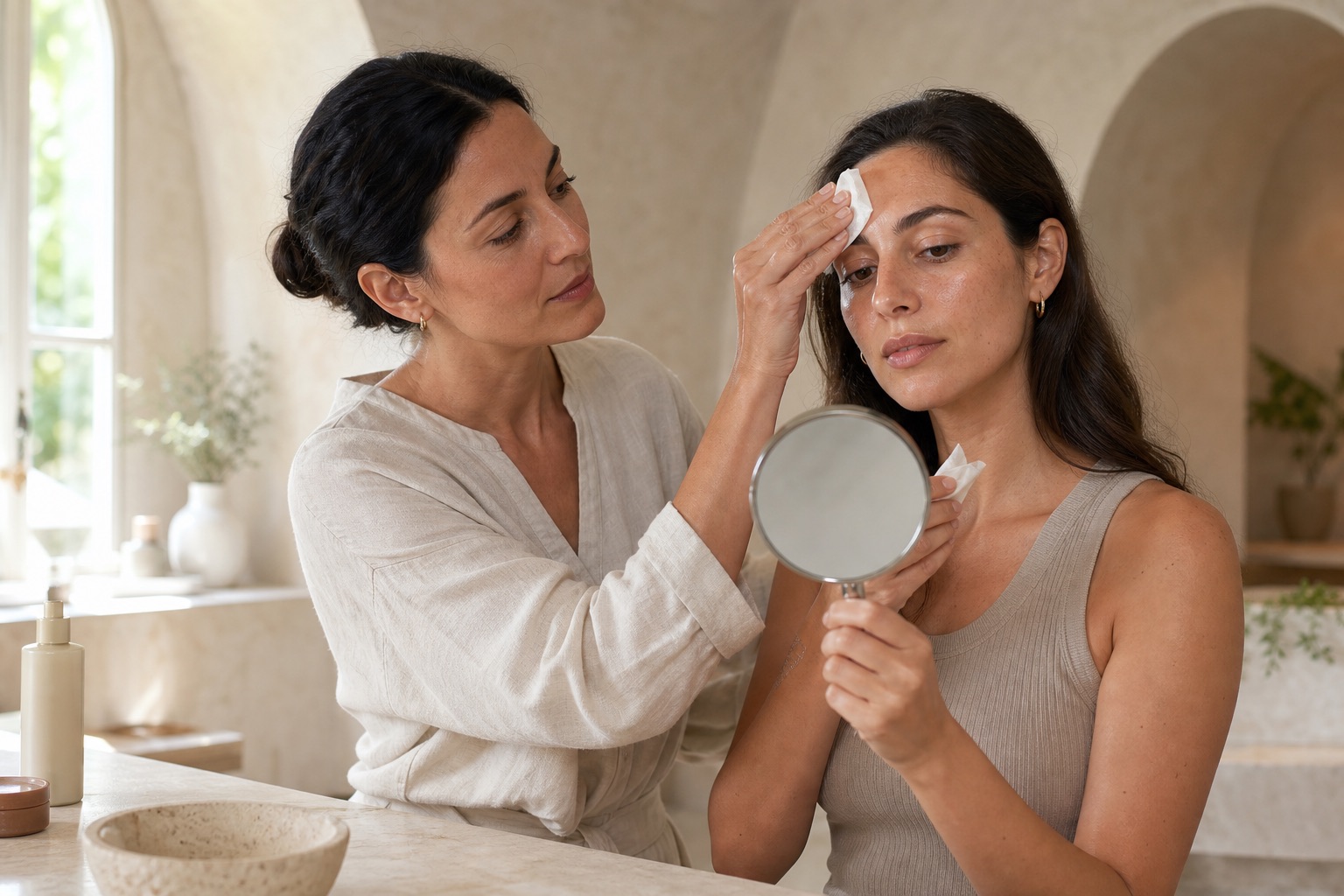
A skincare routine for oily or combination skin should not try to dry the face into submission. Its job is to remove what needs removing, preserve comfort and water balance, provide reliable sun protection and address one defined concern at a time. Sebum, visible shine, stratum-corneum hydration, sensitivity and acne are different variables. A shiny forehead may need less product while tight cheeks need a more supportive layer during the same routine.
Quick routine: in the morning, cleanse gently only if needed, use a light moisturiser or adjust the amount by area, then apply a comfortable broad-spectrum sunscreen. At night, remove makeup and sunscreen, cleanse without scrubbing, apply one treatment matched to the objective and moisturise. Do not begin salicylic acid, a retinoid, a mattifying serum and a scrub together. Assess the routine over several weeks, but stop promptly for persistent burning, swelling, blistering or clear deterioration.
This page owns the oily and combination-skin routine intent: morning and evening order, shine, hydration, zone-based adjustment and treatment load. The guide to skin types and conditions explains classification; the general skincare routine pillar owns universal product order. Here we do not diagnose or treat acne, and we do not duplicate the vertical guides on niacinamide, exfoliants or retinoids.
Oily and combination skin: begin with zones, not labels
Oily skin is a cosmetic description for widespread or dominant sebum and shine. Combination skin describes an uneven distribution, commonly with an oilier forehead, nose and chin and less lipid-rich or less comfortable cheeks. There is no universal home threshold. Instrumental research has found regional differences between the T-zone and cheeks as well as seasonal variation, meaning one person’s pattern can shift through the year.
Sebum is a mixture of lipids released by sebaceous glands through the follicle. It contributes to the surface film, while quantity and distribution vary with body area, age, hormones, climate and other factors. Visible shine is not a direct measurement of total production: light, sweat, moisturiser, sunscreen and makeup all affect what you see. A blotting sheet shows surface lipids at that moment; it does not diagnose acne or a hormonal condition.
Hydration mainly describes water in the stratum corneum; sebum describes surface lipids. An area can therefore look shiny while feeling tight, stinging after cleansing or flaking. ‘Oily but dehydrated’ can be a useful practical description if it is not treated as a diagnosis. The skin hydration guide separates humectants, emollients, occlusives and ceramides from sebum.
Observe for one week before rebuilding the routine
For seven ordinary days, record the current routine and response. On waking, note shine, tightness and location. Around midday, record where surface oil appears. In the evening, assess comfort, makeup, sunscreen and flaking. Use photographs with the same light, distance and camera settings. Do not infer skin type from one hot day, a menstrual-cycle phase or the morning after a new product.
Record cleanser, amount, water temperature, moisturiser, sunscreen, treatment, makeup, exercise and weather. If only the forehead becomes shiny while cheeks remain comfortable, you may need to adjust quantity rather than buy two complete routines. If the whole face feels tight immediately after washing, investigate cleansing first. If burning starts after an active, do not add a heavier cream merely to continue the same frequency.
Visible pores, blackheads and shine do not define oily skin by themselves. Sebum measurements, pore appearance and hydration do not necessarily move together. A pore cannot be permanently closed, a macro photograph does not quantify sebum and a matte cheek is not automatically dehydrated. Use multiple observations rather than one dramatic close-up.
How to use blotting paper without turning it into a diagnostic test
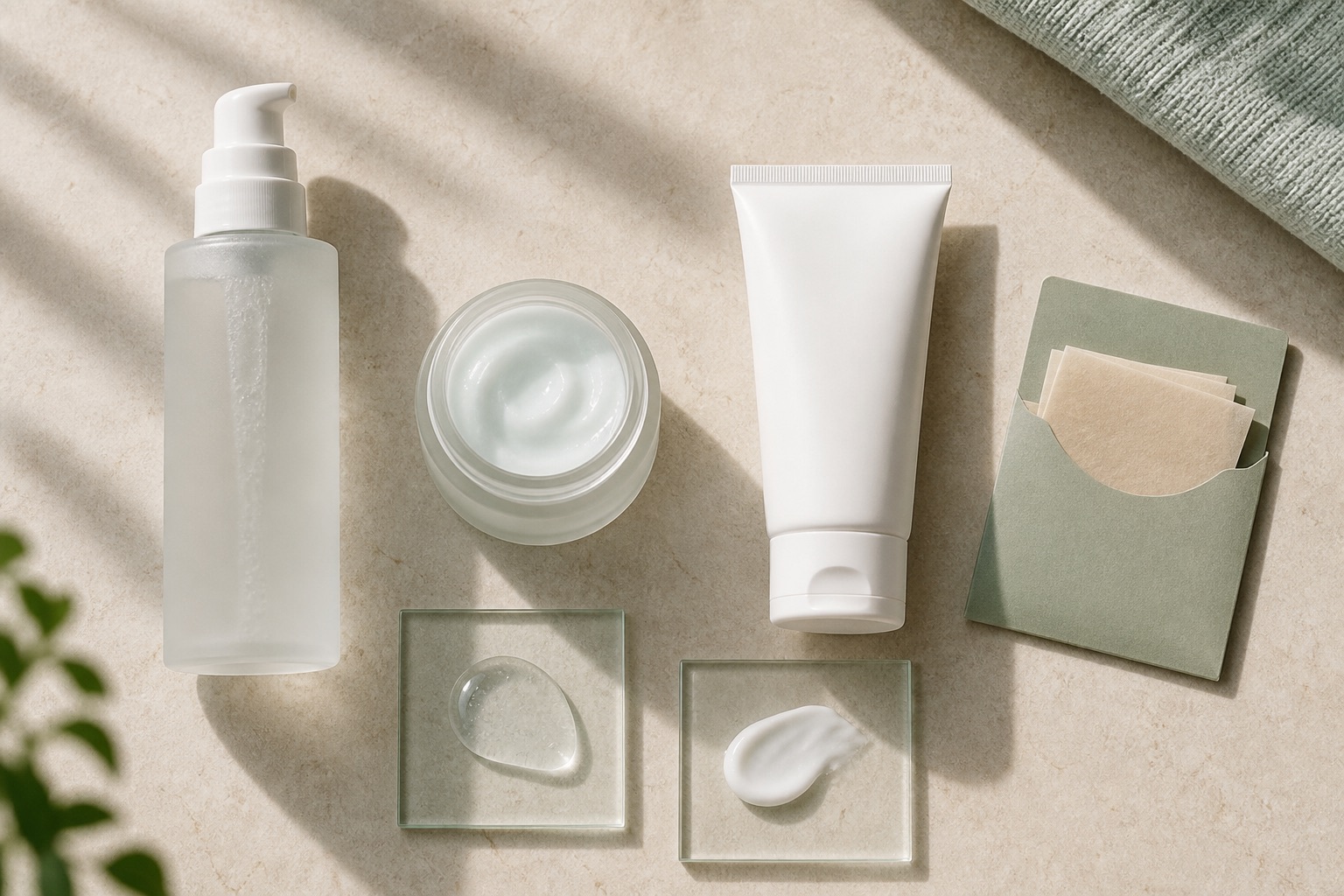
If you use blotting paper to compare zones, test at least two hours after cleansing and products, under similar conditions and without recent sweating. Press a fresh sheet briefly against forehead, nose and cheek without rubbing. Compare only your own results over time. Paper, pressure, product residue and timing change the mark; the sheet cannot measure gland activity, identify sebum composition or replace dermatological assessment.
Morning routine for oily and combination skin
The morning objective is a comfortable surface and an even photoprotective film. A complete routine may contain only three steps: cleansing if needed, moisturising and sunscreen. A targeted treatment is optional. A serum does not earn a place simply because it feels light; every layer should solve a defined problem without making the sunscreen harder to apply.
Step 1 — Cleanse, rinse or leave the skin alone
If you wake with substantial surface oil, sweat or residue from a night treatment, use a gentle rinse-off cleanser. If skin feels comfortable and only mildly oily, test lukewarm water or a smaller amount of cleanser. Judge by the result: no heavy residue, but also no tightness, itch or immediate urge to compensate. Brushes, rough cloths and very hot water are unnecessary.
Step 2 — Add one optional treatment
A serum is optional. If shine is the objective, a niacinamide formula may be evaluated without chasing the highest percentage. The niacinamide guide explains evidence, concentration and tolerance. If the moisturiser or sunscreen already contains it, duplication is not required. A watery hydrating serum can improve comfort, but it is not inherently superior to one well-designed light moisturiser.
Step 3 — Moisturise with an adjustable texture and dose
Gel-cream, lotion and light emulsion are starting points, not fixed rules. Choose a formula that spreads without friction and remains comfortable for several hours. Apply a light amount to the whole face, then add only where skin feels tight. Combination skin can often use one moisturiser in different amounts; two formulas are needed only when areas have genuinely incompatible needs.
Step 4 — Sunscreen without sacrificing the tested amount
Choose broad-spectrum protection in a texture you can apply evenly and generously. Mattifying should not mean powdery, irritating or impossible to spread; moisturising should not mean unbearably greasy. If sunscreen provides enough comfort, test reducing or omitting the moisturiser beneath it. Never reduce sunscreen dose merely to improve finish. Use the daily face-sunscreen guide for SPF, UVA, amount and reapplication.
Evening routine for oily and combination skin
At night, remove sunscreen, makeup, particulate matter and excess surface oil, then leave skin able to tolerate the selected treatment. The number of cleansers depends on what you wore, not on the oily-skin label. Double cleansing is useful when one step dissolves a resistant film and the second removes residue; it is not compulsory when one cleanser works without repetition.
Step 1 — Remove resistant sunscreen and makeup
For durable makeup or water-resistant sunscreen, use a compatible remover, emulsify if directed and rinse. Do not rub the T-zone until it feels stripped. The guide to cleansing and double cleansing explains when an oil-based and a water-based step are useful. Two strong cleansers do not become gentle because they are used in sequence.
Step 2 — Cleanse gently and rinse completely
Use clean hands, enough cleanser to reduce drag and lukewarm water. Rinse the hairline, sides of the nose and jaw, then pat with a clean towel. Abundant foam, squeaking and a cold tight sensation are not efficacy tests. Up to twice-daily cleansing and washing after heavy sweating suits many people, but irritated skin may need individual adaptation.
Step 3 — Use one treatment, not a home laboratory
Choose treatment by objective. Blackheads and blocked follicles, inflammatory acne, post-inflammatory pigmentation and uneven texture are not one condition. Introduce one finished formula and keep the basic routine stable. The skincare actives pillar owns compatibility and scheduling; this routine simply reserves one interpretable treatment slot.
Step 4 — Moisturise and schedule recovery nights
Apply moisturiser after treatment according to directions, or use it alone on recovery nights. Very oily skin may prefer a thin emulsion; tight cheeks may need a second layer or richer local cream. If burning, increasing tightness and scaling appear, do not continue exfoliating while covering the reaction with more cream. Reduce treatment and return to a minimal barrier-support routine.
Combination skin: adjust by area without building two bathrooms
Zone adjustment means changing dose, frequency or placement only where needed. Begin with one gentle base. Use less moisturiser on the T-zone when sunscreen already provides comfort, a second layer on tight cheeks and an exfoliant only on tolerant, relevant areas. Avoid the eye contour, nose folds and irritated patches when directions require it.
If forehead and nose become shiny at midday, press a clean blotting paper without rubbing. Rewashing at work or repeatedly layering powder is rarely necessary. If cheeks look matte but feel comfortable, do not add products only to manufacture glow. Comfort, even sunscreen coverage and tolerance matter more than making every zone share one finish.
Season and environment can change the balance. In warm humid weather you may reduce moisturiser on the T-zone while keeping sunscreen amount unchanged. In cold dry weather, add emollience to cheeks without making the cleanser harsher. A seasonal change does not prove that a permanent skin type has transformed; it shows that routine should respond to context.
Cleansing: remove excess without stripping the surface
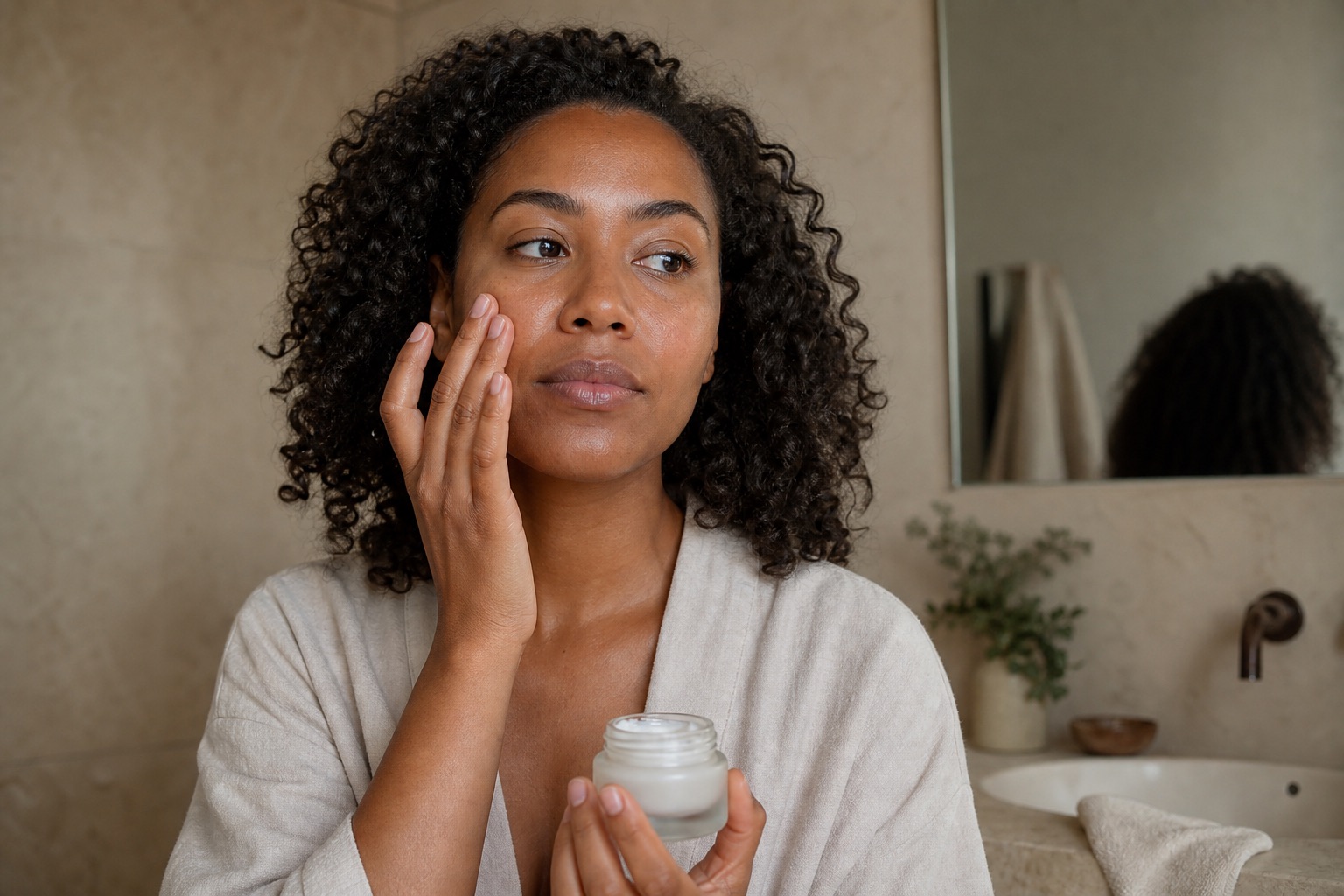
Cleansers remove soil and lipids through surfactants and rinsing. More degreasing is not more appropriate. Tightness means the routine is uncomfortable, not deeply cleansing. Gentle cleansers and moisturisers can support people using acne treatments by improving comfort and adherence; that does not make the cleanser an acne medicine.
The idea that stripping automatically forces sebaceous glands into a simple ‘rebound’ is repeated more confidently than evidence permits. Harsh washing can disrupt comfort, barrier and surface appearance; sweat, irritation and compensating products may also change perceived shine. It is more accurate to assess symptoms and results than to describe every change as glands reacting on command.
Avoid very alkaline soaps not designed for facial use, daily scrubs, abrasive brushes and repeated cotton-pad friction. A salicylic-acid cleanser may have a role, but it combines cleansing and treatment and makes total exposure harder to interpret. If you already use a leave-on BHA, another active cleanser may be redundant.
Hydrating oily skin: water, lipids and texture
Moisturiser is not the same as adding sebum. Humectants such as glycerin help bind water; emollients improve surface continuity; occlusive components reduce water loss. A light formula can combine these roles in different proportions. ‘Oil-free’ does not describe total efficacy or tolerance, and ‘non-comedogenic’ cannot guarantee that no individual develops lesions.
Assess spread, required amount, sunscreen compatibility, pilling and comfort after four to eight hours. If a cream feels too rich, first reduce the dose; if the unwanted film remains, try a lotion or gel-cream. If a gel dries tight, choose more emollience instead of abandoning hydration. A humectant serum alone may be insufficient or sticky.
Evidence from complete moisturisers containing niacinamide and lamellar lipids belongs to those products and protocols, some with industry affiliations. It does not prove that every cream sharing one ingredient has identical performance. Select the finished product and the job it must do, not an ingredient leaderboard.
Actives for oiliness, blackheads and texture: choose one priority
Salicylic acid and other exfoliants
Salicylic acid is a lipophilic BHA used in cosmetic exfoliants and blemish products. It does not need to be used daily or across the whole face. Begin at the labelled frequency, avoid stacking scrubs or other acids and reduce use for persistent stinging, tightness or scaling. The AHA, BHA and PHA guide explains family differences and limits.
Niacinamide
Some 2% formulas changed sebum measurements in specific studies, with differences between populations. Niacinamide may also support barrier-oriented formulas, but 10% is not automatically more effective. Use it as one optional strategy, not a compulsory oily-skin step, and avoid duplicating it unknowingly across serum, moisturiser and sunscreen.
Retinol, retinal and acne medicines
Cosmetic retinol or retinal may be selected for a cosmetic objective, but must be introduced gradually and cannot be treated as interchangeable with prescription retinoids. Prescription acne treatment follows a clinician’s plan. Use the cosmetic retinoids guide for the distinction and never stop prescribed therapy because a routine feels dry without contacting the prescriber.
Oily skin is not the same as acne
Sebum contributes to the follicular environment, but acne is a multifactorial inflammatory disease. A person can have oily skin without acne, or acne while the surface is dry and irritated from treatment. Comedones, pustules, nodules, pain and scarring require different levels of care. A cosmetic routine can support cleansing, comfort and photoprotection; it cannot establish diagnosis or replace treatment.
Seek dermatological assessment for persistent inflammatory acne, nodules, pain, scarring, rapid worsening or lesions across face and trunk. Persistent redness, itch, plaques, fissures, discharge or eye involvement also fall outside a routine guide. A sudden change in oiliness accompanied by menstrual irregularity, terminal hair growth, hair loss or other symptoms warrants medical evaluation.
Common oily-skin routine mistakes
Cleansing three or four times daily, using very hot water or chasing a squeaky finish.
Removing moisturiser and compensating with several watery serums without checking comfort.
Stacking salicylic acid, glycolic acid, retinoids, scrub and active cleanser because the T-zone still shines.
Underapplying sunscreen or tolerating an irritating formula solely for an ultra-matte finish.
Treating every area identically when cheeks and T-zone show different needs.
Calling every breakout or burning episode purging and continuing an intolerable product.
Treating oily skin and acne as synonyms and delaying care for painful or scarring lesions.
How to review the routine over four weeks
Define three indicators before changing anything: comfort after cleansing, location of midday shine and tolerance of the treatment. Add weekly photographs in matching light, distance and camera exposure, without makeup or filters. Count new lesions only when relevant, and do not overinterpret one day.
After one week, assess tightness, pilling and practicality. After two to four weeks, look for patterns in shine and tolerance. Comedones and pigmentation can take longer and acne may require treatment. Change one variable at a time: moisturiser amount, treatment frequency or sunscreen texture. Do not replace the entire routine because one afternoon was unusually hot.
A successful routine does not make the face completely matte. It is repeatable, compatible with treatment, free of persistent burning and simple enough to sustain. If shine is the only issue and skin is healthy and comfortable, blotting once may be more proportionate than adding another active.
Frequently asked questions
What is a basic routine for oily skin?
Morning: gentle cleansing if needed, light moisturiser and sunscreen. Evening: remove makeup and sunscreen, cleanse, use one optional treatment and moisturise. Toner, essence and several serums are unnecessary unless each has a defined role.
Does oily skin need moisturiser?
Often yes, especially when cleansing, weather or treatments cause tightness. Choose a tolerable texture and amount. A lotion, emulsion or gel-cream can provide humectant and emollient support without a heavy film. If sunscreen is moisturising enough, test reducing the morning cream.
Can oily skin be dehydrated?
Yes. Sebum and water are different variables, so shine can coexist with tightness, roughness or flaking. Reduce harsh cleansing and active overload, then assess a moisturiser rather than trying to eliminate every lipid.
How often should oily skin be washed?
Many people do well with up to twice daily and after heavy sweating, using a gentle cleanser. Some need only water in the morning. Repeated washing, hot water and friction can increase irritation without producing stable sebum control.
Is double cleansing necessary every night?
No. It is useful when resistant makeup or sunscreen requires a dissolving first step and a rinse-off second step. If one cleanser removes everything comfortably, it may be enough. Two harsh cleansers are still harsh.
Should salicylic acid be used every day?
Not necessarily. Frequency depends on formulation, instructions, other treatments and tolerance. Begin conservatively and avoid stacking scrubs or acids. Persistent burning, tightness and scaling mean reduce or stop.
How do I manage an oily T-zone without drying my cheeks?
Use a gentle base across the face, then adjust placement: less moisturiser or a local treatment on the T-zone and more emollient support on the cheeks. Do not spread exfoliants automatically into nose folds, the eye area or irritated patches.
How long should I test the routine?
Comfort, pilling and tightness become clear within days; shine patterns and treatment tolerance need several weeks. Comedones and pigmentation can take longer. Stop sooner for marked burning, swelling, blistering or rapid worsening.
Scientific and professional sources
American Academy of Dermatology: dermatologist-reviewed oily-skin care guidance. Read the AAD guidance
Youn et al.: regional and seasonal variation in facial sebum and combination skin. Read the PubMed record
Thadanipon and Kitsongsermthon: sebum, hydration and pores in self-reported oily and dry skin. Read the PubMed record
Lain and Andriessen: cleansers and moisturisers supporting acne treatment. Read the PubMed record
NICE evidence review: skincare advice for people with acne vulgaris. Read the PubMed record
Draelos et al.: 2% niacinamide cream and facial sebum measurements. Read the PubMed record
Use the English skincare guide hub to deepen cleansing, hydration, barrier and active use without duplicating routine steps. Explore online skincare courses for structured professional learning in cosmetic observation and product selection.
To distinguish a stable dry profile from temporary surface water loss and build a practical routine, read dry vs dehydrated skin: differences, textures and review criteria.
For a tolerable base, treatment support and clear referral criteria, read the acne-prone skincare guide without treating oily skin, irritation and acne as the same condition.
To separate a recurring sensitivity pattern from temporary reactivity and build a controlled baseline, read the sensitive versus sensitised skin guide for tolerance testing, a minimal routine and clear referral criteria.
To distinguish an acne lesion from a normal follicular structure and visible texture, read the blackheads, sebaceous filaments and visible pores guide for realistic skincare, strip and extraction limits.
For a cautious distinction between cosmetic discolouration and a mark that needs assessment first, read the facial dark spots and skincare guide for photoprotection, cosmetic options, measurement and dermatology referral criteria.
For a practical routine shaped by skin, shaving and facial hair rather than gendered packaging, read the men’s skincare guide for cleansing, moisturising, razor-bump prevention, beard care and sunscreen.
For a repeatable professional method that separates observation from diagnosis, read the cosmetological skin-analysis guide for type, current conditions, tools, documentation, privacy and referral limits.
To turn cosmetic observations and existing products into a plan a client can understand and follow, use the professional skincare-consultation protocol for intake, product audit, written handover, follow-up and referral boundaries.