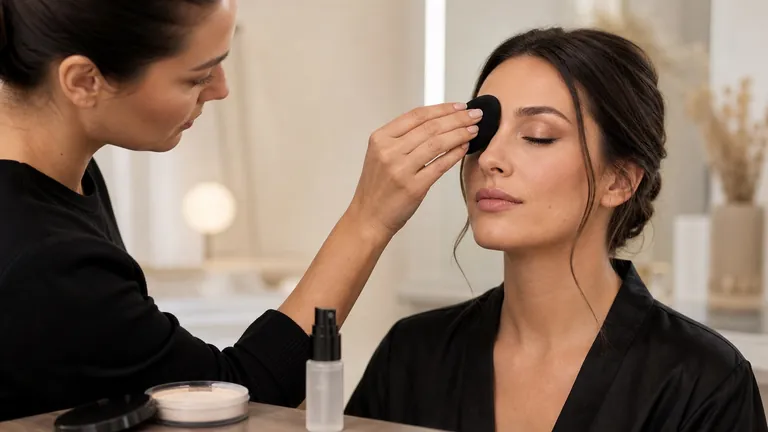
Making makeup last does not mean immobilising the face beneath powder or soaking it in a final spray. Wear is a system: surface observation, compatible preparation, thin product amounts, settling, selective setting and review in realistic conditions. Powder, setting spray and fixing spray can contribute, but none repairs a base that is already thick, separated or unsuitable.
Quick answer: prepare without leaving unnecessary residue, apply the thinnest useful complexion, remove product that has collected in folds, press a small amount of powder only where movement or oil requires it and use spray at the distance and dose stated on its label. During touch-up, blot sweat or oil first. More powder and more spray do not automatically produce longer wear.
This guide owns setting, wear testing and touch-up decisions. The primer and foundation compatibility guide explains whether underlying films work together; skin preparation before makeup owns skincare order and settling. Here the starting point is a correctly built base that needs an evidence-based setting plan.
Long-wear makeup should age evenly, not remain frozen
Long wear is a system, not a final spray
Preparation, thin films, selective setting and repair work together
Prepare
No redundant surface residue
Layer
The thinnest useful coverage
Set
Powder or spray by function
Review
Movement, climate and contact
A durable application keeps colour, coverage and boundaries readable without excessive separation, transfer or crease build-up. It does not remain identical to minute zero. Expression, temperature, sebum, sweat, tears, food, clothing and touch change every cosmetic film. The professional goal is gradual, even, comfortable and repairable wear rather than one universal hour claim.
Signal | Controlled wear | Film failure |
|---|---|---|
Finish | Even luminosity or planned matte zones | Patchy shine, dryness or powderiness |
Coverage | Gradual, visually even reduction | Open gaps around nose, mouth or local correction |
Moving zones | Minimal, repairable creasing | Thick build-up and fixed lines |
Comfort | Flexible, comfortable surface | Tightness, burning or irritation |
Design wear by zone instead of powdering the whole face
Set only the zones that need stability
A face does not move or produce oil evenly
T-zone
Distinguish shine from slipping
Under eye
Remove collection before powder
Cheeks
Preserve a stable finish
Mouth
Expect movement and contact
The forehead, sides of nose and chin may need more control, while cheeks and the outer face may remain flexible. Eye contours, nasolabial movement and the mouth need extremely thin films. Observe each zone under front and side light before setting. Reflection alone is not evidence that foundation is slipping, and a matte surface is not automatically better adhered.
T-zone: separate healthy reflection from mobile product before applying powder.
Under eyes: remove concealer that has already gathered before powder can fix the fold in place.
Cheeks: preserve the designed finish when the base is stable and needs no additional film.
Nose and mouth: reduce layers and plan for tissues, food, drinks, glasses and movement.
Choose the underlying formula using the foundation texture, coverage and finish guide. At the setting stage, the goal is not an entirely matte face: stabilise the areas likely to move and preserve those that are already balanced.
Setting powder, setting spray and fixing spray are not the same
Marketing names do not define formula behaviour
Read the label and test the complete film
Powder
Stability and reflection control
Setting
Finish and powder integration
Fixing
Possible supportive wear film
Limit
Cannot rebuild a broken base
Setting and fixing are not universal technical categories. Two products with the same marketing label may contain different films, directions and precautions. Powder commonly reduces mobility and reflection over cream. A product called setting spray may integrate powder or modify finish; one marketed as fixing spray may aim for greater resistance through a deposited film. The individual label—not the front name—defines its intended use, dose, distance and warnings.
Product | Possible contribution | It cannot repair |
|---|---|---|
Loose or pressed powder | Stability, reflection control and a surface for powder colour | A thick, dry or separated complexion |
Setting spray | Powder integration, finish and sometimes resistance | Pilling, incompatible films or excess skincare |
Fixing spray | A supportive wear film when the formula is designed for it | Wrong colour, fixed build-up or uneven structure |
Do not infer performance from water, alcohol or one isolated ingredient. A cosmetic is a complete formula. Read intended use and warnings, inspect the mist pattern and test the full sequence on the actual complexion. The English market may use the words setting and fixing differently across brands, so the product directions remain more reliable than a shopping category.
Compare setting products with a controlled wear test
Compare powder or spray over the same preparation and foundation. Use half-face symmetry or repeat the test while keeping amount, tools, light and duration constant. Change one variable. Record application, drying, initial finish, comfort, shine, transfer and touch-up response. An immediate photograph shows finish, not longevity; include movement, realistic temperature and several hours.
Practical use matters. A fine powder that is difficult to dose may create errors under time pressure; a valid spray formula with a poor nozzle can leave droplets; a very resistant fixing film may feel unsuitable for the brief. Combine appearance, repeatability, comfort, hygiene, directions and context. Record approximate amount, tool, distance and zones so a good result can be repeated rather than remembered vaguely.
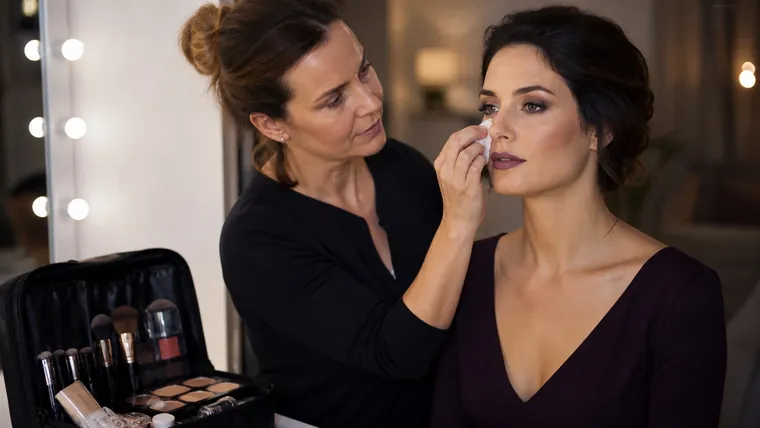
Choose and apply setting powder with restraint
Loose and pressed powders can both work. Assess dose, particle behaviour, colour, finish and tool. A translucent claim does not guarantee invisibility on every skin depth or under flash; tinted powder can adjust the complexion but may also distort a correctly matched foundation. Test in neutral light and with the intended camera.
For precision, load a small amount into a puff or brush and remove excess. Press where stability is required without dragging the base. A large flexible brush lays a veil; a clean puff gives controlled pressure; a small tool reaches the sides of the nose and under-eye area. The professional makeup-brush guide connects tool density to deposit.
Baking is optional. Leaving a substantial powder deposit may support particular formulas and visual styles, but it can increase dryness, thickness and flash response. Compare the result with minimal targeted setting. If the larger amount does not improve real wear or appearance, it has not added technical value.
Apply setting and fixing spray safely
Test the nozzle away from the face to confirm a regular mist. Follow the manufacturer’s distance, ask the person to close eyes and mouth and apply the stated amount evenly without saturating one area. Let the film dry without touching, using an unhygienic fan or immediately adding powder. Clean and store the nozzle as directed.
Use sprays and aerosols in adequate ventilation and away from flames or heat where the label requires it. FDA consumer safety guidance advises using cosmetic sprays in well-ventilated spaces and avoiding heat or open flame for flammable products. Stop if irritation, burning, coughing or eye discomfort develops. Completing the makeup never takes priority over an unexpected response.
A professional long-wear setting sequence
Define skin surface, climate, intended duration, movement, contact and finish.
Prepare with the fewest useful compatible products and allow settling.
Build foundation and concealer in thin layers, adding coverage locally.
Remove collection from folds and moving zones before it can be fixed.
Press minimal powder onto areas that need stability; preserve flexibility elsewhere.
Complete powder colour, eyes and lips in a formula-compatible order.
Apply the selected spray with the labelled amount, distance and drying method.
Review in side light, at conversation distance and through natural expression.
Run a wear test and record shine, transfer, creasing and separation by zone.
The sequence does not automatically require spray between layers. Repeated mist can re-wet, move or stiffen makeup depending on the formula. Add it only when a comparison demonstrates a defined benefit. Practise amount and order in the beginner makeup course and connect wear to full looks through the daytime makeup course or evening makeup course.
Adapt setting to oily, dry, mature and mixed zones
For an oily T-zone, differentiate centre and cheeks: reduce residual preparation, keep base thin and press powder only where the film moves. On dry or dehydrated-feeling areas, extra spray is not a substitute for appropriate preparation and amount. On mature texture, inspect folds and expression, thin the eye and mouth area and set selectively.
Do not reduce a person to one skin label. Mixed zones, sensitivity, medication, climate and the day itself can change response. The mature-skin makeup guide demonstrates flexible films and movement review, principles that can be adapted at every age.
Plan for heat, humidity, sweat, friction and contact
Heat, humidity and physical activity make wear harder but do not justify universal waterproof claims. Reduce redundant emollient layers, use tested formulas, keep movement zones thin and prepare a touch-up. Cold or dry air may expose powder and texture, so preventive all-over mattifying can also make the result fail.
Phones, glasses, hands, tissues, clothing and masks create friction. No spray eliminates all transfer. Simulate the service: put on glasses, speak, smile and blot with a tissue before assessing contact zones. Wedding and camera work need the longer professional bridal makeup trial rather than a first test on the event day.
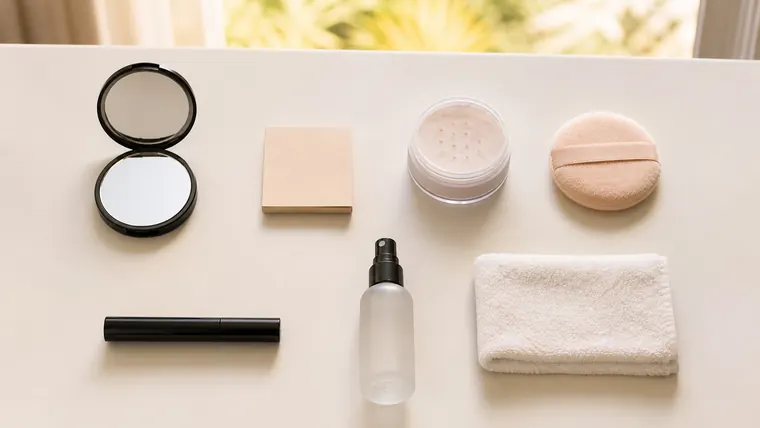
Set eyes, brows and lips as separate systems
Face powder and final spray cannot replace products suited to each area. On the lid, remove excess skincare, use minimal eye base when useful and check the crease before shadow. Brows and mascara need formulas compatible with oil, tears and friction. Never direct spray into open eyes or place a face product on the wet rim unless intended for it.
Lip wear depends on preparation, thin boundaries, liner, formula, food and drinks. Blot excess and review while the person talks and smiles. Automatically powdering or spraying lips can change comfort and texture. A personal lip product in the touch-up kit is often more useful than adding another spray layer to the entire face.
Touch up without building thickness
Blot, stabilise, assess, then add
Never press powder straight into sweat or oil
Blot moisture or oil
Let the film stabilise
Press open edges together
Add only what is missing
Before powder, blot sebum, sweat or moisture using a clean tissue or blotting sheet without rubbing. Let the surface stabilise, then decide whether powder is actually required. Adding it directly over moisture creates paste and spots. If foundation has opened, press the edges together first with a clean tool and the smallest amount of compatible product.
A practical kit may contain tissues, a small mirror, personal lip colour and a tested powder. Do not hand over professional sprays or tools the person cannot use safely. Explain where to blot, where to add product and when to stop. Touch-up restores visual continuity; it does not need to recreate the first minute exactly.
Common mistakes that reduce makeup wear
Using excess skincare and primer, then covering them before they settle.
Increasing all-over coverage instead of correcting locally.
Powdering over creases and product collection that already exists.
Applying the same powder amount to T-zone, cheeks and under eyes.
Spraying too close, leaving droplets and touching before drying.
Confusing matte with adhesion or natural luminosity with failure.
Stacking powder and spray without a half-face or repeated wear comparison.
Adding powder directly over oil or sweat without blotting first.
Diagnose separation, dryness, droplets and flashback
Problem | Possible variable | Next controlled test |
|---|---|---|
Foundation separates | Residue, amount or incompatible layers | Reduce preparation and base; remove one step |
Under eye looks dry | Excess concealer or powder | Thin, remove creasing and set only as needed |
Spray leaves drops | Nozzle condition, distance or dose | Test and clean the nozzle; follow the label |
White flashback | Powder, amount, light, camera and complete system | Reduce and test the actual powder and flash setup |
Even shine with intact base | Natural finish or surface oil | Blot and reassess before powdering |
Check photography, flash and the dried finish
A base that appears smooth in a ring light can show powder, texture differences or reflection under side light and flash. Test the complete system with the intended camera and distance. Do not attribute flashback automatically to one ingredient: dose, zone, exposure, camera processing and formula interaction all affect the image.
Let spray dry completely before photography. A wet surface can look oily or shift apparent colour. Change one variable, then document formula, tool, amount, light and time. For an evening brief, connect wear and visual hierarchy through the professional evening-makeup guide.
Maintain hygiene and respect product limits
Use personal or correctly processed puffs, clean brushes and palettes that prevent recontamination. Do not touch a spray nozzle to skin; keep containers clean and closed. Review separation between clean, service and used materials in the makeup hygiene guide.
The European Commission CosIng database provides ingredient information, but a listed name does not establish that every finished formula is suitable for every use. Product safety, intended area, directions and warnings remain essential. Stop for irritation or respiratory discomfort and seek appropriate healthcare assessment for persistent or significant symptoms.
A six-point test before a long service
Record surface, products, amounts, tools, climate and intended duration.
Divide the face or tests and change one variable: powder, spray or amount.
Photograph immediately in neutral, side and flash light when relevant.
Review after two, four and later hours before performing a touch-up.
Record separation, creasing, shine, comfort, transfer and repair quality.
Keep the best protocol for its context rather than declaring one universal recipe.
A comparison turns an impression into reusable evidence. Connect long-service planning to the bridal makeup course or develop the full sequence through the complete makeup artist course.
Frequently asked questions about making makeup last
How can makeup last all day?
Prepare without residue, use compatible thin layers, set by zone and test realistic wear. Blot before touch-ups. No product creates identical wear on every skin, climate and activity.
What is the difference between setting and fixing spray?
There is no universal definition. Setting may emphasise powder integration or finish; fixing may claim a stronger wear film. Read the actual formula directions rather than relying on the name.
Does powder make foundation last longer?
It can stabilise mobile or oily zones. Excess may emphasise texture or create thickness. Remove collection first and press a small amount only where useful.
Are both powder and spray necessary?
No. Keep each only when a wear comparison demonstrates its function. A stable base may need local powder alone; another tested formula may benefit from its directed spray.
Does powder go before setting spray?
A common sequence sets cream zones with powder and uses spray after powder products. Some formulas specify another use, so follow the label and test the complete order.
How much setting spray should be used?
Dose depends on nozzle and directions. Use the stated number or amount of even mists at the correct distance—not a wet face—and let it dry untouched.
Why does foundation separate after a few hours?
Preparation residue, excess amount, incompatible films, oil, sweat or friction can contribute. Change one variable; powdering over separation does not solve its cause.
How can concealer be kept out of folds?
Use less, thin the edges, allow natural movement, remove collection and then set minimally. Heavy concealer plus heavy powder often makes the fold more visible.
Is translucent powder invisible on every complexion?
No. Translucent does not mean invisible at every dose, depth or flash setting. Test on the real complexion and avoid powder where setting is unnecessary.
Does baking always improve wear?
No. It can work in a specific system and still increase dryness, thickness or flashback elsewhere. Compare it against a minimal setting control.
How should a shiny T-zone be touched up?
Blot oil or sweat using a clean sheet, allow the film to stabilise and add minimal powder only if needed. Do not powder directly over moisture.
Can spray be used between makeup layers?
Only when the product directions and a controlled test support it. Repeated mist may move, re-wet or stiffen the films and is not a universal long-wear step.
How can spray droplets be prevented?
Test and clean the nozzle, respect distance and mist evenly. If the spray remains irregular, do not direct it at the face until the delivery is controlled.
When should powder or spray use stop?
Stop for burning, irritation, coughing, eye discomfort or another unexpected reaction. Remove as directed and seek healthcare assessment for persistent or significant symptoms.
Sources, limits and next steps
Review the FDA guidance on using cosmetics safely and the European Commission CosIng database scope. Product directions govern distance, amount, intended area and precautions. This guide does not guarantee the same number of hours on every person or replace medical advice; it deliberately owns powder, setting and fixing spray, wear testing and touch-ups, while base compatibility and preparation remain separate intents.
Continue through the English makeup guide library or compare the current online makeup courses. Editorial review: 5 September 2026.
Connect wear to flash and HD capture
After setting is planned, review powder, reflection and high definition through the photographic makeup guide.
Separate a wear plan from an absolute promise
Understand what a service may include in the professional makeup cost guide.
Set without masking every area
Use zone-based wear decisions from the acne-prone skin makeup guide.
Plan selective setting and groom touch-ups
Use the collar and event checks in the groom makeup protocol.
Treat lash wear as a separate film system
Use the professional mascara guide.
Test removal as well as wear
Finish the long-wear plan with the waterproof makeup-removal guide.
Adapt wear strategy to heat and humidity
Apply the waterproof climate-makeup protocol.
Do not confuse setting spray with sunscreen reapplication
Use the sunscreen-and-makeup reapplication guide.
Stabilise the cut crease without thick layers
Continue with the professional cut crease setting method.
Set under-eye correction without excess powder
Continue with the colour-corrector setting method.
Wear-test specialist coverage without making transfer-proof claims
Continue with the camouflage setting and transfer test.