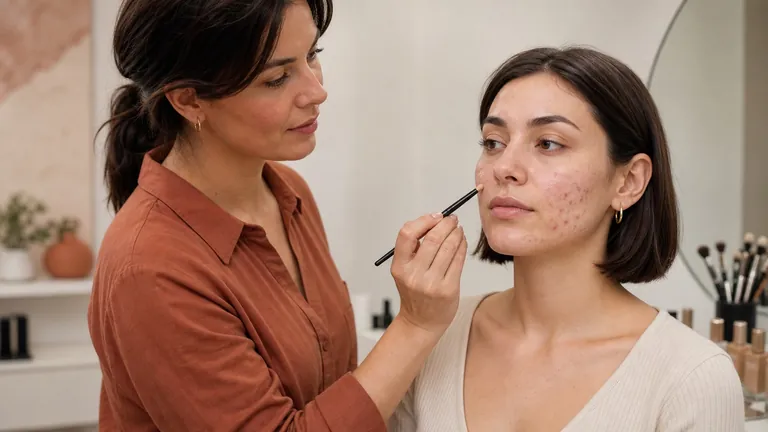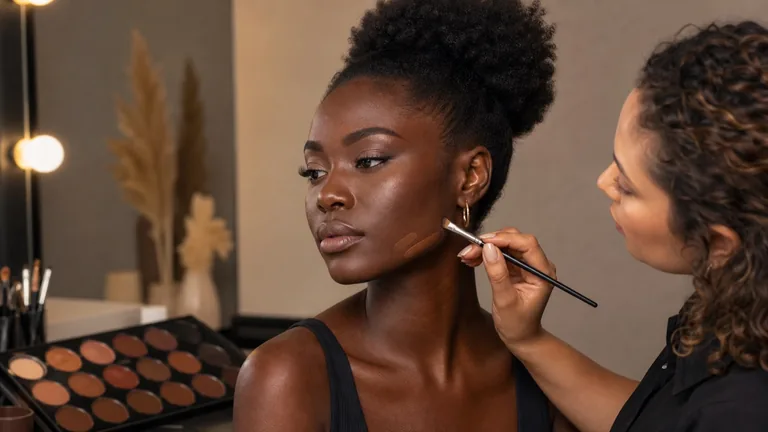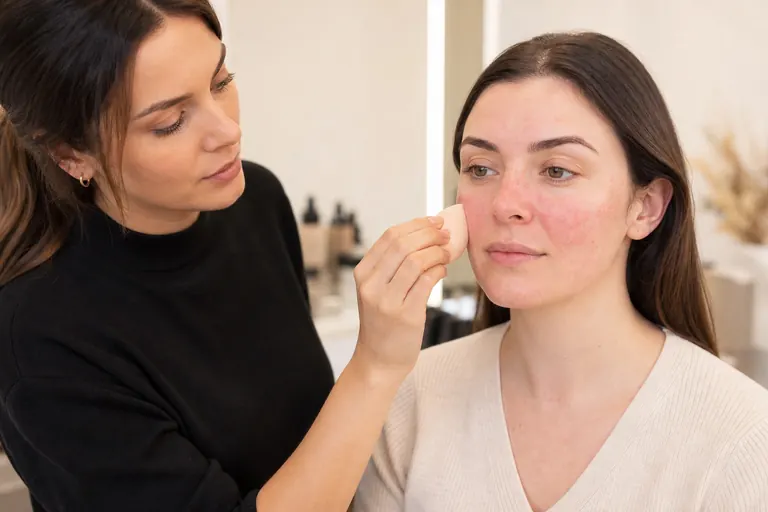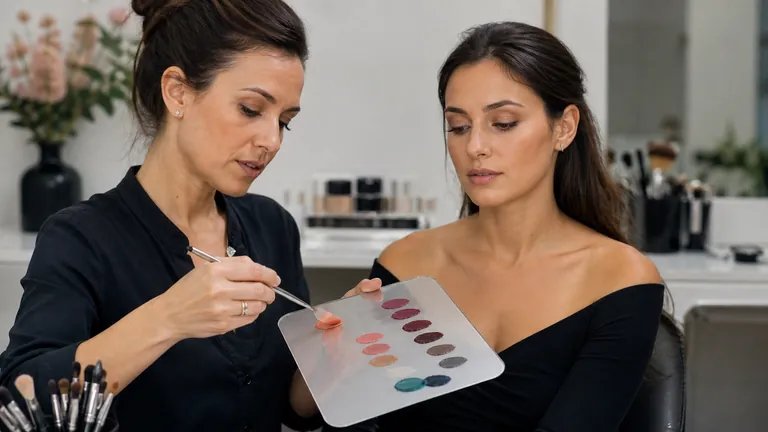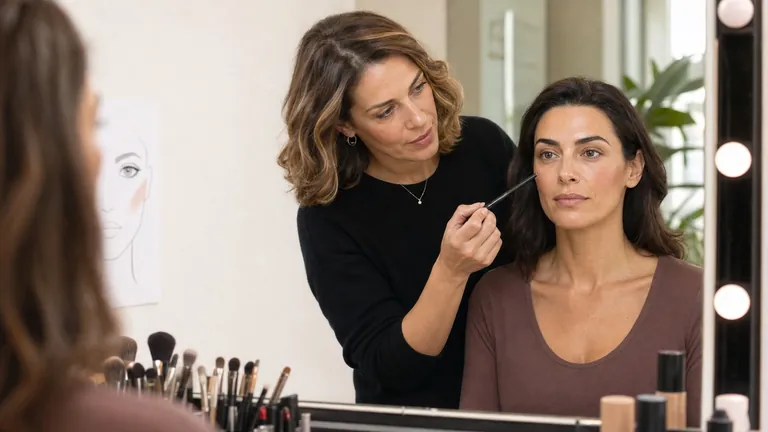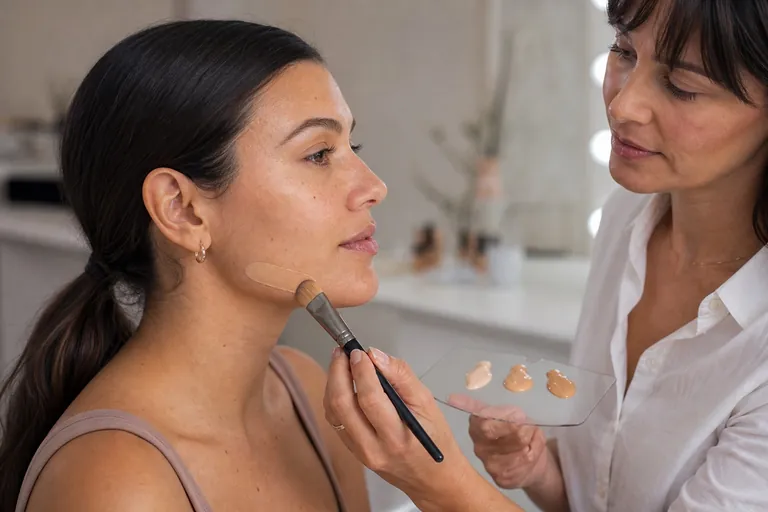
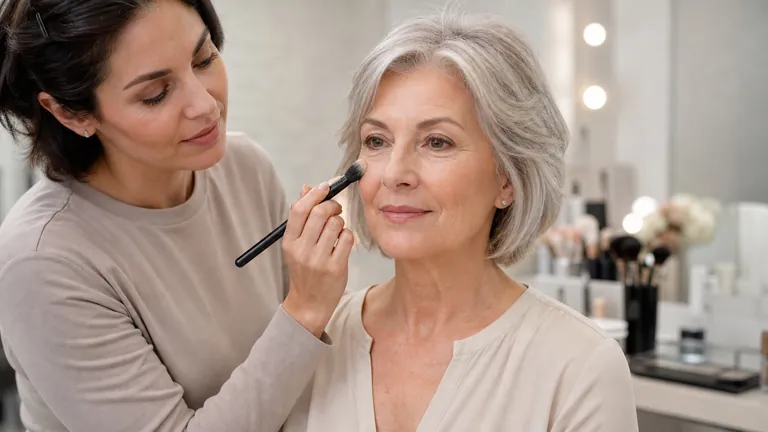
Makeup for mature skin is not a method for erasing age, lines or character. It is a way to create a comfortable, balanced and readable result on the person’s real moving skin. Professional decisions begin with observation: hydration, oil, texture, visible colour variation, flexible zones, preferences and context differ from one adult to another. Chronological age alone cannot choose the foundation, finish or technique.
Quick answer: observe mature skin by zone rather than treating age as a skin type; prepare with the smallest useful amount; allow films to settle; apply a thin complexion layer and correct only what remains; remove build-up from moving lines before selective setting; keep brows, eyes, cheeks and lips expressive; then inspect in movement, side light and the intended camera.
This guide owns adaptation of a complete makeup application to mature texture. It does not prescribe a skincare routine or anti-age treatment; that intent belongs to the mature-skin skincare guide. Detailed preparation remains in skin prep before makeup, while formula behaviour remains in the foundation texture and finish guide. Practise inclusive complexion and feature adaptation through the beginner makeup course or the wider complete makeup artist course.
Mature skin is not one skin type
With time, skin may become thinner, drier, less elastic or more reactive and may show lines, visible vessels, uneven pigment or changes in tone. These changes do not appear in the same combination or intensity for everyone. Oil production, climate, medication, health conditions, cumulative sun exposure, habits and current routine all influence how makeup behaves. Mature skin may be dry, oily, combination, dehydrated-feeling, comfortable or sensitive.
Avoid automatic rules such as never use powder, choose only luminous foundation or remove strong colour. Observe each zone and give each product a job. A shiny forehead may need a different finish from dry cheeks; a mobile lid may need stability even when the face needs flexibility. Personalisation is more accurate and respectful than an age label.
Respectful consultation and realistic expectations
Ask how the person normally wears makeup, which features they enjoy, which textures feel comfortable and what result still feels like them. Do not assume they want to look younger, wear beige or hide every line. Some people prefer a light daytime look; others want graphic liner, reflective shadow or an intense lip. Age does not reduce aesthetic choice. Technique should support preference, morphology, context and comfort.
Ask about known sensitivities, allergies, recent procedures and products they have been advised to avoid. A makeup artist does not diagnose a lesion, swelling, pain or abrupt change. Do not automatically cover an open, significantly irritated or unexpectedly reactive area. Adapt, postpone or stop and recommend appropriate health advice when the situation sits outside a cosmetic service.
Observe in neutral and side light before choosing products
One face can hold several different needs
Age never replaces zone-by-zone observation
Dry zones
Comfort with low friction
Moving zones
Thin flexible layers
Shiny zones
Selective setting
Colour variation
Local correction
View clean skin in broad, reasonably neutral light from the front and side. Note surface dryness, oil, scaling, raised texture, dynamic lines, mobile eyelids, visible colour variation and relationships between face, neck and upper chest. Touch only with clean hands, consent and minimal pressure. Side light reveals texture useful for product planning; it should never become a tool for criticising the person.
Create a functional zone map: where comfort needs support, where emollience should be limited, where broad evening is useful, where local correction is enough and where thickness will collect. Mature-skin makeup rarely needs identical amounts across the face. A zone map prevents the common response of adding product when the issue began with an overloaded surface.
Prepare mature skin with less product and more observation
Effective preparation is not a compulsory stack. Cleanse gently only if needed, then apply a measured amount of a compatible moisturising product. Spread without aggressive rubbing, give the film time to settle and blot mobile excess before complexion. Do not bury a slippery surface beneath primer or powder. Add a step only when its purpose and interaction are understood.
Mature skin may lose water more readily and feel dry, yet excessive skincare can make foundation slip or split. Work by zone: more comfort on dry areas, less emollience where makeup moves. In daytime service, sunscreen remains part of the person’s routine. Respect its directions and settling without implying that foundation replaces the required sunscreen application.
Do not perform vigorous last-minute exfoliation or pull away visible flakes. Scrubs, brushes and acids are not a professional shortcut to smooth makeup. Reduce manipulation if the surface is irritated. The dedicated skin-preparation guide explains layer order, settling and how to test pilling without turning a makeup appointment into a skincare treatment.
Primer is optional and should solve one defined problem
Use primer only when it gives a specific benefit: optical smoothing in a selected zone, local shine control, extra grip or a better transition between compatible films. Apply the minimum amount after skincare has stabilised. A very adhesive, mattifying or silicone-rich primer can increase rolling and collection when it conflicts with foundation or the movement of the area.
When a combination is unfamiliar, test it locally. Apply primer and complexion on a small representative area, wait and observe as the face moves. If pilling, streaking or separation appears, remove excess and simplify. The separate guide to primer and foundation compatibility owns formula troubleshooting; adding a third product rarely repairs two unstable films.
Choose foundation by behaviour, not an age claim
Liquid, cream, stick and powder are not automatically suitable or unsuitable for mature skin. Evaluate the individual formula: elasticity, open working time, actual pigment, reflection, spread and how it sets. A fast-evaporating liquid may catch; an elastic cream may look excellent when thinned; fine powder can stabilise a small area; a dense stick can feel heavy when used indiscriminately.
Choose coverage from the brief rather than the number of visible marks. Begin with a thin layer and correct what remains. Trying to hide every colour difference with full-face foundation increases thickness over lines and already-even areas. Use the foundation texture, coverage and finish guide to separate product behaviour from colour matching and marketing terms.
Match face, neck and upper chest without lightening the person
Redness, uneven pigment and face-to-neck differences can make shade choice harder. Test neighbouring depths along the jaw and examine the whole exposed area after each formula settles. A much lighter foundation does not create reliable luminosity; it can make the complexion appear grey, detach the face from the body and exaggerate surface relief.
Use local corrector for remaining colour when helpful, while foundation provides wider continuity. The skin undertone and foundation matching guide separates depth, undertone and surface colour. Do not force the whole face towards a saturated corrector direction just because one area is red or pigmented.
Apply thin layers with controlled pressure
Build only where the face needs it
Review between one film and the next
Thin first pass
Movement review
Local correction
Lift collected excess
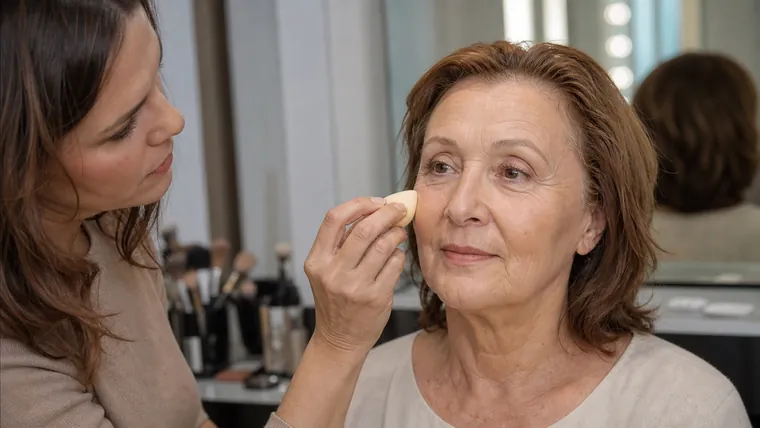
Load a small amount, distribute from the centre or only where required and feather the boundary. Brush, clean sponge and hygienically appropriate fingers create different effects; choose the tool that controls the formula without dragging the surface. Use short movements and low pressure. On mobile lines, a light pressing action often disturbs less than repeated rubbing.
Stop after the first pass. Inspect close up, at conversation distance and while the person speaks and smiles. Add only where the improvement is visible. If product collects, do not hide the ridge with more coverage: lift excess with a clean sponge or unloaded brush and reconsider preparation, formula and amount. Mature-skin makeup often improves through subtraction.
Concealer and the mature eye area
The eye area is mobile and may be thinner or drier than the cheek. Place concealer only on the shadow you intend to reduce rather than automatically filling the entire area. Choose a depth related to the complexion and discolouration; a much lighter shade can create excessive projection and contrast. Allow it to settle, ask the person to move their eyes and remove product from lines before setting.
Correction does not require total opacity. Some transparency often preserves a convincing face while reducing thickness. If neutralisation is useful, use a tiny targeted amount and cover it with a fine concealer film. A dry formula or large quantity does not become appropriate because it is marketed as long-wear. The complete corrective makeup method keeps local corrections within whole-face balance.
Powder and setting should be selective
Set a function, not an age group
Different zones may need different amounts
Centre
Manage shine and friction
Eye area
Remove collection first
Cheeks
Keep flexibility when stable
Powder is not forbidden on mature skin. It should be fine, controlled and placed. Stabilise the sides of the nose, centre, lids or friction points where necessary, leaving already-stable dry cheeks more flexible. Remove excess from movement lines first, load very little and press without repeatedly polishing or building opaque layers.
Do not use baking as an automatic mature-skin procedure. A large deposit left in place can emphasise dryness and folds. Review in side light and through expression. Setting spray may help compatible formulas look integrated, but it does not dissolve excessive powder or repair the wrong complexion base.
Blush, bronzer, contour and reflected light
Restoring colour and dimension can make a face feel balanced, but there is no universal lifting placement. Observe bone structure, mobility, focal point and the person’s style. Place blush where it remains visible from the front and side, then soften its border without dragging all colour towards the hairline. Cream and powder can both succeed when formula and quantity are controlled.
Contour creates the perception of depth; bronzer adds warmth. Use them for those jobs rather than treating them as interchangeable. A coarse highlight can draw attention to texture, while a fine controlled reflection can be beautiful. The guide to corrective face proportions explains placement without one-size-fits-all diagrams.
Brows and mature eyes can still carry definition and colour
Brow hair may become sparser, lighter or change direction. Observe existing growth and build only the areas that need support. Fine strokes, a light powder veil or tinted gel can preserve transparency; one dark opaque block may dominate the face. Match colour to current hair, skin and look intensity rather than relying only on an original hair colour. The eyebrow mapping guide provides proportion checkpoints.
A mature lid may have more movement, folds or less visible fixed space. Map shadow with the eye open and place middle value where it remains visible in the person’s resting position. Matte texture can be controllable, but satin and reflective colour are not prohibited. Concentrate them where the surface and design support them. Use small brushes, limited product and short movements.
Define lashes without turning every liner into a thick stripe. Diffused pencil, a fine line or appropriate between-lash definition can add contrast. Use the corrective eye makeup guide and the eyeliner guide for shape-specific decisions rather than pulling the skin into a temporary geometry.
Mature lips: moving boundaries, migration and comfort
Prepare gently and remove excess balm before colour. Define with a fine compatible pencil, correcting only where useful. Thin layers, blotting and movement checks reduce build-up. A very dry lipstick is not automatically professional if it compromises comfort or exaggerates the surface. Bright and deep colours remain valid when precision, formula and maintenance support them.
To limit migration, reduce product close to the border, use a compatible liner and inspect several minutes later. The corrective lip makeup guide owns border mapping and layering. Here the concern is how those choices remain comfortable and balanced on the complete mature face.
Adapt day, evening and camera makeup without thickening the base
Daytime work benefits from clean boundaries and inspection in natural light. Evening makeup can increase eye depth, contrast, colour or reflection without increasing foundation thickness. Compare the complete day-makeup protocol with the evening-makeup protocol to see how hierarchy and lighting change while surface restraint remains.
For video and photography, do not judge only beneath a ring light. Review neutral and side light and the intended camera without beauty filters. Flash, sharpening and compression can emphasise colour or texture differences. Classify the issue before correcting it: alter colour, reflection or amount locally instead of powdering the entire face to solve one small zone.
Long wear without making moving skin rigid
Wear comes from compatible preparation, thin films, settling and selective setting. Mobile areas must remain light; friction points may need more stability. Test combinations before a major event and inspect after several hours. Never promise one universal duration: climate, movement, tears, touching, current products and the individual surface all change performance.
Plan realistic maintenance using tissue or blotting paper, the lip product and a small amount of powder only where necessary. Blot first, then add. Powder layered over surface oil, sweat or collected product creates texture. Record product, amount, environmental conditions and what changed so the next application begins with evidence.
A fifteen-step professional mature-skin makeup protocol
Agree style, comfort, wear and focal point without age-based assumptions.
Ask about known sensitivities, recent procedures and products to avoid.
Observe face, neck, upper chest, texture and moving zones in neutral light.
Prepare by zone with gentle cleansing only if needed and measured hydration.
Allow settling and remove mobile excess before considering primer.
Use primer only where a tested, specific need exists.
Swatch complexion colour and behaviour between face, jaw and chest.
Apply one thin layer and feather all folds and boundaries.
Correct only remaining local colour and shadow.
Remove collection from movement lines before selective setting.
Restore colour and structure through blush, brows and eye definition.
Build lips with fine boundaries, a comfortable formula and restrained amount.
Review close up, at conversation distance and in expression.
Check the intended light, camera and flash where relevant.
Prepare minimal touch-ups and record formulas, amounts and results.
Common mistakes in mature-skin makeup
More product does not create more evenness
Correct the cause before adding another film
Excess
Skincare, primer or base
Rigidity
Too much powder on movement
Correction
Lift, thin and reposition
Frequent complexion mistakes are excessive skincare, primer across every zone, very opaque or over-light foundation, product pushed into lines, a large under-eye concealer triangle, automatic baking, powder on already-dry areas and coarse highlighter placed over prominent texture. Each adds material where better observation or removal would be more effective.
Feature and representation mistakes include rigid brows, liner thick enough to hide the lid, avoiding all colour, using only matte textures, promising the same lifting map to everyone and smoothing mature texture out of portfolio photographs. Professional work improves balance and comfort without denying expression, identity or the way real adult skin moves.
A progressive practice plan
Exercise one: compare essential and overloaded preparation on the same face, documenting settling and pilling. Exercise two: apply a thin reviewed layer to one side and the amount you habitually use to the other, then inspect at two and four hours. Exercise three: compare selective with broad powder under controlled light. Exercise four: photograph without filters in front, side and natural light.
Exercise five: design brows and eyes for three different mature morphologies without copying one map. Exercise six: compare a transparent and intense lip, monitoring migration. Exercise seven: repeat the full protocol inside a planned time without eliminating consultation, sanitation or checks. Write down products, approximate amounts and one concrete improvement rather than judging only whether the person looks younger.
Frequently asked questions about makeup for mature skin
What is the best foundation for mature skin?
No single formula is best. Assess the person’s current skin, comfort, requested coverage, finish, wear and preparation. Liquid, cream, stick or powder can work when its behaviour and amount suit the relevant zone. Test a thin settled layer instead of choosing by age claim.
Does mature skin need luminous foundation?
No. Luminous finish can feel fresh but may emphasise some texture when highly reflective. Natural, satin or soft-matte finishes can also work. Choose reflection by zone and inspect live, in side light and in photographs.
Can powder be used on mature skin?
Yes, selectively. Use a small amount of fine powder on movement, shine or friction zones and leave stable dry areas flexible. Remove build-up first, press lightly and inspect in side light. Amount and placement often matter more than product category.
How can foundation be kept out of lines?
Prepare without excess, apply thin layers and reduce product in mobile areas. Let the formula settle, move the face and remove collection before setting. Makeup cannot stop normal line movement; the goal is to limit build-up while preserving comfort.
Can smoothing primer erase wrinkles?
No. It may temporarily alter reflection or slip in a small zone, but it does not remove lines. Use a minimum amount only where helpful and test foundation compatibility. A thick layer can increase pilling and collection.
How can uneven pigment be covered without heaviness?
Create broad continuity with a thin foundation layer, then correct only the remaining areas using a suitable colour and texture. Feather every edge. Heavy full-face coverage adds product to lines and zones that were already even.
Which concealer suits a mature eye area?
Choose enough pigment and flexibility to use little product. The depth should reduce the shadow without creating a bright patch. Apply locally, let it move and settle, then remove collection from lines before minimal setting.
Are cream products better than powder products?
Not universally. Thin creams may retain flexibility and fine powders may provide control. Some creams set dry and some powders remain soft. Test the individual formula, amount and tool, then assign each texture a real function.
Which eyeshadow colours suit mature eyes?
There is no compulsory palette. Consider iris, skin, hair, style and desired contrast. Well-placed middle values and controlled depth clarify form. Satin and intense colours remain options when their placement and area are deliberate.
Can eyeliner be worn on a mature lid?
Yes. Map thickness and direction on the open relaxed eye. A fine line, diffused pencil or between-lash definition may be more controllable than a copied wing. Do not stretch the skin into a position it will not hold.
How can lipstick migration be reduced?
Remove excess balm, use a fine compatible liner and keep less lipstick at the edge. Blot and recheck after movement. Very dry lipstick is not the only solution and may reduce comfort; balance precision, flexibility and touch-up.
Should mature skin avoid shimmer and highlighter?
No. Choose particle effect, intensity and placement. A fine satin can support the design, while coarse reflection may make texture more visible. Test in front and side light and keep reflection where it serves the intended focal point.
How can makeup last on mature skin?
Use compatible preparation, thin settled layers and selective setting while keeping mobile areas flexible. Test in advance and prepare minimal maintenance. Climate, activity, contact and individual skin prevent a universal guaranteed duration.
What should a makeup artist never promise?
Do not promise to erase age, diagnose skin changes or make one product work on everyone. Do not judge lines, impose neutral colour or work carelessly on an unsuitable area. Respect identity, consent, hygiene, product directions and professional limits.
Sources and next steps
For evidence-based information about age-related skin change and general care, consult the US National Institute on Aging resource on skin care and ageing and the American Academy of Dermatology guidance for skin in the 60s and 70s. For product handling and reactions, review FDA guidance on using cosmetics safely.
Continue through the English makeup guide library or compare the current online makeup courses. Editorial review: 5 September 2026. This educational article does not diagnose age-related skin change or prescribe treatment. It deliberately owns makeup application on mature texture; mature-skin skincare routines, foundation matching and individual eye, lip and corrective methods remain separate search intents.
To choose head shape, density and fibre from the mark you need, continue with the professional makeup-brush guide. It connects product loading, first contact, pressure and angle to a repeatable result.
For a controlled comparison of depth, warmth and cheek colour, continue with the contour, bronzer and blush guide. It covers colour, film order, anatomical placement and troubleshooting without one-size-fits-all maps.
Selective setting and flexible wear
Control powder and spray without stiffening moving zones using the long-wear makeup guide.
Comfort and stop criteria remain non-negotiable
Thin texture does not justify covering skin that is reacting; review cosmetic allergy, irritation and application stop criteria.